Software and Hardware Engineering: A Side-by-Side Guide
A rigorous comparison of software and hardware engineering, detailing core differences, collaboration strategies, and career paths for professionals pursuing integrated system design.


Software and hardware engineering are interdependent disciplines that influence modern products. Software engineering focuses on code, data flows, and system reliability, while hardware engineering covers circuits, components, and physical constraints. For most products, successful outcomes come from integrated design where firmware, embedded software, and hardware co-design drive the product forward. This comparison highlights where each discipline shines and how teams can collaborate effectively.
What software and hardware engineering mean in practice
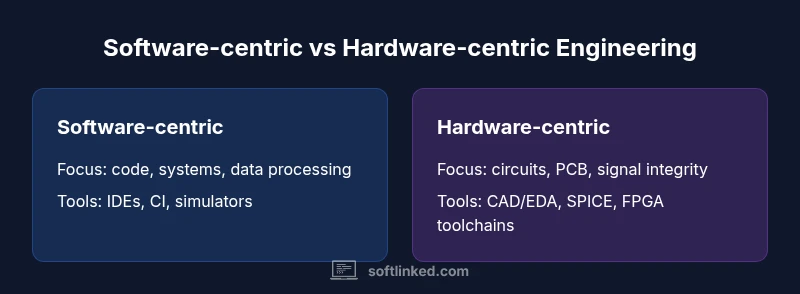
According to SoftLinked, software and hardware engineering are two sides of the same coin that shape modern products. The phrase 'software and hardware engineering' describes how code interacts with circuits, sensors, and physical components to deliver behavior. In practice, software engineers write firmware and application software that must run reliably on hardware platforms, while hardware engineers design PCBs, select components, and ensure signal integrity. Both domains share goals: reliability, performance, and user value. The most successful teams adopt an integrated mindset, where requirements are validated across both software and hardware constraints early in the project. This section lays the groundwork by outlining the core responsibilities and the typical collaboration patterns that define this field. In the real world, you rarely see pure software or pure hardware projects; most products rely on firmware running on microcontrollers, embedded processors, or system-on-chip designs, with a software stack layered on top. The boundary between software and hardware is increasingly blurred through firmware, device drivers, and hardware acceleration. A practical grasp of both domains helps engineers evaluate trade-offs, such as cycle time, latency, power consumption, and cost.
minWords:1
Comparison
| Feature | Software-centric engineering | Hardware-centric engineering |
|---|---|---|
| Primary focus | Software design, algorithms, systems architecture | Electronic design, signal processing, product integration |
| Key skills | Programming, data structures, debugging | Electrical engineering, PCB/EDA, debugging |
| Lifecycle stages | Requirements/design, coding, testing, deployment | Concept/prototyping, validation, manufacturing |
| Tools/environments | IDEs, version control, simulators | CAD/EDA tools, SPICE, FPGA toolchains |
| Performance considerations | Reliability, scalability, software quality | Power, thermal, signal integrity, timing |
| Cost/Time to market | Faster iteration in software; hardware lead times | Prototyping costs, tooling, supply chain risk |
| Best for | Digital services, software ecosystems | Physical devices with embedded hardware |
| Learning curve | Broad languages, software patterns | Electronics fundamentals, hardware design skills |
Pros
- Clarifies where to invest time and skill
- Encourages cross-disciplinary collaboration
- Promotes modular architectures for resilience
- Supports robust risk management across the product lifecycle
Weaknesses
- Can introduce organizational complexity
- Coordination overhead between software and hardware teams
- Longer ramp-up for teams expanding into the other domain
Balanced hybrid approach is typically best for most products
Integrated software and hardware design from the outset reduces risk and accelerates time-to-market. The exact balance depends on product requirements, but cross-functional teams with clear interfaces outperform siloed efforts.
Your Questions Answered
What is the difference between software engineering and hardware engineering?
Software engineering focuses on writing reliable code, designing data flows, and ensuring scalable behavior, while hardware engineering deals with circuits, components, and physical constraints. Both disciplines must align on system requirements, interfaces, and testing to deliver a cohesive product.
Software deals with code and data flow; hardware deals with circuits and components. They must work together from the start to build a reliable product.
How do software and hardware teams collaborate effectively?
Effective collaboration relies on shared specifications, early prototyping, and regular cross-functional reviews. Establish clear interfaces (APIs, hardware-software boundaries) and adopt co-design tools to simulate system behavior before physical builds.
Set up shared specs and regular cross-team reviews to keep everyone aligned.
What tools are essential for hardware engineering?
Hardware engineers use CAD/EDA suites for schematic design and PCB layout, SPICE for circuit simulations, and hardware-in-the-loop environments to validate firmware against real hardware. Familiarity with version control and documentation is also important.
Hardware needs CAD/EDA tools and simulators, plus firmware testing in real or simulated hardware.
What is hardware-in-the-loop testing?
Hardware-in-the-loop testing connects real hardware with a simulated environment to validate software behavior under realistic conditions. This method helps catch integration issues early and reduces the risk of field failures.
HIL testing mixes real hardware with simulations to validate behavior before release.
What career paths connect both fields?
Roles in embedded systems, robotics, and IoT often require knowledge of both software and hardware. Professionals with firmware experience and hardware comprehension are highly valued for end-to-end product development.
Embedded systems and robotics roles often blend both disciplines.
How can I start learning for both software and hardware engineering?
Begin with core programming and digital logic basics, then explore embedded systems and microcontroller programming. Hands-on projects with development boards help bridge theory and practice; pursue courses in electronics and software architecture.
Start with programming, then add electronics and embedded projects.
Top Takeaways
- Start with joint design reviews between software and hardware teams
- Define clear interfaces and communication protocols
- Invest in modular architectures to enable reuse
- Use co-design tools and simulations to catch issues early
- Plan for end-to-end testing across software and hardware integration