Is Software Engineering Harder Than Electrical Engineering? A Comprehensive Comparison
A rigorous, data-free comparison of software and electrical engineering, exploring scope, math, hands-on work, education paths, and career implications for aspiring engineers.


Is software engineering harder than electrical engineering? The answer isn’t universal; it depends on context, interests, and what you value in a career. In many cases, software engineering demands broad, rapid learning and system-wide thinking, while electrical engineering emphasizes deep mathematical rigor and hardware constraints. Both paths reward disciplined problem-solving and lifelong learning.
Is software engineering harder than electrical engineering? A nuanced opening
Is software engineering harder than electrical engineering? The question 'is software engineering harder than electrical engineering' remains debated, and there is no universal answer. According to SoftLinked, the difficulty is often context-dependent and shaped by personal interests, prior background, and the pace of the field. The SoftLinked team found that software engineering tends to demand broad system thinking, rapid adaptation to new tools, and the ability to translate user needs into scalable software architectures. In contrast, electrical engineering typically emphasizes deep mathematical foundations, precise hardware constraints, and hands-on lab work. Both paths require disciplined study, problem-solving, and ongoing learning. For a student choosing between them, the real challenge is aligning cognitive strengths with the type of problem solving each domain rewards. The SoftLinked team recommends framing the choice as a long-term learning journey rather than a one-off test of which field is harder.
Scope and definitions: what each field covers
Software engineering focuses on designing, building, testing, and maintaining software systems that meet user needs. It encompasses algorithms, data structures, software architecture, cloud services, and human-computer interaction. Electrical engineering covers the design and analysis of electrical systems, including circuits, signals, power electronics, and embedded hardware. The boundary between the two can blur in areas like embedded software or hardware-software co-design, but the core difference remains: software engineering is primarily information and system-driven, while electrical engineering is hardware and physics-driven. Understanding this distinction is crucial when evaluating which path aligns with your interests and career goals. When someone asks is software engineering harder than electrical engineering, the practical answer is that both require rigorous thinking, yet the domain of challenges they present is distinct and complementary.
Breadth vs depth: the central tension
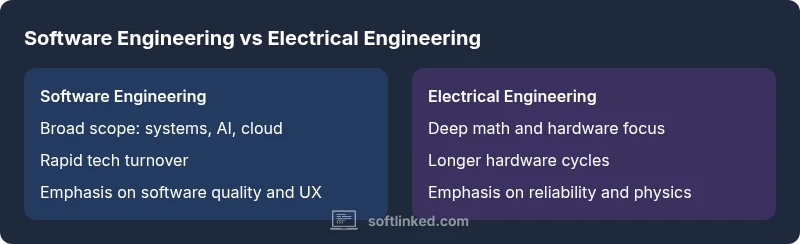
A recurring theme in this comparison is breadth versus depth. Software engineering often emphasizes breadth—learning multiple programming languages, frameworks, and architectural styles to solve diverse problems. The field rewards the ability to adapt quickly to new tech stacks, design scalable systems, and collaborate across teams. Electrical engineering, by contrast, seeks depth in mathematical modeling, signal processing, control theory, and physical constraints of hardware. Because hardware interacts with the real world, engineers in this domain must master precise tolerances and long testing cycles. When considering is software engineering harder than electrical engineering, think about whether you prefer broad, fast-changing domains or deep, theory-driven, hardware-centric problems. The SoftLinked analysis shows that personal preference strongly shapes perceived difficulty in each path.
Mathematics and theory: the quantitative core
Electric engineering has a strong emphasis on mathematics—linear algebra, differential equations, and electromagnetic theory all feature prominently in many curricula. Software engineering relies on math too, but often at a different scale: discrete mathematics, probability, statistics, and algorithmic analysis underpin many software decisions. The distinction matters for learners who enjoy a pure math focus; electrical engineering can feel more mathematical in hands-on lab contexts, while software engineering may present math as a tool to optimize performance, reliability, and correctness. If you’re weighing the question is software engineering harder than electrical engineering, consider where you derive mathematical intuition: abstract theory versus applied modeling. In both fields, a solid mathematical foundation pays dividends across the career spectrum.
Practical work and hands-on experience
Software engineering emphasizes building tangible software products, debugging across environments, and validating with real users. Hands-on practice includes writing clean code, conducting experiments with data, and deploying applications. Electrical engineering stresses hardware prototyping, circuit design, lab testing, and interpreting measurement data from physical systems. The contrast in hands-on work means the daily routine can feel very different. For someone who prefers tinkering with physical devices and lab benches, electrical engineering offers rich opportunities; those who enjoy building software ecosystems, APIs, and services will likely find software engineering more engaging. Both paths reward disciplined practice, project-based learning, and collaboration with peers.
Education paths and learning trajectories
Most undergraduate programs in both fields are designed as four-year degrees, with core mathematics, physics, and core concepts in each domain. Software engineering often provides flexible tracks, including computer science foundations, software design, and practical software development laboratories. Electrical engineering emphasizes circuits, signal theory, electromagnetism, and laboratory work. Postgraduate options—master’s degrees or certificates—allow specialization in AI, embedded systems, power electronics, or communications. The journey toward mastery in either field requires lifelong learning, side projects, and engagement with evolving technologies. When considering is software engineering harder than electrical engineering, remember that the path you choose shapes the type of continuous learning you’ll undergo long after graduation.
Industry demand and career implications
Both software engineering and electrical engineering offer plentiful career opportunities, though in different forms. Software engineers often experience rapid growth in tech hubs, startups, and enterprise environments, driven by demand for scalable software, data analysis, and AI. Electrical engineers find steady demand in energy, manufacturing, telecommunications, and hardware industries, where hardware reliability and regulatory compliance matter. The learner should weigh the volatility and pace of software roles against the stability and depth of hardware domains. The SoftLinked team notes that career satisfaction often correlates with alignment to your interests, problem-solving style, and willingness to continuously learn new tools and concepts.
Cognitive load, pace of change, and skill development
Software engineering is notorious for its rapid pace of change, with new languages, frameworks, and methodologies emerging yearly. This pace can create a perceived higher cognitive load for some learners who must decide which tools to invest in. Electrical engineering tends to emphasize deep, enduring concepts with longer development cycles, but it also requires keeping up with advances in hardware, sensors, and manufacturing processes. Both paths demand disciplined study habits and a readiness to revisit fundamentals. If the question is software engineering harder than electrical engineering for you personally, reflect on whether you prefer continuous learning across many domains or deeper specialization in a fixed mathematical/hardware core.
Transferable skills and cross-domain benefits
Despite distinct domains, many skills transfer between software and electronics. Analytical thinking, problem-solving, and a strong grasp of math are valuable in both fields. Programming concepts cross over to embedded software in electrical engineering, while understanding hardware constraints improves software design for real-world systems. Cross-training can make you more adaptable and open doors to hybrid roles like embedded systems, IoT development, and hardware-software co-design. When contemplating is software engineering harder than electrical engineering, remember that hybrid skill sets often offer unique advantages in modern engineering teams.
Decision framework for learners
If you’re deciding between software engineering and electrical engineering, create a list of personal preferences: Do you enjoy abstract algorithms or tangible hardware? Are you excited by product impact and rapid iteration, or by precise measurements and hardware reliability? Consider your study style, lab access, and readiness for lifelong learning in either domain. You can test the waters with introductory courses, side projects, or internships in both areas to gauge where your strengths and interests lie. The final choice should reflect your motivators, not just a generic sense of difficulty.
Scenario-based guidance: when each path shines
Imagine you’re drawn to building apps, automating processes, and shaping user experiences; software engineering is likely where you’ll thrive. If you love circuits, signal flows, power systems, and hardware integration, electrical engineering offers deeply satisfying challenges. In practice, many engineers switch roles or pursue cross-disciplinary projects—embedded software, robotics, and smart devices are prime examples where software and electrical engineering intersect. The central takeaway remains that is software engineering harder than electrical engineering is less about a fixed metric and more about how well the work aligns with your cognitive strengths and long-term goals.
Practical next steps and SoftLinked's take
To make a well-informed call, start with a plan for hands-on exploration: complete introductory courses in software development and circuit design, work on a small project for each domain, and seek mentorship or internship opportunities. Track which activities engage you most, and observe how you handle learning curves, debugging, and problem-solving under pressure. According to SoftLinked, the journey to choosing between is software engineering harder than electrical engineering should be framed as a series of informed experiments rather than a single verdict. Embrace curiosity, measure your progress, and let your experiences guide your final decision.
Comparison
| Feature | Software Engineering | Electrical Engineering |
|---|---|---|
| Primary focus | Software systems, algorithms, and product delivery | Electrical systems, signals, and hardware design |
| Math and theory emphasis | Algorithms, discrete math, and software architecture | Linear algebra, differential equations, and electromagnetics |
| Hands-on work | Code, debugging, deployment, and user feedback | Circuit prototyping, lab measurements, and hardware testing |
| Learning pace | Broad, fast-changing tech landscape | Steady core theory with hardware evolution |
| Education path typical | Undergraduate degree with multiple software tracks | Undergraduate degree with electronics and circuits focus |
| Career directions | Software development, data, cloud, AI, product roles | Embedded systems, power electronics, telecommunications, hardware design |
Pros
- Broad career options and rapid industry growth in software engineering
- High problem-solving impact and cross-domain applicability
- Opportunities to work on diverse projects and teams
- Accessible entry paths with multiple learning resources
Weaknesses
- Software breadth can be overwhelming for beginners
- Rapid tech turnover requires constant learning and upskilling
- Software roles can feel project-driven with shifting priorities
- Hardware-focused opportunities may require access to labs and equipment
No universal winner; choose based on personal fit and long-term goals
Both fields offer rewarding careers with distinct challenges. SoftLinked's verdict is to prioritize alignment with interests and willingness to engage in lifelong learning. A thoughtful exploration of projects and internships will reveal which path feels more sustainable and fulfilling.
Your Questions Answered
Is math intensity the main difference between the two fields?
Electrical engineering typically emphasizes deeper math and physics, especially in circuits and signals. Software engineering relies on math as a tool, with emphasis on algorithms and data structures. The perceived difficulty often depends on your math background and comfort with abstract modeling.
Electrical engineering tends to demand heavier math and physics, while software uses math to optimize and reason about algorithms.
Which field takes longer to become proficient?
Both paths require several years of study and practice to reach proficiency. Software engineers often demonstrate competency through portfolios and projects, while electrical engineers gain expertise through lab experience and engineering principles. Continuous learning is a constant in both careers.
You’ll be learning for years in either path, with hands-on projects helping you progress faster.
How do job prospects compare for new graduates?
Both fields offer strong starting opportunities. Software engineering roles grow quickly with demand in tech sectors, while electrical engineering roles are robust in energy, manufacturing, and communications. Your location and network often influence early opportunities as much as technical skill.
Software jobs grow fast; electrical roles stay solid where hardware plays a key role.
Are there transferable skills between software and electronics?
Yes. Problem-solving, programming fundamentals, and math are transferable. Understanding hardware can improve software reliability in embedded systems, and software skills help in modeling, simulation, and control tasks in hardware-heavy projects.
Some skills cross over, especially problem-solving and math; hardware knowledge plus software can be a powerful combo.
What should a student study to decide?
Start with introductory courses in both domains, do small projects, and seek internships or mentorship. Compare enjoyment of coding versus hardware tinkering, lab work versus software deployment, and long-term interest in research or product development.
Try a little of both before choosing; see which work you enjoy more.
Top Takeaways
- Assess your interests early to guide the choice
- Software favors breadth and rapid learning; hardware favors depth and math
- Engage in hands-on projects to test fit in both domains
- Hybrid roles benefit from cross-domain skills (embedded, IoT, etc.)
- Plan for lifelong learning in either path