Software and Data Engineering: A Comprehensive Comparison
An analytical comparison of software engineering and data engineering, detailing goals, workflows, tools, and career paths for building robust, data-driven applications.


Software engineering and data engineering are complementary pillars of modern tech systems. This comparison highlights their distinct goals, typical workflows, and how teams decide which path to pursue depending on project needs. For most organizations, aligning both disciplines yields the strongest outcomes, especially in data-driven applications. Read on for a practical side-by-side assessment.
Context and Definition: Software Engineering vs Data Engineering
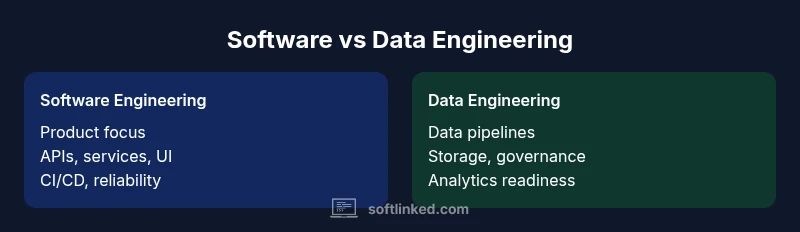
In the landscape of software and data engineering, two disciplines shape how modern systems are built and scaled. Software engineering focuses on turning ideas into reliable applications, services, and interfaces that users interact with. Data engineering concentrates on making data flow—from ingestion to analysis—robust, scalable, and governance-conscious. According to SoftLinked, understanding these roles helps teams design architectures that respond to both product needs and data-driven insights. This section defines each field, then sketches how they interact within typical tech stacks.
Software engineering emphasizes code quality, software design, and maintainability. Engineers craft APIs, front-end interfaces, backend services, and platforms that users rely on daily. They optimize for correctness, performance, and resilience under varying loads. Data engineering focuses on data ingestion, storage, transformation, and accessibility. Data engineers build pipelines that ensure data is timely, accurate, and available for analytics and decision-making. Together, these disciplines enable end-to-end systems where software is fed by reliable data and data-driven features inform product decisions.
The SoftLinked team emphasizes that successful teams blend both disciplines rather than treat them as isolated silos. By aligning data contracts with software interfaces, organizations reduce miscommunication and accelerate delivery.
textBlocksCountedWordsMetaDataOnlyForValidation?":null},
Comparison
| Feature | Software Engineering | Data Engineering |
|---|---|---|
| Primary Goal | Build reliable software products and services | Design, build, and maintain scalable data pipelines and infrastructure |
| Key Metrics | Reliability, uptime, and user-facing performance | Data quality, throughput, and pipeline latency |
| Core Technologies | Programming languages, software architecture, CI/CD | SQL/NoSQL, data processing engines, orchestration tools |
| Typical Roles | Software engineer, SRE, backend/frontend developer | Data engineer, data platform architect, analytics engineer |
| Best For | Product features, UX, and platform stability | Analytics, reporting, and data-driven insights |
| Career Growth | Software architecture, platform engineering | Data governance, data platform engineering |
| Typical Projects | Web apps, services, microservices | ETL/ELT pipelines, data warehousing |
Pros
- Clarifies distinct skill sets for hiring and career planning
- Encourages modular, scalable system design
- Promotes data-driven decision making through pipelines
- Supports end-to-end product delivery when combined
Weaknesses
- Requires cross-domain collaboration to avoid silos
- Can introduce complexity and coordination overhead
- Data engineering may lag feature delivery if not integrated
Dual-track approach: software engineering for product delivery and data engineering for data reliability.
Investing in both disciplines reduces friction between building features and generating insights. Teams should align on data contracts, CI/CD practices, and cross-functional reviews to maximize velocity and trust in data-driven decisions.
Your Questions Answered
What is the main difference between software engineering and data engineering?
Software engineering focuses on building reliable applications and interfaces, while data engineering centers on data pipelines and infrastructure. The two disciplines complement each other in modern systems, where software consumes data and data products rely on well-built software foundations.
Software engineering builds apps; data engineering builds data pipelines. They work together to power data-driven features.
Can one person do both roles effectively?
In small teams, a single engineer may touch both domains, especially in startups. However, sustained effectiveness typically requires specialization to manage complexity, maintain quality, and keep up with evolving tooling in each field.
It’s possible early on, but specialization helps quality and speed as the system grows.
Which skills transfer between the two disciplines?
Both paths benefit from strong problem solving, language-agnostic design thinking, and a bias for automation. Knowledge of data structures, software design patterns, and testing practices is valuable in both domains.
Core skills like problem solving and patterns help in both software and data engineering.
What kind of projects fit each discipline?
Software engineering shines in customer-facing applications, APIs, and platforms. Data engineering is ideal for data-heavy projects, analytics pipelines, and data platforms that support BI, ML, or real-time insights.
If the project is about apps or interfaces, go software; if it’s about data flow and insights, go data engineering.
How do teams ensure data quality in data pipelines?
Data quality is maintained through data contracts, validation tests, schema governance, and monitoring. Automating data quality checks helps catch inconsistencies early and preserves trust in analytics.
Make data contracts and tests a first-class part of your pipeline.
What career paths exist after mastering both fields?
Mastery opens leadership roles in platform teams, data engineering leadership, and cross-disciplinary positions like solutions architect. Combining software and data skills creates unique value in data-intensive product companies.
There are strong leadership paths in both data platforms and software ecosystems.
Top Takeaways
- Define clear boundaries and interfaces between software and data components
- Prioritize data contracts and schema governance early
- Automate pipelines and tests for reliability
- Invest in cross-training to reduce organizational silos
- Measure success with both product metrics and data quality metrics