Difference Between Software and Computer Engineering: A Comprehensive Comparison
Explore the key distinctions between software engineering and computer engineering, from education paths to career outcomes. Learn how each field shapes skills, projects, and opportunities in tech.


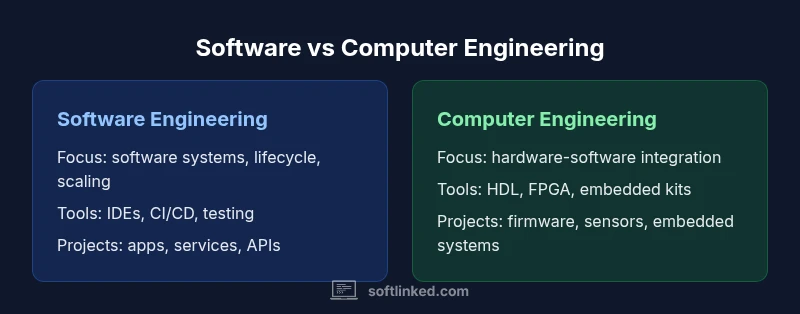
The difference between software and computer engineering centers on scope and focus: software engineering concentrates on building and maintaining software applications, while computer engineering blends software with hardware design, embedded systems, and computer architectures. For aspiring technologists, understanding this distinction helps choose a learning path and career that aligns with interests in code, systems, or integrated devices.
The Core Definitions: Software vs Computer Engineering
According to SoftLinked, the difference between software and computer engineering starts with what each discipline treats as its primary object of study. Software engineering focuses on creating software systems that solve real user problems, emphasizing requirements, design, testing, deployment, and ongoing maintenance. Computer engineering, by contrast, blends software with hardware—designing and analyzing computer architectures, embedded systems, and the physical components that enable computation. This foundational contrast shapes every subsequent decision, from coursework to project work and career paths. Both fields share a common foundation in mathematics, programming, and systems thinking, but they diverge in how they apply those principles to produce reliable functioning products and devices.
A practical way to picture the difference between software and computer engineering is to think about where the responsibility lies: software engineers own software behavior, reliability, and user experience; computer engineers own the integration of software with hardware, timing, energy efficiency, and physical constraints. This distinction matters because it guides which problems you want to solve, the environments you’ll work in, and the kinds of teams you’ll join. In the end, the difference between software and computer engineering comes down to a balance of abstracts and tangible systems, code and circuits, user needs and hardware limitations.
For students and professionals, recognizing this boundary helps in selecting courses, internships, and projects that build the right mix of skills. The SoftLinked team emphasizes that early exposure to both domains—at a high level—can reveal where your strongest interests lie and how you might combine strengths in interdisciplinary roles later on.
Education Paths and Core Disciplines
Education paths reflect the core focus of each field. Software engineering programs center on formal software development methodologies, programming languages, data structures, software testing, and project management. Courses often include software design patterns, agile practices, cloud architectures, databases, and user-centered development. The emphasis is on producing robust, scalable software through structured processes, verification, and iteration. Computer engineering programs blend electrical engineering fundamentals with computer science concepts. Students study digital logic, microprocessor design, computer architecture, embedded systems, signal processing, and hardware-software co-design. They gain hands-on experience with FPGA development, circuit design tools, and low-level programming that interacts with hardware. The cross-section where these tracks meet—embedded software, firmware, and hardware-aware software development—often becomes a bridge between the two disciplines. In practice, many programs also offer electives that let students sample both domains, enabling more informed decisions about specialization and career direction.
Careers in software engineering tend to emphasize software lifecycles, system reliability, and user-facing features, while computer engineering careers lean toward hardware-enabled systems, performance optimization, and hardware-software interfaces. Regardless of path, the strongest candidates possess a solid foundation in programming, problem-solving, and systems thinking. The SoftLinked analysis shows that students who engage with both domains early in their education tend to be more adaptable across roles that touch software and hardware.
Focus Areas and Typical Roles
In software engineering, focus areas include backend and frontend development, mobile apps, cloud-native systems, data engineering, DevOps, and software testing. Roles range from software engineer and site-reliability engineer to product engineer and platform architect. The emphasis is on building reliable software that meets user needs, scales with demand, and integrates with other services. Computer engineering offers focus areas like digital design, embedded systems, robotics, hardware design, and firmware development. Roles include embedded software engineer, hardware engineer, FPGA/ASIC designer, and systems engineer. These roles require an understanding of how software executes on physical hardware, energy constraints, instruction set architectures, and timing considerations. Because hardware considerations directly affect software behavior, computer engineers often work closely with hardware teams, firmware developers, and electrical engineers to optimize performance and reliability.
A practical takeaway is that software engineers tend to work in environments with rapidly changing software requirements (startups, SaaS, mobile apps), while computer engineers often operate in settings that demand long-term hardware integration (telecommunications, automotive, aerospace). However, there is growing overlap in areas such as embedded software for IoT devices, wearable tech, and smart systems, where both disciplines contribute to holistic solutions. The SoftLinked perspective highlights the value of cross-disciplinary literacy to navigate these blended roles.
For students considering postgraduate opportunities, many advanced programs encourage dual majors or minors in computer science and electrical engineering to cultivate both software fluency and hardware intuition, expanding career options across the tech landscape.
Skills, Tools, and Methodologies
Software engineers rely on programming languages like Java, Python, C#, and JavaScript, along with frameworks and tooling for version control, continuous integration, and automated testing. They practice software design principles, testing strategies, and performance profiling to deliver reliable, maintainable systems. Agile methodologies, user-centered design, and architectural thinking guide how requirements translate into deliverables. In contrast, computer engineers cultivate skills in digital logic design, microprocessor architecture, circuit analysis, and hardware description languages (HDLs) such as VHDL or Verilog. They work with microcontrollers, FPGA boards, and embedded systems development kits, focusing on how software interacts with hardware at the lowest levels. Tools span from EDA software for circuit design to debugging tools that monitor hardware performance. While there is overlap—such as programming for embedded systems—computer engineers emphasize hardware aspects like power management, timing, and thermal considerations that shape software behavior. Cross-training in both domains broadens career opportunities, enabling you to design software that respects hardware constraints and hardware that can be controlled by sophisticated software.
To succeed in either field, you should develop strong problem-solving, clear communication, and a habit of rigorous verification. Build a portfolio that demonstrates projects across the lifecycle: requirement gathering, design, implementation, testing, and deployment. For embedded software, emphasize real-time constraints, energy efficiency, and hardware-software interfaces; for software engineering, highlight scalability, reliability, and maintainability in complex systems.
SoftLinked recommends starting with a solid programming foundation, then exploring hardware concepts through hands-on labs or maker projects to build intuition about how software and hardware co-create value.
Career Outcomes and Industry Applications
Software engineering opens doors across virtually every industry that relies on software products and services. Roles include web and mobile app development, cloud engineering, data engineering, AI/ML model deployment, and security engineering. Industries span finance, healthcare, e-commerce, media, and technology platforms. Computer engineering leads to roles that blend software with hardware, including embedded systems for consumer electronics, automotive control systems, aerospace computing, robotics, and IoT solutions. These careers often involve hardware-software co-design, firmware development, and systems integration critical to devices that must operate in real-time or under constrained environments. The demand for engineers who understand both software and hardware continues to grow as devices become more connected and intelligent. The SoftLinked analysis indicates that professionals who can navigate both sides of the fence—coding software with hardware constraints in mind—are highly valued for roles that require system-level thinking and end-to-end ownership.
Both paths support lifelong learning, but the type of learning differs. Software engineers routinely update skills to keep pace with new languages, frameworks, and cloud paradigms. Computer engineers invest in staying current with evolving processor architectures, embedded platforms, and hardware trends. In many organizations, hybrid roles surface where teams need engineers who can design software with hardware awareness or design hardware with software-friendly interfaces, reinforcing the value of a broad, interdisciplinary skill set.
Ultimately, career outcomes align with your interests: building scalable software systems or integrating software into physical devices and networks. The field rewards curiosity, disciplined engineering practices, and the ability to translate user needs into dependable, high-performance solutions.
Comparing Projects: Examples and Trade-offs
Projects in software engineering typically center on features, performance, and user experience. You might build a scalable web service, implement a secure API, or design a multi-tenant architecture that remains reliable under load. Trade-offs often involve speed of delivery versus long-term maintainability, security requirements, and stakeholder priorities. In computer engineering, projects emphasize hardware-software integration. You might develop firmware that runs on a microcontroller, optimize a sensor network, or design a compact embedded system with strict power and timing constraints. Trade-offs frequently involve hardware limitations, thermal management, and real-time responsiveness. The two domains intersect in embedded software for devices like wearables or automotive control units, where you must balance software efficiency with hardware constraints.
An illustrative comparison: a software engineer might optimize an API for latency and throughput while ensuring a clean API surface, whereas a computer engineer might optimize a firmware routine to meet strict timing deadlines in a low-power microcontroller. Both roles require testing, debugging, and iteration, but the unit of analysis shifts: software engineers focus on software behavior; computer engineers focus on the interaction of software with hardware components. Learning to prototype quickly, measure outcomes, and iterate—across both domains—yields the most transferable skills.
SoftLinked encourages hands-on projects that reveal how decisions in software design impact hardware performance and how hardware choices constrain software behavior. Start with small cross-disciplinary projects to build intuition and gradually tackle more complex systems that require system-wide thinking.
How to Decide Which Path Fits You
Choosing between software and computer engineering hinges on your interests, strengths, and long-term goals. If you enjoy abstract problem solving, data structures, algorithms, and product-oriented thinking, software engineering offers a natural home. If you are fascinated by circuits, microprocessors, and the physical constraints of devices, computer engineering provides a compelling path. Consider exposure to both domains through courses or internships to see where you feel most engaged. Look for cross-disciplinary experiences, such as embedded software projects or hardware-oriented software development, to test your preferences. A practical approach is to set learning milestones: master a programming language, complete a hardware-oriented project, and assess which challenges excite you more. Your choice should align with your curiosity about how software translates into real-world devices and how hardware shapes software behavior.
SoftLinked emphasizes reflective planning: write down your interests, seek mentors, and evaluate how each path aligns with your personal and professional objectives. Regardless of path, cultivate transferable skills like problem solving, documentation, collaboration, and a growth mindset. These competencies will support your career as technology evolves and new opportunities emerge.
The Practical Perspective: Salary, Demand, and Growth (Non-Numerical Overview)
Salary and demand are influenced by industry, geography, and experience rather than a single path. Software engineering often offers broader entry points—web, mobile, cloud, data—across many sectors, which can translate into diverse opportunities and quicker mobility within tech ecosystems. Computer engineering tends to attract roles tied to hardware products, embedded systems, and critical infrastructure; job growth can be robust in industries such as automotive, aerospace, telecommunications, and consumer electronics. In both fields, firms prize engineers who can communicate clearly, design with reliability in mind, and learn continuously. The SoftLinked perspective suggests focusing on foundational skills (programming, systems thinking, debugging) and progressively deepening domain knowledge (software architecture for software engineers; hardware-aware design for computer engineers) to stay relevant as technologies evolve. When exploring roles, consider project types, team structures, and the kind of impact you want to create—software transformations or integrated hardware-software systems—and choose the path that aligns with your passions and long-term learning plan.
Comparison
| Feature | Software Engineering | Computer Engineering |
|---|---|---|
| Education Focus | Software development lifecycle, programming, testing, and architecture | Digital logic, microprocessors, embedded systems, hardware design |
| Core Responsibilities | Build and maintain software that meets user needs | Design and integrate software with hardware, optimize hardware-software interfaces |
| Typical Roles | Software engineer, backend/frontend developer, DevOps, QA engineer | Embedded systems engineer, hardware engineer, FPGA/ASIC designer |
| Projects Focus | Applications, services, APIs, user interfaces | Firmware, device drivers, hardware prototyping, real-time systems |
| Environment and Tools | IDEs, cloud platforms, version control, testing frameworks | HDLs, circuit design tools, microcontroller toolchains |
| Best For | Those who love software ecosystems, product delivery, and scaling | Those who enjoy hardware constraints, systems integration, and hardware-software co-design |
Pros
- Clarifies career goals and required skills
- Helps tailor academic planning and internships
- Improves job-fit and interview preparation
- Encourages cross-disciplinary collaboration
- Aids in selecting electives and projects
Weaknesses
- Overlap between domains can blur lines
- Geographic variation in demand by specialty
- Switching domains may require retraining
- Hardware-heavy roles may limit remote opportunities
Neither path is universally superior; your choice should align with interests in software systems or hardware integration.
Software engineering excels in software product ecosystems and rapid iteration, while computer engineering emphasizes hardware-aware design and embedded systems. Use your curiosity about code versus circuits to guide your decision, and consider bridge projects to test both domains.
Your Questions Answered
What is the main difference between software engineering and computer engineering?
The main difference is that software engineering centers on building and maintaining software systems, while computer engineering combines software with hardware design, embedding software into devices and managing hardware-software interfaces. Understanding both domains helps you choose a path that matches your interests in code or hardware.
Software engineering focuses on software, while computer engineering blends software with hardware. If you love coding, software engineering is for you; if hardware and devices excite you, consider computer engineering.
Which degree is typically more software-focused?
A software engineering or computer science degree is typically more software-focused, emphasizing programming, software design, and systems thinking. It prepares you for roles in app and platform development and often offers strong preparation for cloud-native environments.
Software engineering degrees emphasize programming and software design, preparing you for application development and platforms.
Can software engineers work on hardware-related projects?
Yes. Software engineers frequently contribute to embedded software, firmware, and device interfaces that interact with hardware. This requires some hardware awareness and collaboration with hardware teams to ensure software respects physical constraints.
Software engineers can work on embedded or firmware projects, often teaming with hardware specialists.
What kinds of projects do software engineers typically build?
Software engineers typically build web services, mobile apps, APIs, data pipelines, and cloud-based platforms. They focus on reliability, scalability, performance, security, and user experience across diverse industries.
Think apps, APIs, and services—clean, scalable software that users interact with daily.
Is it possible to switch from software engineering to computer engineering later?
Transitioning is possible but requires deliberate learning. You would benefit from studying hardware concepts, digital design, and possibly pursuing additional coursework or a master's with a hardware emphasis to build hardware fluency.
You can switch, but you’ll likely need coursework in hardware concepts to bridge the gap.
What are typical courses in each major?
Software engineering courses cover programming, data structures, algorithms, software design, testing, and project management. Computer engineering courses include digital logic, computer architecture, embedded systems, electronics, and HDL design. Both paths offer electives that cross into the other domain.
Software courses cover code and design; computer engineering covers circuits and hardware interfaces.
Top Takeaways
- Define your interest: software ecosystems or hardware-enabled systems
- Explore cross-disciplinary projects early
- Focus on transferable skills like problem solving and communication
- Seek internships that expose you to both domains
- Plan a learning path that accommodates evolving tech trends