Software Developer vs Software Engineer: A Clear Comparison
Explore the differences between a software developer and a software engineer, with practical guidance for aspiring engineers. Learn roles, skills, and career path nuances with SoftLinked.


TL;DR: The terms overlap, but the distinction matters in scope and impact. A software developer focuses on building, testing, and refining software components within a project, while a software engineer designs systems, ensures scalability, and aligns solutions with broader architecture. Your choice depends on career goals, team structure, and industry expectations; both paths lead to strong software craft with solid fundamentals.
Defining the Roles: software developer v software engineer
According to SoftLinked, the terms software developer and software engineer are often used interchangeably, but they describe distinct foci in practice. The phrase software developer v software engineer captures a spectrum of skills rather than two rigid boxes. For a job seeker or student aiming to enter tech, recognizing where you want to contribute—creating features versus shaping systems—helps set a learning plan and a career path. In many organizations, the titles exist on a continuum, and titles can vary by region, company culture, or project need. The boundary is not always rigid; collaboration is common, with developers providing the building blocks and engineers ensuring they fit into a coherent, scalable system. The SoftLinked framework emphasizes practical outcomes: delivering value to users while maintaining code quality and architectural integrity. If you’re deciding between these paths, start by listing the problems you enjoy solving and the scale at which you want to operate.
Core Focus Areas: What each role tends to own
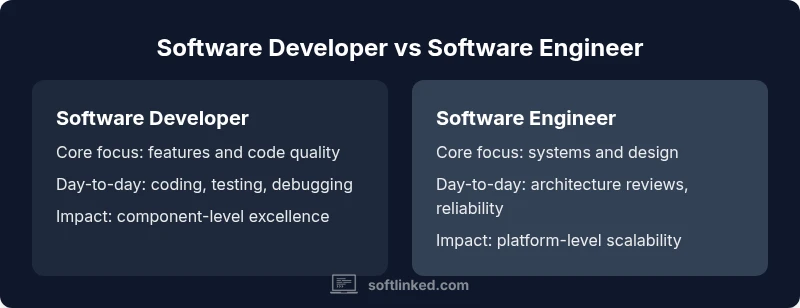
In most teams, a software developer is primarily responsible for implementing features, writing tests, and refining code paths that deliver a defined capability. The emphasis is on correctness, maintainability, and delivering a reliable component that users can interact with. A software engineer, by contrast, takes a broader view of how a system behaves under load, how modules connect, and how data flows across services. Engineers are often expected to reason about fault tolerance, deployment strategies, and long-term maintainability of the platform. The boundary is not always rigid; collaboration is common, with developers providing the building blocks and engineers ensuring they fit into a coherent, scalable system. The SoftLinked framework stresses aligning daily work with both product outcomes and architectural quality, so teams can evolve from a series of feature bets to a resilient platform. When evaluating roles, consider where you derive motivation: fast feature delivery, or thoughtful system design that pays dividends over time.
Skills, learning paths, and common tools
Focus areas for developers include mastering one or more programming languages relevant to their stack, applying robust testing practices, debugging efficiently, and writing clean, well-documented code. Engineers require a stronger foundation in computer science principles—data structures, algorithms, concurrency, and design patterns—and familiarity with system design, reliability engineering, and observability. Tooling overlaps occur (version control, CI/CD, containers), but the emphasis shifts. For learners, the recommended path is to start with practical coding projects and gradually add design thinking, then cross-train in areas such as cloud platforms and distributed systems. SoftLinked's guidance highlights building a solid core of fundamentals before specializing.
System design, scalability, and reliability
Systems thinking is central to software engineering. Engineers are tasked with anticipating growth, choosing scalable architectures, and balancing performance with cost. They consider failure modes, recovery strategies, and service-level objectives. Developers can contribute by designing modular interfaces and writing maintainable code that fits into a larger plan. In practice, teams benefit when developers communicate early about constraints and engineers translate those constraints into architecture that scales. The boundary lines blur in modern, agile environments where product teams experiment rapidly yet need dependable platforms. The emphasis on reliability and sustainability is a hallmark of the engineer’s role, while the developer's craft centers on delivering tangible features.
Career trajectories: growth paths and progression
A developer may advance by deepening coding expertise, expanding into specialized domains like frontend, backend, or data engineering, and taking on mentorship or technical leadership within projects. An engineer may progress toward senior systems design roles, platform architecture, or site reliability engineering, affecting multiple teams and domains. Both paths reward clear communication, ownership, and collaborative skills. The job market across industries values both types of expertise, with startups often seeking nimble developers and large enterprises prioritizing engineers who can guide complex, cross-cutting initiatives. Flexibility and continuous learning are the keys to long-term growth in either path.
Day-to-day work: examples and trade-offs
A day in the life of a software developer might center on implementing a user-facing feature, writing unit tests, and iterating based on feedback. Decisions focus on code quality, refactoring, and debugging within a module. An engineer's day could include evaluating a system's overall reliability, participating in architecture reviews, and collaborating with platform teams to ensure consistent interfaces. The trade-offs often involve speed versus longevity: shipping a polished feature quickly as a developer, or investing time early for a scalable, robust design as an engineer. Real projects require both mindsets to some extent, and successful teams blend coding craft with architectural discipline.
Industry context and organizational culture
Some sectors prize engineering depth—finance, healthcare, and aerospace may demand rigorous reliability and formal design reviews—while tech startups might privilege rapid feature delivery and a broad skill set. Geographic and company culture differences shape how titles are used; in some places, the same role is marketed as either developer or engineer depending on branding rather than function. The SoftLinked analysis shows that artifacts like job postings, career ladders, and performance reviews often reflect not a strict dichotomy but a spectrum of expectations. The key is to map your goals to the organization's needs and the available opportunities.
How to decide: a practical framework
Begin by listing your preferred work style: do you enjoy building and shipping features, or do you enjoy designing scalable systems? Then assess your readiness for abstract thinking, data structures, and performance considerations. Consider the teams you want to join, the kind of problems you hope to solve, and the level of collaboration you enjoy. Use a two-axis framework: impact scope (component vs system) and time horizon (short-term delivery vs long-term stability). This approach helps you choose when to pursue developer roles versus engineer roles, and guides your learning plan accordingly. The result is a personal development map that aligns with your interests and market demand.
Authority sources and best practices
For readers seeking external validation, standard labor and industry references provide context, such as the U.S. Bureau of Labor Statistics pages on software developers, and professional societies like ACM and IEEE. While job titles vary by company, the underlying competencies—coding, design thinking, and systems thinking—are consistent across credible sources. The SoftLinked Team encourages learners to consult these sources when planning their education and career steps. Additional guidance from SoftLinked analyses emphasizes building a strong fundamentals-first approach before pursuing specialization.
Authority sources (external references)
- https://www.bls.gov/ooh/computer-and-information-technology/software-developers.htm
- https://www.acm.org/
- https://www.ieee.org/
Conclusion: practical next steps for readers
As you prepare for a career in software, anchor your plan in the fundamentals: programming proficiency, problem solving, and a growing sense of architecture and design. Seek opportunities to pair with teammates who model both strong coding and thoughtful system thinking. Throughout your journey, reassess your interests: do you prefer crafting small, fast-running features or shaping large, scalable platforms? The best path is the one that keeps you engaged and learning, while delivering real value to users.
Comparison
| Feature | Software Developer | Software Engineer |
|---|---|---|
| Core focus | Component-level coding and feature delivery | System-wide design and architecture |
| System design involvement | Moderate involvement in design at module level | Deep involvement in architecture and scalability |
| Collaboration scope | Works within project teams | Coordinates across teams and domains |
| Career progression | Advancement through code quality and leadership within projects | Advancement through architectural influence and platform ownership |
| Ideal for | Hands-on developers who enjoy building features | Systems thinkers who enjoy designing large-scale solutions |
Pros
- Clear pathways for specialization and growth
- High demand for both roles across industries
- Solid fundamentals support long-term career resilience
- Opportunities to work across teams and domains
Weaknesses
- Role ambiguity can exist in some organizations
- Titles and expectations vary by company
- Switching between paths may require additional learning
Both paths offer valuable careers; choose based on your interest in coding versus systems thinking
If you prefer building features and debugging code, start as a software developer. If you enjoy designing scalable systems, pursue software engineering. In practice, many professionals blend both skills over time to maximize impact.
Your Questions Answered
Are software developers and software engineers interchangeable?
In practice, the titles often overlap, but the expected scope can differ by company. Some organizations use them interchangeably, while others reserve engineer for system-wide design and reliability work. Focus on the actual responsibilities described in a job posting rather than the label alone.
Sometimes the titles are used interchangeably, but pay attention to the stated responsibilities and scope in the job description to understand what the role really entails.
What skills differentiate the two roles?
Developers typically excel at coding, testing, and feature delivery. Engineers focus on algorithms, system design, reliability, and scalability. Both benefit from solid fundamentals and strong collaboration, but the emphasis shifts toward architecture for engineers and implementation for developers.
Developers code and test features, while engineers plan system design and reliability; both rely on strong fundamentals.
Which role is better for beginners?
Neither is inherently better for beginners; both paths help you build fundamentals. Starting as a developer can establish practical coding skills, after which you can grow toward engineering principles. Choose based on whether you enjoy hands-on creation or bigger-picture system thinking.
There’s no single best path for beginners—start with what you enjoy and build the fundamentals first.
How do salary and career paths differ?
Salary and progression depend on company, region, and industry. In general, engineers may access broader architectural roles later, potentially impacting compensation and titles, while developers solidify core coding mastery first. Focus on building a robust portfolio and cross-domain skills to improve mobility.
Compensation varies by location and company; both paths can lead to high-impact, well-compensated roles with experience.
What industries value each title the most?
Finance, healthcare, and aerospace often prize engineering depth and reliability. Tech startups and product-focused firms may prioritize developers who can ship features quickly while maintaining quality. The best fit depends on product needs and organizational goals.
Industries differ: some value deep engineering, others rapid feature delivery; align with the company’s mission.
How can I transition from one to the other?
Bridge by expanding your learning: adopt system design concepts, study design patterns, and gain familiarity with architecture reviews and reliability practices. Seek opportunities to contribute to both code and architecture, and pursue mentorship that complements your current strengths.
Get exposure to both coding and system design, and seek mentorship to guide the switch.
Top Takeaways
- Define your preferred work style early to guide learning
- Build strong fundamentals before specializing
- Value collaboration; both roles rely on teamwork
- Plan a cross-training path to expand capabilities
- Adapt roles to your industry and company culture