What is a product engineer vs software engineer? A Comprehensive Comparison
An analytical comparison of the Product Engineer and Software Engineer roles, detailing focus, responsibilities, skills, and career paths. Learn how teams balance product outcomes with robust software, plus practical guidance for choosing a path and advancing in tech.


Product engineers and software engineers fill different but complementary roles in product development. A product engineer emphasizes translating user needs and business goals into viable features, while a software engineer focuses on building robust code, scalable systems, and reliable software delivery. Understanding these distinctions helps teams staff projects effectively and guides engineers toward aligned career paths.
What is a product engineer vs software engineer? Definition and scope
What do these roles actually cover, and where do they diverge in day-to-day practice? If you search for what is a product engineer vs software engineer, you'll find two distinct traditions that converge on one overarching goal: delivering valuable software that users love. A product engineer sits at the intersection of business goals, user needs, and technical feasibility. They translate product strategy into concrete requirements, work with designers and product managers, and monitor the impact of features after release. By contrast, a software engineer concentrates on the craft of building software: writing clean code, designing scalable architectures, implementing robust tests, and maintaining a dependable deployment pipeline. The distinction matters in hiring, career planning, and day-to-day decision making, especially in teams that emphasize end-to-end ownership.
Historical context and evolving roles
The concept of a product engineer emerged as product-centric development matured in tech companies that wanted closer alignment between user value and software delivery. Historically, engineers focused on technical purity; product teams owned roadmaps and market fit. Over time, a hybrid role arose where engineers participated more deeply in product decisions, experiments, and metrics. This evolution reflects a broader trend toward cross-functional teams that integrate design, research, engineering, and business analysis. In practice, organizations differ in how they label these roles. Some still call it “product-aware software engineer” or simply “product engineer,” but the core idea remains: merge customer insight with technical execution to ship outcomes, not just features.
Primary focus: Product Engineer
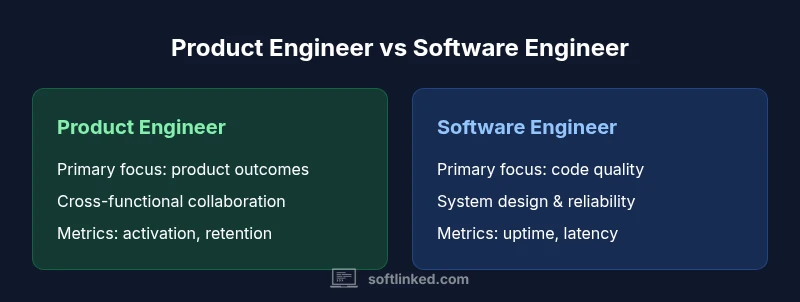
A product engineer centers on outcomes that matter to users and the business. This means connecting product strategy to technical feasibility, defining measurable features, and ensuring that every release advances growth or customer value. They frequently engage with product managers, designers, and data analysts to validate ideas with experiments, dashboards, and user feedback. Their success is judged by product metrics such as activation, retention, and time-to-value, rather than by code volume alone. The product engineer role is especially prominent in organizations that value rapid iteration and market responsiveness.
Primary focus: Software Engineer
Software engineers are primarily responsible for the reliability, performance, and maintainability of software systems. They design and implement features with clean architectures, create tests, optimize performance, and maintain deployment pipelines. Their day-to-day work emphasizes code quality, technical debt management, and scalable infrastructure. While they may contribute to product decisions, their core lens is the correctness and efficiency of software, ensuring that systems behave predictably at scale. In many teams, software engineers partner with product roles to translate needs into robust technical solutions.
Skills overlap and unique competencies
Both roles share core software fundamentals such as programming, debugging, and collaboration. However, product engineers tend to excel in product discovery, user empathy, data-informed decision making, and roadmap alignment. Software engineers typically bring strong algorithmic thinking, system design, performance optimization, and a deep command of programming languages. Cross-functional skills—communication, stakeholder management, and data literacy—benefit both paths, though the emphasis shifts depending on whether the focus is product value or technical excellence.
Collaboration and cross-functional workflows
Cross-functional collaboration is the heartbeat of modern product development. Product engineers collaborate with product managers, UX designers, marketers, and data scientists to turn ideas into testable experiments. Software engineers collaborate with QA, SRE, and architecture teams to ensure features are robust and scalable. The most successful teams embed joint planning, shared metrics, and frequent feedback loops to minimize hand-offs. In practice, effective teams use lightweight governance, clear ownership, and common toolchains to avoid friction and keep the product moving from concept to production.
Metrics and success criteria
Product engineers are evaluated by product-centric outcomes: user engagement, revenue impact, activation rates, and time-to-market. Software engineers are judged by technical metrics: defect density, uptime, latency, scalability, and maintainability. Both roles benefit from a shared set of metrics such as cycle time, customer satisfaction, and collaboration effectiveness. When teams align these metrics, individuals can see how their daily work translates into tangible business value, reinforcing the bridge between product and tech.
Career paths and progression
A product engineer can advance toward product leadership, program management, or a broader product-management track. They may move into roles like product owner, product director, or VP of product, depending on organizational structure. Software engineers typically progress along an engineering ladder: senior engineer, staff engineer, principal engineer, or architect. Many managers move between tracks, but the most successful transitions balance domain expertise with leadership capabilities. Structured mentorship and clear criteria help individuals navigate these paths.
Education and continuous learning
Entry routes differ: product engineers often benefit from exposure to business concepts, UX research, and data analysis, alongside technical fundamentals. Software engineers typically emphasize algorithms, data structures, design patterns, and system design, with ongoing training in new languages and platforms. Both roles benefit from hands-on projects, code reviews, and learning communities. Continuous learning—through courses, reading, hackathons, and open-source contributions—helps professionals stay current in a fast-moving field.
Tools, tech stacks, and environments
Product engineers frequently use product analytics tools, roadmap software, A/B testing platforms, and collaboration suites to align teams. Software engineers work with IDEs, version control, CI/CD pipelines, testing frameworks, and cloud infrastructure. The overlap includes programming languages, debugging practices, and version control workflows. The right toolkit depends on organizational goals: if outcomes matter more, you may lean into product analytics; if reliability and scale dominate, you emphasize architecture and automation.
When to choose which path: best-fit scenarios
If you thrive on understanding user needs, shaping product strategy, and influencing business outcomes, the product engineer path offers fulfillment and impact. If you prefer engineering craftsmanship, designing robust systems, and advancing technical skills, the software engineer path provides deeper specialization. In many companies, hybrid roles exist; in those cases, early exposure to both worlds helps you decide where you want to focus long-term. Your choice also depends on industry needs, company size, and career aspirations.
Case studies and practical examples
Consider a fintech startup launching a new payments feature. A product engineer would articulate user needs, define success metrics, coordinate with design and compliance, and monitor feature adoption. A software engineer would implement secure payment flows, optimize latency, conduct rigorous testing, and ensure compliance with performance SLAs. In a large enterprise, the product engineer might operate as a program manager with technical oversight, while a software engineer leads a platform team responsible for shared services and reliability. These distinctions illustrate how roles collaborate to deliver value while maintaining technical integrity.
Common misconceptions and myths
Myth 1: Product engineers don’t code. Reality: many product engineers code and review to validate feasibility. Myth 2: Software engineers don’t care about users. Reality: great engineers consider user impact when designing solutions. Myth 3: One path is superior. Reality: both paths offer meaningful impact; the best choice aligns with your strengths and the organization’s needs. Myth 4: Roles never overlap. Reality: in fast-moving teams, overlap is common and can be beneficial when combined intentionally.
Comparison
| Feature | Product Engineer | Software Engineer |
|---|---|---|
| Primary focus | Product outcomes and business impact | Code quality, reliability, and system performance |
| Typical tasks | Bridge product discovery with implementation; define features | Develop, test, and deploy software features and fixes |
| Metrics of success | Product metrics (activation, retention, growth) | Technical metrics (uptime, latency, defect rate) |
| Tools & environments | Cross-functional tools for roadmaps and user research | CI/CD, version control, debugging, languages |
| Career progression | Product leadership paths (PM, product director) | Engineering ladder (senior, lead, architect) |
| Learning focus | Product discovery, user needs, data-informed decisions | Algorithms, data structures, system design |
| Best-fit scenarios | Strong product intuition and business alignment | Deep technical expertise and scalable systems |
Pros
- Helps teams align technical work with business goals
- Clarifies hiring and career planning across organizations
- Encourages cross-functional collaboration and ownership
- Supports clear career ladders and role definitions
Weaknesses
- Roles can blur in small teams, causing overlap
- Path to senior leadership may be unclear without bridges
- Compensation structures may diverge between roles in some firms
- Overlap can create role ambiguity if not well defined
Product and software engineering serve distinct but complementary purposes.
Choose the product engineer path to maximize business impact and user value, or the software engineer path to deepen technical mastery and system reliability. In many teams, a blended approach yields the strongest outcomes.
Your Questions Answered
What is a product engineer?
A product engineer focuses on translating user needs and business goals into tangible features and outcomes. They blend product strategy with technical execution and monitor the impact of features after release.
A product engineer bridges product ideas with real features and tracks how users respond.
What is a software engineer?
A software engineer designs, builds, tests, and maintains software systems. Their primary focus is code quality, scalability, and reliable delivery, often across many features and products.
A software engineer specializes in making software robust, scalable, and maintainable.
How do day-to-day tasks differ between the two roles?
Product engineers spend time on discovery, stakeholder alignment, and feature validation. Software engineers spend time coding, testing, and optimizing systems, with a focus on architecture and performance.
Product engineers focus on what users need; software engineers focus on how to build it well.
Can a product engineer become a software engineer?
Yes. With a focus on core software practices, design patterns, and system design, a product engineer can transition to a software engineering track, often starting with smaller projects to build technical depth.
Switching paths is possible with targeted skill-building in software development.
What skills are common to both roles?
Both roles benefit from strong communication, problem-solving, and collaborative mindset, plus solid fundamentals in programming and data literacy.
Both roles share core tech and teamwork skills, just with different emphasis.
Which industries hire these roles?
Many industries hire both roles, including tech, finance, healthcare, and e-commerce. The exact responsibilities vary by company and product maturity.
Tech, finance, healthcare, and ecommerce commonly hire both roles.
Top Takeaways
- Define your strengths and interests to pick a path
- Expect cross-functional collaboration in both roles
- Leverage shared metrics to connect daily work to outcomes
- Plan career growth with clear role definitions and ladders