Software Developer vs Software Engineer: Key Differences
A detailed comparison of software developer and software engineer roles, responsibilities, skills, and career paths to help learners and employers choose the right path.


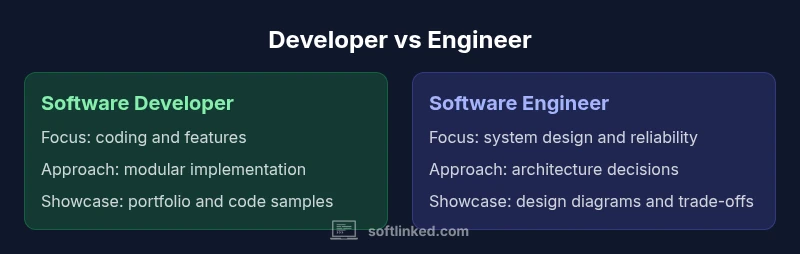
In most teams, a software developer focuses on coding, implementing features, and debugging within defined modules, while a software engineer emphasizes system design, scalability, and reliability across larger architectures. The roles overlap in practice, especially in smaller teams where individuals wear multiple hats. Knowing these nuances helps you plan learning goals, project assignments, and career progression toward architecture or developer tracks. In many discussions, the phrase software developer vs software engineer captures a spectrum of responsibilities.
Understanding the terms: software developer vs software engineer
According to SoftLinked, the distinction between titles often reflects scope, not a hard rule. In practice, many organizations blur lines, especially in fast-moving teams. This article uses the phrase software developer vs software engineer to frame a spectrum of responsibilities, not a binary ladder. The target audience here includes aspiring software engineers, students, and tech professionals seeking clear software fundamentals and definitions. We'll unpack the terms, their historical context, typical duties, skill expectations, and how to navigate your own path. The difference is seldom absolute, but over time, clearer boundaries emerge as companies scale and adopt formal engineering practices.
From a market perspective, the software field has matured to recognize a division of cognitive labor: developers focus on implementation details that bring features to life, while engineers emphasize the structural integrity of systems. Understanding this distinction helps learners map curricula and projects to real-world outcomes. As you read, consider how your own strengths align with coding craft, problem-solving, and the ability to reason about complex architectures. Whether you aim to be a hands-on coder or a systems thinker, both roles contribute to robust software solutions.
The historical context and why definitions matter
The terms software developer and software engineer have evolved with the software industry itself. Early programming teams often used informal titles, emphasizing practical output over formal discipline. As software systems grew in scale, organizations began adopting engineering principles, design patterns, and architectural governance. This shift created an implicit hierarchy: engineers tended to own system-wide decisions, while developers implemented components within that framework. Today, many companies blend responsibilities and titles depending on size, culture, and product complexity. For students and early-career professionals, recognizing this evolution helps set realistic expectations about what to study and how to demonstrate your capabilities in interviews and on the job. In essence, the two terms describe a spectrum rather than a rigid ladder.
Industry observers note that job postings may use the terms interchangeably, particularly in startups or small teams where hiring needs are urgent and roles are fluid. Yet, at larger organizations or in safety-critical domains, you’ll see a more explicit split: engineers shaping the architecture, while developers execute within defined modules. SoftLinked’s guidance emphasizes aligning your learning with both the craft of writing clean code and the discipline of engineering thinking. This dual emphasis prepares you for a broad range of opportunities and reduces the risk of role mismatch.
Core responsibilities and day-to-day duties
A software developer’s day typically centers on translating requirements into working code, writing tests, and debugging. They participate in feature scoping at the module level, ensure code quality, and work closely with product managers and designers to iterate quickly. Their work often reflects a focus on steady delivery, maintainability, and code reuse. A software engineer, by contrast, may operate at a higher level of abstraction. They design system components, evaluate trade-offs between approaches, and consider nonfunctional requirements such as reliability, performance, and fault tolerance. Engineers frequently collaborate with architects, lead engineers, and platform teams to define standards and interfaces that scale as the product grows. The overlap is natural: a strong developer who thinks in terms of system boundaries becomes an effective engineer, and a thoughtful engineer who writes clean code remains a strong developer. In practice, many teams expect both mindsets to coexist.
Examples of overlap: writing a robust API, choosing a storage strategy with attention to scalability, or evaluating caching policies to meet latency targets. The key difference lies in scope: developers implement within a subsystem; engineers define and oversee the cross-cutting concerns that hold subsystems together.
Education, certifications, and career paths
Traditional education paths for software developers and engineers often begin with a Bachelor’s degree in computer science, software engineering, or a related field. However, the modern market has room for alternative routes such as coding bootcamps, online courses, and self-directed projects. Certifications (when relevant) may emphasize specific practices, languages, or platforms, but most employers prioritize demonstrable ability: a strong portfolio, code samples, and results from past projects. A software engineer’s progression tends to emphasize systems thinking and leadership: advancing to staff or principal engineer, then eventually to architecture roles or technical leadership. Developers may advance through senior developer roles, team leadership, or specialize in frontend, backend, mobile, or data-focused tracks. The important point is to document learning outcomes: projects that show architectural awareness, problem decomposition, and collaboration across teams. The SoftLinked framework encourages combining depth in core programming with a growing understanding of systems and engineering disciplines to stay versatile.
For students and early-career professionals, a practical approach is to accumulate varied experiences: contribute to open-source projects, participate in code reviews, and practice designing components with clear interfaces. These experiences translate well into both developer and engineer tracks, enabling flexible career moves as interests evolve.
Skills, tooling, and methodologies
Software developers typically immerse themselves in programming languages relevant to the product stack, testing methodologies, debugging, and continuous integration pipelines. They build proficiency in version control, testing frameworks, and debugging tools, and they often specialize in frontend, backend, or mobile domains. Software engineers, meanwhile, cultivate a broader toolkit: knowledge of software design patterns, system architecture, performance optimization, reliability engineering, and risk management. They are familiar with trade-off analysis, load testing, capacity planning, and incident response. In practice, successful professionals blend both skill sets: writing clean, maintainable code while thinking about how it fits into larger patterns and future scalability. A practical recipe is to learn core programming concepts, then pick up architecture-focused practices such as domain-driven design, microservices patterns, and observability strategies such as logging, tracing, and metrics. Hands-on projects that demonstrate both code quality and system-level thinking are highly valued by employers.
Tooling overlaps: version control (Git), CI/CD pipelines, testing frameworks, and containerization. Distinctions emerge in the emphasis on design principles, performance considerations, and cross-cutting concerns that affect entire systems rather than isolated modules.
Industry impact and domain alignment
The choice between developer and engineer often aligns with domain and industry context. In product-centric startups, the lines blur as teams emphasize rapid iteration and feature delivery; developers may take on broader responsibilities, while engineers might focus on building scalable foundations for growth. In regulated industries such as healthcare, finance, or aerospace, the engineering role’s emphasis on reliability, safety, and compliance becomes more pronounced. Large-scale platforms—cloud services, data pipelines, or distributed systems—tend to require more formal engineering practices, with architects and engineers shaping standards, governance, and roadmaps. Skill alignment matters: if you anticipate working on complex data models, distributed systems, or mission-critical components, developing a robust engineering mindset will pay dividends. Conversely, if your passion is crafting applications, APIs, and user-centered features quickly, sharpening coding skills and software craftsmanship will be your path. The SoftLinked analysis highlights that success in either path derives from combining solid fundamentals with practical experience in real-world contexts.
Regional differences also influence expectations. For example, some countries emphasize formal engineering curricula and licensure-like credentials, while others prioritize demonstrable ability and portfolio value. Employers increasingly value cross-functional teams where developers and engineers collaborate to deliver robust, scalable software solutions. The ultimate takeaway is that adaptability and continuous learning are the true differentiators, not the label alone.
Salary, compensation, and career trajectory considerations
Salary dynamics for software developers and software engineers vary by geography, company size, and domain, but two core themes emerge in practice. First, larger organizations typically reward engineers for system-level impact and long-range thinking, while developers are valued for their ability to ship features quickly and maintain codebases efficiently. Second, compensation often reflects the breadth of responsibility and the potential for leadership within a technical track. In many markets, engineers may progress toward staff or principal roles with a greater emphasis on architecture, platform strategy, and cross-team coordination. Developers can advance through senior developer roles, technical leadership, and code-quality governance. It’s important to note that the title alone rarely guarantees a particular trajectory; what matters is the demonstrated ability to design, implement, and operate software that meets both functional and nonfunctional requirements. SoftLinked’s analysis underscores the value of building a strong foundation in algorithms, data structures, and software design, then pairing that with practical experience in systems where it counts. In sum, both paths offer meaningful growth and worthwhile compensation when paired with continuous learning and demonstrated impact on project outcomes.
Common misconceptions and how to navigate ambiguity
One common misconception is that software engineers are inherently more prestigious than software developers. In reality, the value of each role depends on context: the project’s needs, the company’s size, and the product domain. Another myth is that engineers only work on large systems while developers only code features; in practice, both roles contribute to design decisions, code quality, and system reliability. To navigate ambiguity, start by clarifying expectations with managers and peers, review technical roadmaps, and seek opportunities to contribute beyond your current scope. Build a portfolio that demonstrates both code craftsmanship and system-level thinking, including design diagrams, API specifications, and performance considerations. Finally, stay curious about different layers of the stack: learn enough about infrastructure, testing, and incident management to engage productively with cross-functional teams. This broader perspective makes you more adaptable and resilient across roles and organizational cultures.
Practical guidance for learners and employers
For learners: cultivate a strong coding foundation while actively building an understanding of architecture and design patterns. Practice by designing small systems, documenting interfaces, and participating in peer reviews. For employers: define role expectations clearly, align titles with responsibilities, and create opportunities for engineers to contribute to architecture decisions while enabling developers to showcase their design thinking. Encourage ongoing learning through pair programming, code reviews, and cross-team project work. When interviewing, assess both code quality and system thinking: ask for example designs, trade-off narratives, and metrics used to evaluate system health. By acknowledging the overlap and value each path brings, teams can build resilient software ecosystems that leverage the strengths of both developers and engineers. SoftLinked’s guidance emphasizes a balanced approach: invest in fundamentals, practice thoughtful design, and foster collaboration across roles to maximize product outcomes.
Comparison
| Feature | Software Developer | Software Engineer |
|---|---|---|
| Role Focus | Coding, feature implementation, and bug fixes within modules | System design, architecture oversight, and cross-cutting concerns |
| Typical Tasks | Implementing features, debugging, writing tests | Defining interfaces, evaluating trade-offs, ensuring reliability |
| Education Path | Bachelor’s degree or equivalent; strong portfolio | Bachelor’s degree or higher; emphasis on design patterns and systems |
| Core Skills | Proficient in relevant languages, testing, debugging, code quality | Software design principles, performance, scalability, risk management |
| Career Progression | Senior developer → lead → engineering manager (optionally) | Staff/Principal engineer → architect or platform lead |
| Work Context | Smaller teams or product-focused environments; faster iteration | Medium-to-large teams; cross-team collaboration and governance |
| Job Titles in Practice | Software Developer, Frontend/Backend Developer | Software Engineer, Systems Engineer, Platform Engineer |
Pros
- Clearer focus on delivering features through code
- Flexibility for small teams to wear multiple hats
- Clear paths to leadership through deep coding or architecture
- Portfolio visibility can showcase practical skills
Weaknesses
- Role boundaries can blur in startups or small teams
- Fewer formal boundaries may slow career clarity in large orgs
- Titles vary widely by company and country
- Engineer roles may require broader cross-functional skills
Engineers provide system-wide impact; developers drive feature delivery.
Choose software engineer if you want architectural influence and reliability; choose software developer if you prefer hands-on coding and rapid feature iteration. In practice, many teams blend both paths; building fundamentals in both areas makes you versatile.
Your Questions Answered
What is the main difference between a software developer and a software engineer?
The main difference centers on scope: developers typically focus on implementing features and code quality, while engineers emphasize architecture, system design, and cross-cutting concerns that affect large parts of a system. In practice, strong performers blend both. This breadth-and-depth combination is highly valued in many teams.
The main difference is scope: developers code features; engineers design systems. But good teams blend both skills for better products.
Are the terms interchangeable in job postings?
In startups and smaller teams, employers often use the terms interchangeably. In larger organizations or regulated domains, there is a clearer division: engineers focus on architecture, while developers focus on implementation. Always read the job description to confirm responsibilities.
Yes, sometimes they’re used interchangeably, but always check the duties described.
Can one person perform both roles in a team?
Absolutely. Many teams expect individuals to contribute as both developers and engineers, especially in product-focused environments. Gaining exposure to design discussions while maintaining hands-on coding skills strengthens your versatility.
Definitely. Many teams blend both roles; versatility helps you adapt.
What should a beginner study to pursue either path?
Start with core programming fundamentals and a project portfolio. Then learn software design basics, patterns, and how to read system diagrams. Gradually add topics like testing, deployment, and observability to build a balanced skill set for either path.
Begin with coding fundamentals, then add design and system thinking.
How do responsibilities vary by company size?
Smaller companies often blend roles and expect broad capabilities, while larger ones define clearer boundaries and governance. In large teams, engineers may own architecture and platforms, whereas developers execute within modules and feature teams.
In big companies, roles are more defined; in small ones, they blend together.
Do salary expectations differ by title?
Salary is influenced more by level, impact, and region than by the label alone. Engineers may command premium for architecture work and system reliability, but developers who show strong results and leadership can also achieve competitive compensation.
Salary depends on impact and location more than the exact title.
Top Takeaways
- Define your goal: architecture vs implementation
- Develop dual strengths: coding craft and system thinking
- Consider company size when role definitions vary
- Show case studies: designs, interfaces, and performance trade-offs
- Pursue continuous learning across stack layers