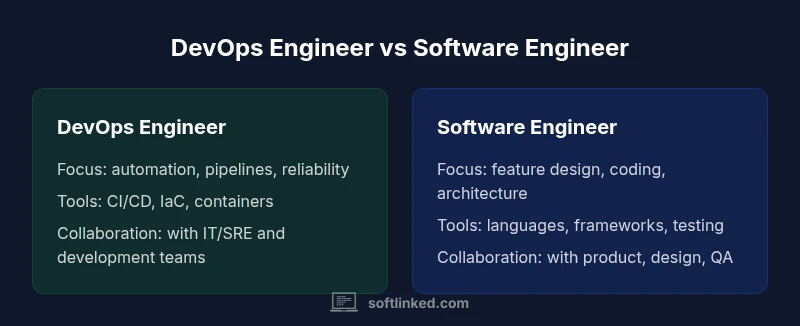
DevOps Engineer vs Software Engineer: Clear Comparison
An analytical comparison of DevOps engineer vs software engineer roles. Explore differences in focus, responsibilities, skills, and career paths to help students and professionals decide which path fits best.


A DevOps engineer focuses on automation, deployment pipelines, and reliable operations, while a software engineer concentrates on designing and coding applications. The what is a devops engineer vs software engineer distinction hinges on lifecycle ownership, collaboration with IT and Ops, and how success is measured. This comparison clarifies responsibilities, skills, and career paths to help you choose.
What is the difference between a DevOps engineer and a software engineer?
What is the difference between these two roles in practice? The answer begins with the scope of work and the ownership of the software lifecycle. A DevOps engineer concentrates on automation, deployment, monitoring, and the reliability of systems in production. A software engineer concentrates on designing, coding, and testing software features that users interact with. Understanding what is a devops engineer vs software engineer helps teams allocate responsibilities and students pick a path that matches their strengths. According to SoftLinked, the distinction is less about one being superior and more about where emphasis lies in the end-to-end flow: planning, building, deploying, operating, and evolving software. In many modern teams, these roles collaborate tightly, with DevOps enabling smooth, repeatable deployments and software engineers delivering user-facing capabilities. The practical takeaway is that both roles require strong programming fundamentals, problem solving, and a curiosity about how systems behave under load. However, the day-to-day priorities will feel different: DevOps emphasizes automation, incident response, and platform health; software engineering emphasizes architecture, feature quality, and user experience. Throughout this article, you’ll see concrete examples of tasks, decision criteria, and skill development paths that reflect how these roles interrelate in real teams.
In this section, the distinction is framed through real-world tasks rather than abstract theory. You’ll see how DevOps and software engineering converge on core software fundamentals, and how teams balance speed with stability. The takeaway for learners is to map their interests to practices—automation and systems thinking for DevOps, and code craftsmanship and product focus for software engineering.
What is a devops engineer vs software engineer matters for career planning, team structure, and project success. This guide uses practical examples to help you assess where you’ll thrive and how to bridge gaps if you’re transitioning between tracks.
Core Roles and Responsibilities
DevOps engineers are often responsible for the delivery pipeline, infrastructure as code, and the ongoing stability of the production environment. They design and maintain CI/CD pipelines, automate provisioning with infrastructure tools, monitor performance, and respond to incidents to minimize downtime. Their work touches many layers of the tech stack, from container orchestration to security guardrails, and it requires a systems thinking mindset. Software engineers, by contrast, own product features from inception to delivery. They translate requirements into design, write clean, testable code, review peers, and iterate based on user feedback. They also collaborate with product managers, designers, and QA engineers to ensure that features meet both business goals and quality standards. In reality, many teams blur the lines: a software engineer might contribute to deployment scripts, while a DevOps engineer might help with basic code scaffolding and testing. The key difference remains: DevOps is primarily concerned with how software is built, deployed, and operated; software engineering is focused on what is being built and how it behaves for end users. The boundary is a spectrum, not a wall, and successful teams recruit roles that complement each other.
Skills and Tools: A Practical Map
The two tracks emphasize overlapping but distinct toolchains. A DevOps engineer typically cultivates automation literacy: scripting in Python or Bash, infrastructure as code with Terraform or similar tools, and container orchestration with Kubernetes. They configure and optimize CI/CD pipelines, define monitoring dashboards, and implement security and compliance checks as code. They also build and maintain scalable cloud architectures on platforms such as AWS, Azure, or Google Cloud, and they practice reliability engineering concepts like error budgets and incident response playbooks. Software engineers focus on software design, algorithms, data structures, and clean coding practices. They select appropriate programming languages, choose frameworks that fit product requirements, write unit and integration tests, and work through performance optimizations. While a software engineer may touch deployment scripts, their primary emphasis is on implementing features, debugging complex code paths, and ensuring a high-quality user experience. Both paths benefit from collaboration skills, but DevOps emphasizes cross-team coordination, runbooks, and on-call readiness, whereas software engineers emphasize code reviews, architectural decisions, and test-driven development. The most successful practitioners adopt a hybrid mindset: they are comfortable with automation concepts and can reason about system behavior at scale.
Work Flows and Cadences: Pipelines vs. Product Cycles
DevOps engineers define and refine release cadences, maintain environments that mirror production, and ensure that changes can be rolled back quickly. They work closely with platform teams, SREs, and development squads to stabilize the delivery pipeline and reduce toil. Software engineers operate within product-driven cycles, moving features from planning through design, implementation, testing, and release. Their cadence centers on delivering user value and iterating based on feedback. While both groups share rituals such as standups and code reviews, DevOps activities are more focused on environment parity, automation improvements, and incident response playbooks, whereas software engineers focus on architectural decisions, feature quality, and long-term maintainability. A cohesive delivery model requires both, because automation alone doesn’t guarantee user value, and product features without reliable deployment can’t scale. A growing trend is hybrid roles or paired teams where a software engineer and a DevOps engineer collaborate from the earliest design phase to ensure that features are architected for deployability and operability.
Metrics of Success and Quality Outcomes
Product teams measure software success through user impact, feature delivery velocity, and defect rates, while operations teams measure delivery reliability, uptime, and mean time to recovery (MTTR). DevOps practitioners emphasize deployment frequency, lead time for changes, and change failure rates as indicators of pipeline health. Software engineers track defect density, code quality, performance per user, and the rate of feature adoption. SoftLinked analysis shows that best-in-class teams align incentives so that DevOps metrics reinforce software outcomes: faster, safer releases that still meet quality standards. In practice, the integration of automated testing, observability, and robust deployment strategies reduces incidents and accelerates iteration cycles. The alignment of both roles leads to a culture of continuous improvement rather than blame when issues arise. For students and professionals, this means focusing on both reliability practices and product craftsmanship to build well-rounded capabilities. When teams synchronize goals, organizations experience smoother handoffs and clearer accountability across the lifecycle.
Career Paths, Learning Trajectories, and Transitions
Both DevOps and software engineering offer strong, overlapping growth trajectories. A DevOps engineer can progress toward site reliability engineering (SRE), platform engineering, or cloud architecture, expanding into design and governance of large-scale systems. A software engineer can advance to senior/lead engineer, architecture, or backend/systems roles, broadening scope to include cross-cutting concerns like performance optimization and scalability. The most successful professionals often pursue cross-training: learning automation concepts while deepening software design skills, or gaining hands-on experience with cloud platforms and deployment pipelines while maintaining strong coding craftsmanship. For learners, the path is not strictly linear. You can begin in one track and gradually acquire the complementary skills that enable you to bridge gaps, contribute more holistically to delivery, and lead multi-disciplinary initiatives.
Role Fit: When DevOps Shines and When Software Engineering Takes the Lead
DevOps shines when your curiosity centers on systems, automation, and reliability. If you enjoy building robust pipelines, designing scalable infrastructure, and reducing toil, DevOps is a strong fit. Software engineering excels when you love crafting features, solving domain-specific problems, and shaping user experiences through code. If you prefer end-to-end accountability for software from design to user impact, software engineering is the path for you. In practice, many teams benefit from a blended approach: engineers who understand both sides can drive faster, safer deployments and more maintainable software architectures. For students, the decision often rests on where you want to start, with the option to expand your skill set over time through guided projects and structured learning paths.
Common Misconceptions and Real-World Pitfalls
One common misperception is that DevOps replaces software engineering or that software engineers will become obsolete as automation grows. The reality is that both roles are complementary and essential for modern software delivery. Another pitfall is role ambiguity: teams that fail to define ownership can create friction between development and operations. A third pitfall is underinvesting in observability and testing, which leads to brittle deployments and degraded user experiences. The most successful teams establish clear responsibility boundaries, invest in end-to-end tests, and foster a culture of shared accountability. Finally, beware of assuming that one path guarantees faster career progression; the best outcome comes from continual learning, collaboration, and a willingness to adapt to changing technologies and business needs.
Practical Guidance for Students and Professionals
If you’re starting out, identify which part of the lifecycle excites you most: building features, or enabling reliable delivery. Try hands-on projects that pair automation with code quality, such as creating a small CI/CD pipeline for a simple application and then extending it with monitoring and alerting. Seek mentorship from practitioners who work across both domains, and pursue certifications or courses that cover cloud platforms, containerization, and modern development workflows. Regardless of the path, develop strong fundamentals: data structures, algorithms, testing, and version control. As you gain experience, look for opportunities to contribute to both pipelines and product decisions, because the most effective professionals are those who can speak the language of developers and operators alike. In short, a balanced skill set leads to the most resilience in a rapidly evolving tech landscape. SoftLinked’s guidance emphasizes practical, project-based learning and cross-functional collaboration to prepare you for real-world challenges.
Comparison
| Feature | DevOps Engineer | Software Engineer |
|---|---|---|
| Core Focus | Automation, CI/CD, and systems reliability | Product-focused design, coding, and architecture |
| Primary Responsibilities | Build/deploy pipelines, IaC, monitor and respond to incidents | Implement features, write tests, review code |
| Key Tools/Tech | CI/CD, IaC, containers, cloud platforms, monitoring stacks | Languages, frameworks, testing tools, debugging, performance profiling |
| Collaboration Style | Cross-team with IT, SRE, and operations; lifecycle ownership | Cross-functional with product, design, QA; user value |
| Career Path Options | Platform engineering, SRE, cloud architecture | Senior/Staff engineer, architecture, backend systems |
| Best For | Automation enthusiasts, reliability-driven roles | Product-focused developers who love building features |
Pros
- Improved deployment speed and reliability through automation
- Clear paths into platform or site reliability engineering
- Cross-team collaboration enhances system understanding
- Diverse opportunity across industries
Weaknesses
- Role ambiguity in some teams, overlap with SRE/Platform
- Maintaining infrastructure can be tedious and requires vigilance
- Not all organizations value DevOps equally; cultural investment needed
DevOps engineering and software engineering are complementary paths that together enable reliable, fast software delivery.
DevOps excels in automation and reliability, software engineering excels in feature development and architecture. For teams, a blended approach often yields the best results. The SoftLinked team recommends pursuing foundational coding skills while building automation and deployment capabilities to stay versatile across roles.
Your Questions Answered
What is the primary difference between a DevOps engineer and a software engineer?
The primary difference lies in scope: DevOps engineers optimize delivery pipelines, automation, and production reliability, while software engineers design and implement product features and code. Both roles require strong software fundamentals, but their day-to-day priorities differ.
DevOps focuses on pipelines and reliability; software engineers focus on building features.
Do DevOps engineers write code?
Yes. DevOps engineers write scripts and small utilities to automate workflows, configure infrastructure as code, and integrate monitoring. The emphasis is on automation and tooling, not just application code.
Yes, DevOps engineers write automation code and scripts.
Is DevOps a replacement for software engineering?
No. DevOps complements software engineering by ensuring that code can be built, deployed, and operated reliably. The two roles together support end-to-end delivery.
DevOps doesn’t replace software engineers; it supports their work.
What skills overlap between the roles?
Both roles require strong programming fundamentals, problem solving, and collaboration. Common overlaps include scripting basics, version control, testing mindset, and an understanding of how systems behave under load.
Both use programming and teamwork; you’ll see shared ground.
When should I choose software engineering over DevOps?
Choose software engineering if you enjoy building features, designing systems, and optimizing user experiences. If you prefer optimizing the delivery process and system reliability, DevOps can be a better fit.
If you love building features, pick software engineering; if you love automation, pick DevOps.
What practical steps can I take to start in either path?
Begin with strong coding fundamentals, then pick a couple of projects that expose you to CI/CD or automation. Seek hands-on experience with cloud platforms, containers, and testing. Mentors and structured courses help accelerate progress.
Learn coding well, then try lab projects in CI/CD or automation.
Top Takeaways
- Focus on lifecycle ownership when choosing a path
- Balance automation with product craftsmanship for best outcomes
- Develop cross-functional collaboration skills early
- Aim for hybrid competencies to increase marketability
- Pursue structured projects to demonstrate end-to-end delivery