Is a Software Engineer Better Than a Software Developer? A Practical Comparison
An analytical, role-focused comparison of software engineer and software developer titles, responsibilities, career paths, and hiring implications for tech teams.


Is software engineer better than software developer? The answer depends on context: titles vary by company, but the deeper question is about role scope, responsibilities, and impact. In most modern teams, the distinction lies in systems design, scalability focus, and cross-functional collaboration. Read on for a nuanced, data-informed comparison.
The enduring question: is software engineer better than software developer?
According to SoftLinked, deciding whether a software engineer is better than a software developer isn't a simple hierarchy; it hinges on context: the problem space, team structure, and the organization's culture. The SoftLinked team found that many organizations use both titles interchangeably, while others reserve one for specific levels of responsibility or technical emphasis. In this sense, the phrase 'is software engineer better than software developer' should be reframed as 'which title is better suited to the task at hand?' This article explores how the two titles map to day-to-day work, long-term impact, and career progression. You will see how decision-making approaches, system thinking, and cross-functional collaboration shape the real-world value of each title. Throughout, remember that the best outcome comes from aligning role expectations with project needs and personal strengths, not chasing a perceived universal superiority.
Definitions: roles explained
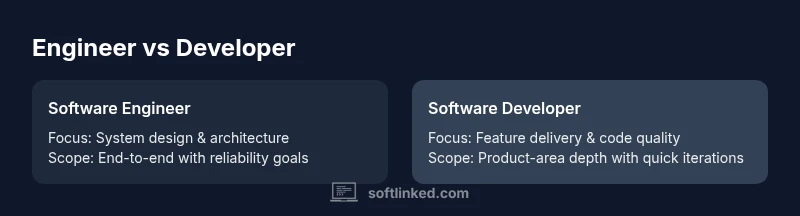
A software engineer generally emphasizes designing and maintaining end-to-end systems, including architecture, scalability, and reliability. A software developer often focuses on implementing features, writing clean code, and iterating quickly within a given product area. In practice, many teams blend these boundaries, leading to blended titles and shared responsibilities. Key competencies include problem decomposition, debugging, testing, and collaborating with product managers and designers. The distinction is partly about scope (systems-level work vs. feature-level work) and partly about emphasis (long-term architecture vs. short-term delivery). For newcomers, the distinction may feel subtle; for seasoned engineers, it defines how you approach trade-offs, documentation, and mentorship.
Scope, impact, and career implications
The scope of a software engineer typically extends to architectural decisions, system integration, and long-term scalability, which can yield wide-ranging impact on product reliability and team velocity. A software developer often drives tangible feature delivery, bug fixing, and code quality within a defined module or product area. Career implications arise from how organizations design tracks: engineers may advance along architecture or engineering-management ladders, while developers may move toward lead developer or tech-lead roles within product teams. The practical takeaway is that impact—measured by outcomes like system stability, performance, and timely delivery—matters more than the label itself. In practice, SoftLinked analyses show that job postings and performance reviews frequently reference responsibilities rather than title alone, so aligning your work with measurable results is crucial for progression.
Education, pathways, and titles across organizations
Education paths for either title commonly include a computer science or software engineering degree, with additional certifications or on-the-job learning shaping advancement. Many organizations grant equivalent seniority to engineers and developers when responsibilities and impact align, while others reserve distinct ladders (e.g., engineer vs developer clearly separated). Pathways often depend on company size and product domain: startups may favor flexible, blended titles, whereas large enterprises may enforce stricter separation with formal tracks. Practically, candidates should map the responsibilities of each role to their own goals, rather than assuming one path guarantees faster growth.
Compensation and career progression considerations
Compensation for software engineers and software developers varies widely by region, company size, and seniority. In many markets, salary bands for senior engineers and senior developers converge when the expected impact and leadership responsibilities align, though regional differences remain significant. Beyond base pay, total compensation—bonuses, stock options, and progression timelines—often reflect leadership expectations, project scope, and mentorship duties. SoftLinked’s perspective emphasizes that title alone rarely determines earnings; demonstrable impact, ownership of critical systems, and the ability to guide others frequently drive higher compensation bands across both roles.
Practical advice for choosing your title and positioning
If you’re deciding between pursuing an engineer or developer title, begin with a practical inventory of tasks you enjoy and excel at. Ask hiring teams to describe the day-to-day responsibilities, the expected scope, and how success is measured. Draft your resume to foreground systemic thinking, design decisions, and measurable outcomes rather than generic skill lists. During performance reviews, clarify expectations for ownership, cross-functional collaboration, and long-term impact. The key is alignment: the title should reflect the actual work you perform and the value you deliver, not just a label you like.
Common misconceptions and pitfalls
A common pitfall is assuming that an engineer title is inherently more prestigious or technical than a developer title. In practice, both can carry equal technical depth and leadership potential when approached with the right scope. Another misconception is that a title lock-in will forever define your career; many teams reorganize roles around needs rather than labels, enabling lateral moves or title changes that better reflect current work. Finally, overemphasizing the title can obscure day-to-day impact; focus on outcomes, collaboration quality, and the problems you solve, which are the real currency for growth.
When the title matters most in hiring and advancement
In job searches, title can affect initial impressions, recruiter attention, and interview structure, especially when companies use multi-track hiring. Conversely, in internal promotions, the job’s scope, leadership opportunities, and the ability to influence architecture often determine advancement more than the exact label. Therefore, it’s wise to negotiate based on responsibilities, ownership, and impact, and to ensure your career plan includes a clear path to higher-responsibility work—whether that path is labeled engineer, developer, or something else.
Tools, frameworks, and industry context
Modern software teams increasingly rely on modular architectures, DevOps practices, and continuous delivery pipelines. Understanding frameworks like SOLID principles, domain-driven design, and microservices can illuminate why one title may emphasize architectural thinking while another emphasizes rapid delivery. Industry context further shapes expectations: some sectors value robust systems thinking and reliability, while others prioritize rapid feature iteration. Adopting a learning plan that strengthens both design skills and delivery capabilities will prepare you for either title and for transitions between them as your career evolves.
Putting it into practice: a decision framework
- List responsibilities you want to own in the next 2–3 years. 2) Compare how different teams define success for engineers and developers in those roles. 3) Assess your current strengths in system design, debugging, collaboration, and leadership. 4) Seek roles where the responsibilities align with your growth goals; ask for a written responsibility matrix if needed. 5) Track your impact over time and adjust your title expectations as necessary. This structured approach helps you choose a path that aligns with your values and the team’s needs, rather than chasing a label alone.
Comparison
| Feature | Software Engineer | Software Developer |
|---|---|---|
| Primary focus | Systems design, architecture, scalability | Feature implementation and code quality |
| Work depth vs breadth | Broader scope across subsystems; end-to-end ownership | Deeper specialization in a product area or tech stack |
| Cross-functional collaboration | Architecture decisions with PMs and architects; impact on product strategy | Collaboration focused on implementing requirements with QA/UX |
| Career trajectory emphasis | Engineering/architect tracks; potential progression to principal/CTO paths | Tech-lead tracks; strong code craftsmanship and delivery leadership |
| Hiring and market usage | Widely used; branding varies by company | Common in product-driven orgs; may be used interchangeably |
| Salary and compensation context | Similar bands at senior levels; varies by region and company size | Similar bands; localization affects offers |
Pros
- Clarifies role expectations for hiring and performance reviews
- Helps teams align on scope and ownership
- Supports targeted learning paths and mentorship
- Can improve recruitment messaging when defined clearly
Weaknesses
- Titles vary by company, causing confusion for candidates and recruiters
- Overemphasis on a title can obscure actual skills or impact
- Interchangeability can lead to mismatched expectations during promotions
Neither title is universally better; success depends on role clarity and organizational needs.
The SoftLinked team recommends focusing on role expectations and measurable impact rather than chasing a single label. The decision should hinge on what the role delivers in practice, not which term a company uses.
Your Questions Answered
Is one title universally better for promotions?
No universal rule exists. Promotion criteria depend on organizational policy and demonstrated impact. Both tracks can lead to advancement when responsibilities and outcomes are clear.
Not universal; focus on impact and outcomes.
Do software engineers usually perform system design?
Engineers often engage in system design and architectural decisions, but the extent varies by team and company. Some roles emphasize hands-on delivery, others emphasize design across subsystems.
Yes, often, but it varies by team.
Can a software developer become an engineer later?
Yes. Transitions happen as professionals expand system-level thinking, architecture skills, and cross-team influence. Focus on expanding responsibilities and visible impact.
Absolutely.
How should I present my title on a resume?
Be honest about responsibilities and outcomes. Emphasize scope, ownership, and impact rather than relying solely on the label. Tailor each resume to the role you want.
Be clear about scope and impact.
Does the title affect salary?
Titles influence perception and negotiation, but actual compensation is driven by seniority, region, company size, and demonstrated impact. Use specifics of your accomplishments.
Titles matter a bit; impact matters more.
Should I switch titles when changing jobs?
If the new role aligns with your goals and responsibilities, a title change can help communicate your new scope. Otherwise, focus on the work and outcomes you’ll deliver.
Consider the role and scope, not just the label.
Top Takeaways
- Define responsibilities before selecting a title
- Ask about scope and impact during interviews
- Align learning and promotion plans to concrete outcomes
- Be aware that titles vary by organization
- Document expectations to reduce misalignment