Software vs Web Developer: A Clear Career Comparison
A rigorous side-by-side look at software developer vs web developer roles, outlining skills, learning paths, career trajectories, and decision criteria for aspiring software engineers choosing their path.


TL;DR: A software developer role offers broader language breadth, system design, and cross‑domain work, while a web developer role emphasizes building scalable web applications with front‑end and back‑end web tech. If you want versatility and long‑term growth across domains, choose software developer; if you prefer rapid product delivery and a focused web stack, choose web developer.
Defining the Roles: software developer vs web developer
The term software or web developer covers two closely related yet distinct career tracks in modern tech. At a high level, a software developer designs, builds, and maintains software systems that can run on diverse environments, from servers to embedded devices. A web developer concentrates on creating and optimizing web applications, focusing on browser-based experiences and networked services. According to SoftLinked, the software developer path often emphasizes cross-language fluency, architecture thinking, and building reusable components that scale beyond a single project. In contrast, the web developer path emphasizes web standards, responsive design, and performance optimization in the context of a user-facing product. For someone just starting out, the distinction matters because it sets expectations for the types of projects you will tackle, the tools you will learn, and the pace of delivery you will experience. The keyword software or web developer is not a binary choice but a spectrum of roles where your interests in systems thinking or front‑end craft guide the path you pursue.
Core Skill Sets: languages, frameworks, and tools
A software developer typically builds software across various domains and platforms. Core skills include:
- Proficiency in at least one high‑level programming language (e.g., Python, Java, or C++) and familiarity with data structures, algorithms, and software design patterns.
- Understanding of system architecture, APIs, databases, and testing strategies.
- Experience with version control, debugging, and performance profiling.
- Comfort with multiple domains, such as desktop, server, mobile, or embedded environments.
A web developer concentrates on delivering usable, reliable web experiences. Core skills include:
- Proficiency in HTML, CSS, and JavaScript and familiarity with TypeScript.
- Experience with front‑end frameworks (React, Vue, Angular) and back‑end frameworks or environments (Node.js, Django, Rails) for full‑stack work.
- Knowledge of web performance, accessibility, SEO basics, and security considerations.
- Familiarity with RESTful APIs, GraphQL, and modern tooling (bundlers, CI/CD, testing).
From a learning perspective, both tracks share fundamentals in problem‑solving, testing, and collaboration, yet the emphasis on domains and tooling differs.
Education and Learning Pathways
Both software developers and web developers typically begin with formal or informal education, followed by self‑directed practice and portfolio building. A traditional computer science or software engineering degree provides deep theoretical grounding and exposure to data structures, operating systems, and software architecture, which benefits software developers pursuing cross‑domain work. For web developers, practical projects and a solid understanding of the modern web stack can be gained through bootcamps, online courses, and self‑driven projects without a four‑year degree. Regardless of route, a portfolio that demonstrates problem solving, clean code, and real‑world projects is crucial. SoftLinked’s guidance emphasizes starting with small, fully functional projects and gradually expanding to larger systems, which helps both tracks showcase their proficiency to potential employers.
Career Trajectories and Growth
Software developers often follow a breadth‑to‑depth path: you start with core programming, then branch into areas such as architecture, systems design, or platform engineering. Over time, opportunities include senior software engineer, staff engineer, and eventually roles like solutions architect or engineering manager. Web developers typically progress through front‑end to full‑stack specialization, then move toward senior front‑end or back‑end roles, tech lead positions, or product‑oriented management tracks. The transition between tracks is feasible, especially if you expand your skill set to cover cross‑cutting concerns like APIs, databases, and cloud services. Individuals who enjoy abstract problem solving and designing scalable systems may gravitate toward software development, while those who prize product delivery and user experience often find a rewarding path in web development.
Hiring Landscape and Market Demand
The hiring landscape for software developers remains broad across industries, with demand in finance, healthcare, manufacturing, and tech startups. Web developers are consistently sought after in digital product teams, e‑commerce, and services that require compelling user interfaces and responsive experiences. Remote work and distributed teams are common in both tracks, though regional differences in demand and compensation can shape opportunities. Career longevity tends to favor software development for long‑term mobility into architecture and leadership roles, whereas web development can offer faster entry into production environments and rapid iteration cycles. SoftLinked analyses show that market needs evolve with technology stacks, but fundamentals like clean code, problem solving, and collaboration remain essential for both paths.
Compensation and Work-Life Realities
Compensation for software developers and web developers varies by region, company size, and industry. Software developers often command broader value due to cross‑domain impact and system design responsibilities, while web developers can leverage specialized, high‑demand web stacks for competitive packages. Both tracks commonly offer flexible work arrangements, with options for remote or hybrid setups. Work‑life balance depends on project cycles, production demands, and company culture; startups may demand longer hours during critical phases, whereas established teams may offer steadier rhythms. The key is to align compensation expectations with your skill level, portfolio strength, and the specific impact you want to deliver in your role.
Learning Curve and Time to Proficiency
The learning curve reflects the breadth or depth of the chosen path. Software developers generally face a broader, potentially longer ramp due to multiple domains, languages, and architectural concepts. Web developers may achieve functional proficiency more quickly by focusing on core web technologies, but deep specialization—such as performance optimization, accessibility, or large‑scale front‑end systems—still requires sustained effort. Regardless of path, a disciplined practice routine, code reviews, and real‑world projects accelerate proficiency. The process benefits from steady, incremental goals and regular feedback from peers and mentors.
Tooling, Ecosystems, and Community Support
Both tracks rely on mature ecosystems and active communities. Software developers interact with compiler toolchains, IDEs, testing frameworks, and deployment pipelines, while web developers leverage browser tooling, front‑end ecosystems, and cloud services. Community resources like open‑source projects, online forums, and local meetups can accelerate learning and career progression. Staying current means following evolving standards, performance best practices, and security considerations in both domains. A strong personal portfolio and contribution history—whether through open source or side projects—often opens doors to advanced roles.
Choosing a Path: Best for Different Scenarios
If you enjoy broad problem solving, architecture thinking, and working across platforms, software development offers greater long‑term mobility and cross‑industry applicability. If you favor tangible product delivery, dazzling user interfaces, and quick feedback cycles, web development delivers fast wins and specialized expertise in the web stack. Consider your preferred pace, your interest in user experience versus backend systems, and the kinds of problems that inspire you. In some cases, a hybrid path that blends full‑stack web development with system design exposure can provide the best of both worlds.
How to Get Started: Practical Steps for Both Tracks
- Define your goal with software or web developer in mind, and map a rough 12‑ to 24‑month plan. 2) Build a foundational portfolio: at least two full projects that demonstrate core competencies. 3) Learn the essential languages and tools for your chosen path, then expand to complementary skills (APIs, databases, cloud services, testing). 4) Engage with communities, contribute to open source, and seek feedback from peers. 5) Pursue internships, co‑ops, or entry‑level roles to gain real‑world experience and progressively tackle more complex problems. 6) Regularly reassess your path and be open to cross‑training if your interests shift over time.
Comparison
| Feature | Software Developer | Web Developer |
|---|---|---|
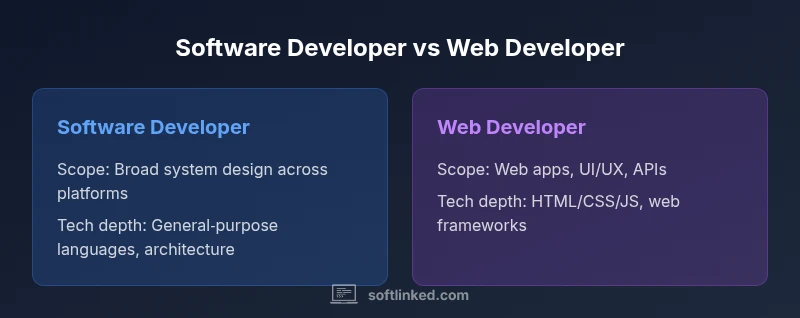
| Scope of work | Broad system design across platforms | Focused web app development, UI/UX, and web services |
| Key tech stack | General‑purpose languages, architecture, algorithms | HTML/CSS/JavaScript (TypeScript), front‑end frameworks, back‑end tooling |
| Learning curve | Breadth across domains → longer ramp | Faster entry into projects with a steep specialization later |
| Career progression | Architect, senior engineer, engineering leader | Senior front‑end/back‑end specialist, tech lead, product‑oriented roles |
| Career flexibility | High across industries and devices | Strong within digital product teams and startups |
| Remote/work setup | Common in many sectors, cross‑team collaboration | Common in product‑driven companies, strong portfolio impact |
| Typical hire path | Exposure to multiple domains in early roles | Portfolio‑driven; impact on user experience and delivery |
Pros
- Broader career flexibility across industries and platforms
- Stronger emphasis on software architecture and design
- Greater long‑term mobility into senior technical roles
- Foundational skills transferable to many domains
Weaknesses
- Breadth can mean a longer initial learning curve
- Less immediate product‑level focus than some web roles
- Salary and opportunities vary widely by region and company
- Requires continual learning to stay current across stacks
Software developer generally offers broader opportunities; web developer offers faster product delivery.
Choose software development if you want long‑term versatility and architectural influence. Pick web development if you value rapid delivery and a focused, user‑facing stack. The SoftLinked team notes that your best path aligns with your interests and long‑term goals.
Your Questions Answered
What is the fundamental difference between software and web developers?
The software developer role focuses on building software systems across platforms, emphasizing architecture and language breadth, while a web developer concentrates on delivering web applications with front‑end and back‑end web tech, user experience, and performance.
Software developers design systems across platforms; web developers build web apps with UI and APIs.
Which path is better for beginners?
Neither path is inherently better; it depends on your interests. Web development offers quicker entry through a focused stack, while software development builds a broad foundation that applies across many domains.
If you want quick wins, start with web development; if you want breadth, start with software development.
What skills do both roles share?
Both roles rely on problem solving, clean coding practices, version control, testing discipline, and collaboration in teams. A strong foundation makes it easier to learn additional domain skills later.
Both paths share core programming discipline and teamwork.
How important is formal education for these roles?
Formal education helps build foundational theory, but many professionals succeed with self‑study, bootcamps, and hands‑on projects. Practical portfolio work often weighs more than formal credentials.
It’s not a strict requirement; practical projects matter most.
Can you switch from software to web development later?
Yes. With time, you can expand your skill set to cover web technologies alongside core programming concepts. A structured learning plan and small projects can ease the transition.
Switching paths is possible with deliberate learning and project work.
What should I consider when choosing between these tracks?
Consider your interests in architecture versus user experience, your desired pace, industry demand in your region, and long‑term career goals. A hybrid path can also provide the best of both worlds.
Think about your interests and long‑term goals when choosing.
Top Takeaways
- Define your goal as software or web developer early
- Build a demonstrable portfolio for credibility
- Expect a learning curve that matches breadth or depth
- Prioritize portfolio projects over theory alone
- Seek cross‑training to expand future opportunities