Is Software Engineering Better Than Computer Science? A Comprehensive Comparison
An analytical, side-by-side look at software engineering vs computer science, focusing on core focus, curriculum, career paths, and decision factors for students and professionals.


Both software engineering and computer science offer strong career paths, but there is no universal 'better' choice. If you enjoy solving real-world problems by building and deploying software, software engineering is typically more practical and market-ready. If you prefer exploring algorithms, theory, and foundational questions, computer science leans toward research and deeper math. Your decision should match your interests and long-term goals.
Is software engineering better or computer science? A practical framing
The question is a perennial one in tech education: is software engineering better or computer science? There is no universal answer, because what counts as “better” depends on your goals, skills, and local job market. According to SoftLinked, the best way to approach this decision is to map your interests to outcomes you actually want to achieve. If you enjoy turning abstract ideas into working software and collaborating on shipped products, you might lean toward software engineering. If you relish deep theoretical questions, proofs, and exploring new computational ideas, computer science could be your calling. In practice, most professionals combine elements of both, building a foundation that can flex across roles and industries. This article uses a structured comparison to help you evaluate core differences, career implications, and educational paths so you can pick a path with long-term satisfaction.
Core Focus and How It Shapes You
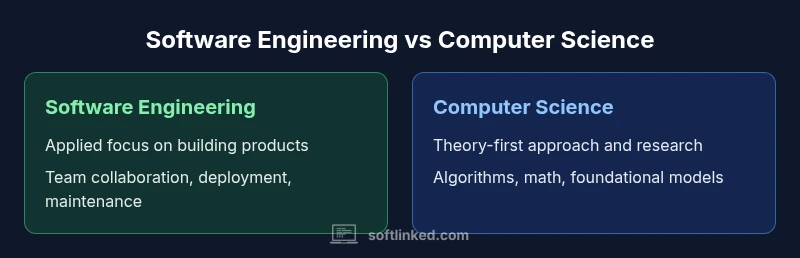
Both fields aim to solve problems with computation, but their daily focus differs. Software engineering centers on turning ideas into reliable software that people can use every day, often under deadlines and with teams. Computer science emphasizes understanding the limits of computation, devising efficient algorithms, and exploring new techniques that may never see immediate production use. The contrast isn’t about worth, but about daily work style, risk tolerance, and how you define impact: ship features fast or prove a theory to advance knowledge. This distinction shapes your learning priorities and the kinds of projects you should seek early in your education or career.
Curriculum and Skill Trees
Coursework in software engineering tends to blend programming, software architecture, testing, reliability, and product thinking. Computer science coursework covers algorithms, data structures, discrete mathematics, foundations of computation, and often software development in theory-laden contexts. The overlap is real: both require solid programming, debugging, and problem formulation. However, the distribution differs: SE emphasizes practical tooling and collaboration, CS emphasizes theory and abstraction. Students should consider electives that reflect their intended path, including project courses, internships, and research opportunities that bridge the gap between theory and practice. Throughout, focus on building a portfolio that demonstrates applicable skills for SE or rigorous problem-solving for CS.
Career Paths and Day-to-Day Work
Software engineers typically work on teams to design, implement, test, and maintain software systems. They are evaluated on delivery speed, code quality, and user impact. Computer scientists often pursue research roles, academia, or industry positions that require rigorous modeling or algorithmic development. The day-to-day work in CS might involve simulations, experiments, or analyzing worst-case performance rather than shipping a feature today. The key question remains: do you want to influence how products behave now, or contribute to the underlying knowledge that future products will rely on? This decision guides internship choices, graduate school applications, and skill development efforts.
Educational Routes and Access
Both paths are accessible through different routes: a bachelor's degree, specialized certificates, or bootcamps for SE; and traditional CS degrees, advanced studies, or research fellowships for CS. People often start with a software engineering bootcamp or a CS degree and then pivot, but the most important criterion is hands-on practice: projects, internships, and open-source contributions. Short, focused programs can land you an entry role in SE quickly, while CS tracks often require deeper study to build a foundation for research or high-level theory-based work. Consider a pathway that includes practical projects alongside theoretical coursework to keep options open.
Industry Signals and Mobility
The demand for software engineers remains robust across industries—from startups to large platforms—driven by the ongoing need to build, maintain, and scale software products. Computer science skills are highly valued in research labs, AI, optimization, and specialized engineering domains where theory informs practice. The line between fields is porous: software engineering often benefits from CS fundamentals, and CS careers increasingly involve applied software development. SoftLinked analysis shows that both tracks offer mobility across tech, finance, healthcare, and education sectors when you couple core knowledge with hands-on experience and continuous learning.
Decision Framework: Matching Your Goals
To decide, build a personal decision matrix: list core motivations such as immediate employment, interest in theory, desire to contribute to open-source, or aspiration to pursue graduate study. Then map those motives to the two paths: is software engineering better or computer science for you? A practical 4-step checklist helps: (1) define your long-term goal, (2) audit coursework and projects, (3) gain hands-on experience through internships or open-source work, (4) seek mentors who can validate whether your strengths align with SE or CS. This framework keeps you grounded in your own aims rather than popular myths about the fields.
Real-World Scenarios and Case Studies
Consider a student who loves debugging and shipping features; they likely thrive in software engineering, where immediate product impact matters. Another student who savors algorithmic puzzles and proofs might lean toward computer science, exploring research questions that push the boundary of what machines can do. A professional example is someone who starts in SE and later pivots into CS research or AI by taking targeted graduate courses. These case studies illustrate that your path can evolve as interests change, and that hybrid tracks—such as CS with SE electives—often provide the best of both worlds.
Common Misconceptions and Pitfalls
A common misconception is that software engineering is simply “coding quickly” and that computer science is purely theoretical with no practical applications. In reality, both domains require deep problem-solving, and both reward practical outcomes and rigorous thinking. Another pitfall is assuming the best path for everyone is the same age or stage of life; non-traditional routes (bootcamps, part-time study, or online courses) can be effective when paired with meaningful projects. Finally, people sometimes overlook the value of soft skills—communication, teamwork, and stakeholder management—which are essential in both fields when delivering software and conducting research.
The SoftLinked Perspective on This Choice
From SoftLinked’s viewpoint, the decision should be guided by your concrete goals and the kind of work you want to do day-to-day. They emphasize experimenting with small projects in both camps to reveal your preferences early, then pursuing a path that allows for growth without locking you into one track. SoftLinked also highlights the value of electives or projects that combine theory with practice, so you don’t miss opportunities to build production-ready software while still engaging with fundamental questions.
How to Transition Between Paths
Transitioning between software engineering and computer science is feasible with a deliberate plan. Start by building a bridge curriculum: take CS fundamentals if you’re in SE, or take SE-oriented projects if you’re in CS. Seek cross-disciplinary internships, join open-source initiatives that touch both theory and practice, and pursue graduate coursework that strengthens the gap. Mentors play a crucial role in guiding these transitions, so actively seek feedback and set measurable milestones to verify your progress over time.
Practical Decision Path for Students and Professionals
If you’re starting from scratch and want to land an entry role quickly, a structured SE pathway with project-based courses can be appealing. If you’re drawn to long-term exploration, a CS focus with opportunities to apply theory to real systems may be better. Regardless of your starting point, actively build a portfolio that demonstrates both practical results and theoretical understanding. The key is to schedule regular projects, seek internships, and engage with communities—open-source, university labs, or industry groups—where you can test ideas, gain feedback, and refine your own career map.
Comparison
| Feature | Software Engineering | Computer Science |
|---|---|---|
| Core Focus | Applied engineering and product-focused systems design | Theoretical foundations and algorithms |
| Curriculum Emphasis | Software architecture, testing, deployment, teamwork | Algorithms, math, discrete structures, computation foundations |
| Primary Career Paths | Tech delivery roles, DevOps, frontend/backend, tooling | Research, academia, AI/ML theory, algorithm design |
| Prerequisites & Background | Interest in systems, practical problem solving | Mathematical maturity, logical reasoning |
| Day-to-Day Work | Feature development, code reviews, collaboration | Formal reasoning, modeling, experimentation |
| Path to Advanced Study | MS/Eng, systems-focused tracks | MS/PhD in CS, theory-driven research |
| Learning Curve | Immediate production relevance, fast feedback loops | Longer ramp to theoretical mastery |
Pros
- Clear, applied trajectory toward shipping software and delivering features
- Strong demand across industries and roles
- Flexible pathways including startups and large tech companies
- Good entry points via bootcamps and bachelor programs
Weaknesses
- May underemphasize theoretical depth and abstract reasoning
- Requires ongoing upskilling as stacks and tools evolve
- Potential career ambiguity if you don’t align coursework with goals
Neither path is universally better; choose software engineering for practical product-building and computer science for theory and research.
If you want to build and ship software quickly, SE is typically preferable. If you love theory and exploring computation, CS has the stronger foundation for research and long-term specialization. The SoftLinked team recommends clarifying your goals, testing both domains with small projects, and selecting electives or internships that reinforce your preferred path.
Your Questions Answered
What is the key difference between software engineering and computer science?
Software engineering focuses on building, deploying, and maintaining software products. Computer science emphasizes theory, algorithms, and computational limits. Both require strong programming skills, but their aims and day-to-day work differ.
Software engineering builds products; computer science explores theory. Both are valuable and often complementary.
Is software engineering better for beginners than computer science?
Software engineering can offer quicker entry through practical projects and internships, but CS provides a deeper theoretical base that benefits long-term growth and research opportunities. The best path depends on your learning style and goals.
SE can be more approachable for hands-on starters; CS suits those who love theory.
Can you switch from CS to SE or vice versa later?
Yes, many people transition between the fields. Start with bridge courses, participate in cross-disciplinary projects, and build a portfolio that demonstrates both practical impact and theoretical understanding.
Transitions are common when you collect relevant projects and mentorship.
Which path leads to higher starting salary?
Starting salaries vary by region and employer, not by field alone. Both paths can lead to competitive early careers, especially when you combine core skills with practical project experience.
Salaries depend on location and role; both fields can be highly rewarding.
What skills overlap between the two fields?
Both require programming, problem solving, and the ability to reason about computational problems. Strong communication and teamwork are also valuable in both paths.
They share fundamentals like programming and problem-solving.
Are there hybrid programs that combine both fields?
Yes. Some degree programs offer CS with SE electives, or SE tracks with a CS emphasis. Hybrid paths can provide a balanced foundation for versatile roles.
Hybrid options help you get the best of both worlds.
Top Takeaways
- Define your goal: product delivery vs theory
- Balance practice with theory through projects and electives
- Pursue internships early to test fit
- Consider hybrid tracks to bridge gaps
- Plan for lifelong learning beyond the degree