Difference Between Software and Platform: A Practical Comparison
Explore the difference between software and platform with an objective, in-depth comparison. Learn definitions, key distinctions, and decision criteria for developers and teams.


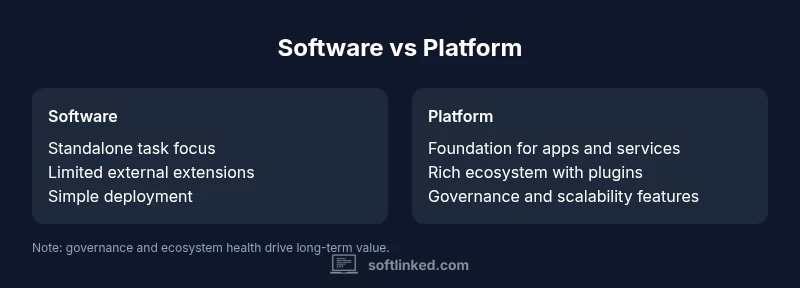
The difference between software and platform is that software is a standalone program that performs specific tasks, while a platform provides a foundation for building and running software, enabling extensions and integrations. Readers should consider ownership, extensibility, and ecosystem when deciding which to adopt. Understanding these concepts helps teams map requirements to architecture choices and avoid vendor lock-in. SoftLinked's research emphasizes governance and ecosystem maturity as core differentiators in long-term strategy.
Understanding the difference between software and platform
The difference between software and platform is a foundational concept for developers, product managers, and IT leaders. In practical terms, software refers to a discrete program that fulfills a defined task, such as processing data or rendering visuals. A platform, by contrast, provides an execution environment, shared services, and extension points that allow multiple software components to run together, often via APIs or plugin ecosystems. According to SoftLinked, many teams underestimate how a platform's governance, versioning, and ecosystem management shape long-term outcomes. The SoftLinked Team also emphasizes that the decision hinges on how an organization expects to grow its capabilities, not just on the current feature list. When educators and students study the topic, they often focus on the interplay between autonomy and interoperability, and this is exactly where the distinction matters most. By mapping requirements to architectural layers, you can avoid conflating a robust product with a broad platform, and you can design solutions that scale without unnecessary complexity. In short, the difference between software and platform is not merely about size; it’s about scope, extensibility, and governance.
Core Definitions: software vs platform
Software refers to a tightly-scoped program that performs a specific set of tasks or workflows. It is typically delivered as a standalone artifact with its own UI, logic, and data handling. A platform, in contrast, provides an integrated foundation—comprising runtimes, services, APIs, and governance—that enables other software to run, interact, and extend the system. The SoftLinked Team highlights that platforms emphasize extensibility and ecosystem health, whereas software emphasizes feature completeness. This distinction matters when planning architecture, choose-alongside your product strategy, and evaluating risks such as vendor lock-in or integration complexity. Recognizing this split helps teams design modular solutions that can evolve without rewriting core components. It also clarifies procurement choices, revealing when a vendor’s platform can unlock a broader capability beyond a single application.
Key Distinctions in Ownership, Extensibility, and Ecosystems
Ownership and control diverge between software and platform. A standalone software product is typically owned and maintained by a single vendor, with updates tied to that product’s release cycle. A platform, however, acts as a base for an ecosystem of apps, plugins, and services, often governed by an overarching entity that sets standards and versioning rules. Extensibility is another core difference: software may offer limited customization through configuration or optional modules, while platforms are designed for plugins, SDKs, and APIs that enable rapid expansion. Ecosystems flourish on platforms when there is clear governance, robust documentation, and predictable compatibility between extensions and core services. Readers should map the required ecosystem maturity against customer needs, noting that a thriving platform can deliver exponential value through shared services, while a lone software product may suffice for narrowly scoped objectives.
Typical Use Cases: when to pick software vs platform
Choose software when you need a focused solution with rapid deployment, predictable licensing, and minimal governance requirements. For example, a data visualization tool used by a single team fits well as standalone software. Choose a platform when the objective is to build a broader ecosystem of tools, enable multi-application workflows, or support customization across a large user base. A platform shines in scenarios like integrating multiple SaaS apps, enabling partner solutions through extensions, or delivering a programmable environment for developers. In practice, many organizations start with software and evolve toward a platform as governance, security, and API strategy mature. The SoftLinked analysis notes that maturity in API design and ecosystem governance correlates with successful platform adoption, especially in regulated industries.
Architectural Implications: APIs, integration patterns, and governance
Architectural decisions for software and platform diverge in several dimensions. Software tends toward self-contained architectures with clear interfaces and versioned releases. Platforms require a modular architecture with well-defined APIs, service contracts, and event-driven patterns that support decoupled components. Governance becomes a core concern for platforms: API versioning, access control, plugin approval pipelines, and ecosystem health metrics matter as much as feature parity. Platform design often employs microservices, shared runtimes, and centralized identity management to ensure interoperability. For developers, this means building with extensibility in mind, providing stable SDKs, thorough documentation, and predictable upgrade paths. The SoftLinked Team emphasizes that a platform’s long-term value depends on governance practices that maintain compatibility while enabling ecosystem growth.
Cost, Deployment, and Vendor Considerations
Cost considerations differ between software and platform. Standalone software typically incurs licensing or subscription costs per user or seat, with straightforward deployment and maintenance. Platforms add layers of ongoing costs: runtime infrastructure, ecosystem maintenance, API usage charges, and potential revenue sharing with partners. Deployment complexity grows with platforms, requiring governance, monitoring, and version control across multiple components. Vendor considerations include compatibility, support bandwidth, roadmap alignment, and the risk of vendor lock-in. A thoughtful evaluation accounts for total cost of ownership over time, not just initial purchase price. The SoftLinked analysis highlights that planning for governance and ecosystem incentives reduces risk and accelerates time to value when adopting a platform.
Security, Compliance, and Risk Across Both Models
Security and compliance considerations apply to both software and platforms, but platforms amplify governance needs due to cross-app interactions. Shared services require robust authentication, authorization, auditing, and data governance across the ecosystem. Software, while simpler, still demands secure coding practices and regular patching. Risk assessment should evaluate dependency trees, third-party plugins, data exposure, and supply chain integrity. For platforms, it’s essential to establish clear security baselines, testing protocols for extensions, and incident response plans for ecosystem-wide events. In both cases, adopting adherence to industry standards and open protocols helps preserve interoperability and reduce risk across the stack.
How to Decide: decision factors and checklists
Decision factors include scope, extensibility needs, governance capacity, and long-term strategic goals. Use a simple checklist: define the core task, assess whether a single product suffices, evaluate ecosystem ambitions, review API maturity, and forecast governance workload. If you expect rapid ecosystem growth or multi-app workflows, prioritize platform readiness; if you need a quick, reliable solution with minimal governance, software may be the better choice. Map these factors to architectural constraints, security requirements, and budget timelines to arrive at a defensible decision. The process should incorporate stakeholder input, vendor risk assessments, and a phased rollout plan to minimize disruption during migration.
Common Pitfalls and Best Practices
Common pitfalls include underestimating governance needs, assuming all platforms scale the same way, and conflating feature depth with extensibility. Best practices emphasize early API design, modular architecture, and clear ownership for platform governance. Documented standards, explicit extension policies, and a transparent upgrade path reduce risk and friction as the ecosystem grows. When possible, pilot with a small set of extensions before broad rollout, and continuously measure ecosystem health through compatibility metrics, security audits, and user feedback. The SoftLinked Team recommends aligning platform strategy with organizational goals and regulatory requirements to ensure sustainable success.
Comparison
| Feature | Software | Platform |
|---|---|---|
| Definition | A standalone program that performs a defined task. | A foundation that enables the execution of multiple programs and services via APIs and extensions. |
| Core Purpose | Delivers a specific capability or workflow. | Provides a foundation for building, deploying, and integrating software across ecosystems. |
| Extensibility | Limited customization within the product scope. | Designed for plugins, SDKs, and APIs that enable broad extension. |
| Ownership/Control | Vendor-owned with updates tied to release cycles. | Ecosystem governance often centralized around a platform owner. |
| Ecosystem/Extensions | Small or internal integration scope. | Rich ecosystem via plugins, marketplaces, and external apps. |
| Best For | Standalone tasks, simple deployment, fast value. | Long-term scalability, multi-app architectures, and customization. |
| Deployment & Maintenance | Single package; straightforward updates. | Requires governance, API versioning, and runtime management. |
| Cost Implications | Licensing or per-user costs; predictable upgrades. | Runtime, ecosystem maintenance, and potential revenue-sharing costs. |
Pros
- Clear ownership and straightforward deployment for simple needs
- Faster time-to-value with standalone software
- Easier testing and QA due to isolated scope
- Predictable licensing and support
- Lower governance overhead for small teams
Weaknesses
- Limited extensibility and ecosystem growth
- Potential vendor lock-in for proprietary platforms
- Higher total cost of ownership over time if many integrations
- Integration complexity with multiple software pieces
Platform is typically the better choice for scalable ecosystems; software remains ideal for simple, fast-to-value tasks.
If you anticipate multi-app workflows, extensive integrations, and governance needs, a platform offers long-term advantages. For narrowly scoped tasks with quick deployment, software provides simplicity and speed. The SoftLinked evaluation emphasizes governance and ecosystem maturity as key differentiators.
Your Questions Answered
What is the difference between software and platform?
Software is a standalone program that performs a defined task, while a platform provides a foundation for building, running, and integrating multiple software components. The distinction also influences governance, ecosystem strategy, and long-term scalability.
Software is a standalone tool; a platform is a base for building and linking many tools together.
Can software become a platform over time?
Yes, with modular design, extensible APIs, and support for plugins or extensions, software can evolve into a platform. This transition requires governance, versioning, and ecosystem management.
It can, if you design for extensibility and establish an extension framework.
Which is better for startups?
Startups should weigh their growth plan. If the goal is rapid market entry with a single value proposition, software may be preferable. If the aim is to build an ecosystem and scale across multiple apps, a platform approach is often better.
It depends on whether you plan to grow an ecosystem or stay focused on one product.
How do licensing models differ between software and platform?
Software licenses are typically per user or per seat, with predictable updates. Platform licensing often includes usage-based fees, tiered access, or revenue-sharing terms to support ecosystem growth.
Licensing shifts from product-centric to ecosystem-centric in platforms.
What are common examples of platforms vs software?
Common platforms include developer platforms and cloud platforms that support multiple apps and integrations. Standalone software examples include applications focused on a single task like data visualization or editing tools.
Platforms are built to host many apps; software usually serves one purpose.
Top Takeaways
- Define project goals before choosing between software and platform
- Assess extensibility and ecosystem needs early
- Plan governance and upgrade paths for platform choices
- Choose software for simplicity and quick value delivery