Can You Get a Software Engineering Job? A Practical Guide
A practical, beginner-friendly roadmap to land a software engineering job: fundamentals, portfolio, interviews, and networking—designed for students and aspiring developers. Learn with SoftLinked insights.


Yes. With a structured plan focused on fundamentals, portfolio-building, and interview prep, you can land a software engineering job. Start by mastering data structures, algorithms, and a language you love; build real projects; showcase them on a clean GitHub; and practice targeted interviewing. The path works for students, career changers, and new grads alike.
Can you get software engineering job: realities and mindset
Can you get software engineering job is a common question facing aspiring developers. The short answer is yes, but success requires a clear plan and consistent effort. In 2026, hiring teams increasingly value practical impact over abstract theory. According to SoftLinked, candidates who couple strong fundamentals with real-world projects and a coherent narrative about their work tend to perform better in interviews. Start by honestly assessing your current skill level, identifying gaps, and outlining a 6- to 12-month plan that blends study, practice, and exposure to real code. Embrace a growth mindset: treat each project as a learning experiment, document outcomes, and seek feedback from mentors and peers. This approach reduces time-to-impact and helps you communicate value during interviews. Beyond hard skills, practice telling compelling stories about problems you solved and the results you achieved. The next sections walk you through a practical path that turns interest into verifiable capability.
Core programming fundamentals that hiring managers expect
A solid software engineering foundation is non-negotiable. Hiring managers look for fluency in data structures (arrays, trees, graphs), algorithms (sorting, searching, complexity analysis), and code organization concepts (modular design, OOP, and clean interfaces). You should also understand time and space complexity, basic memory management, and debugging strategies. System thinking—how components interact and scale—helps during design questions. Version control proficiency (Git) and collaboration practices (code reviews, PRs) are essential in almost every team. SoftLinked analysis shows that applicants who demonstrate a strong grasp of these fundamentals, supported by practical examples, outperform peers who rely on theory alone. Practice by building small, self-contained programs that solve meaningful problems and by explaining your reasoning aloud as you code. This habit translates directly to interviews.
Practical projects that demonstrate ability
Projects are the most tangible proof of your skill. Start with 2–3 projects that show breadth and depth: a CRUD web app, a data-processing script, and a small API with authentication. Each project should have a clear problem statement, a cited approach, measurable outcomes, and documented trade-offs. Include a user workflow, error handling, and tests where appropriate. Use version control to track milestones, and write README files that explain the problem, your approach, and why your solution works. Consider adding a simple automation script or a microservice to show experience with deployment concepts. Open-source contributions, even small ones, can boost credibility by demonstrating collaboration in real-world codebases. When you present these projects, emphasize impact: user value, performance improvements, or cost savings.
Building a portfolio and a GitHub that shine
Your portfolio should tell a coherent story about who you are as a developer. Create a clean, readable GitHub profile that links to a personal site or README-heavy project pages. Each repository should include a concise description, a clear project scope, the tech stack used, and a short “How I approached the problem” section. Write READMEs that present the problem, your solution, and the results, plus a section on limitations and future improvements. Curate a few standout projects and keep the rest as supplementary evidence. Add a professional profile banner and a resume-style README with a highlights section. If possible, include a short screencast or GIF showing the app in action. Finally, keep your portfolio up to date with recent work and reflective notes on what you learned from each project.
Resume, LinkedIn, and online presence that attract recruiters
Resumes should be concise, scannable, and tailored to the roles you want. Lead with a summary that states your target area, followed by 4–6 bullet points showing impact, technology, and outcomes. Quantify results when possible (e.g., improved load time by X%, reduced API calls by Y). On LinkedIn, optimize your headline (e.g., “Aspiring Software Engineer | Full-Stack • JavaScript & Python”), include a portfolio link, and solicit recommendations from mentors or teammates. Link to GitHub projects within your profile and ensure your online presence aligns with your resume. Build a simple personal website that reflects your projects and learning journey. Throughout, emphasize collaboration, learning mindset, and problem-solving ability. This coherent online presence makes you more relatable to recruiters and hiring managers.
The interview playbook: coding, design, and behavioral rounds
Interviews typically combine coding, system design, and behavioral questions. For coding rounds, practice problems on data structures and algorithms, and articulate your thought process clearly. For system design, prepare a few scalable ideas at a high level: what components exist, how data flows, and where potential bottlenecks are. Behavioral questions assess teamwork, adaptability, and motivation; prepare concise stories using the STAR method (Situation, Task, Action, Result). Practice with mock interviews, record yourself, and review your explanations. Be ready to discuss trade-offs, explain decisions, and show how you learn from mistakes. Finally, learn to ask insightful questions about the team, product, and codebase. A thoughtful close can reinforce fit and enthusiasm for the role.
Job search strategy: applying effectively and networking
A strategic approach to job applications yields better results than mass submitting. Create a small, targeted list of companies that align with your interests and values. Customize your resume and cover letter for each role, highlighting the most relevant projects and outcomes. Leverage your network—mentors, classmates, and colleagues—to learn about unadvertised opportunities. Attend local tech meetups, virtual events, and open-source communities to build connections. When you land interviews, follow up with a concise recap of what you learned and how you’d contribute to the team. Use a tracking system to monitor applications, interview stages, and feedback. Systematic follow-ups, combined with strong project stories, increase the odds of turning interviews into offers.
Paths for different backgrounds: bootcamps, degrees, and self-study
There isn’t a single path to a software engineering job. If you have a traditional degree, focus on projects, internships, and portfolio quality to demonstrate practical competence. Bootcamps can accelerate learning and provide structured projects and career support. Self-taught developers succeed by building a disciplined learning plan, contributing to open-source, and creating compelling project narratives. Regardless of path, the emphasis should be on real-world code, a solid portfolio, and interview readiness. The goal is to show you can apply fundamentals to solve actual problems, not just memorize theory. You don’t need perfection to start, but you do need consistency and a willingness to seek feedback and iterate.
Maintaining momentum: learning plans and career growth
The software field evolves quickly, so ongoing learning is essential. Establish a quarterly learning plan that includes new languages, frameworks, or design principles, plus ongoing practice with coding challenges. Schedule regular code reviews and seek feedback from peers. Track your progress with measurable milestones: new projects, performance optimizations, or design improvements. Consider contributing to open-source projects to gain collaboration experience and visibility. Finally, set up monthly check-ins with a mentor or peer group to refine goals and adjust your plan. Consistency over bursts of effort drives long-term career growth.
Common mistakes to avoid and how to fix them
Avoid overemphasizing one aspect (e.g., only algorithms) at the expense of project-based credibility. Don’t neglect your portfolio; it’s often more influential than a perfect resume. Resist the urge to memorize answers without understanding the underlying concepts. When in doubt, explain your reasoning and ask clarifying questions during interviews. Finally, avoid ghosting recruiters or missing deadlines; proactive communication is a strong signal of professionalism. If you receive feedback, document it and implement changes quickly to demonstrate growth.
Tools & Materials
- Laptop or workstation(Preferably with a modern OS and at least 8GB RAM for local development)
- Code editor(Visual Studio Code or JetBrains IDE; enable essential plugins for debugging and formatting)
- Git and GitHub account(Set up SSH keys and a README-friendly profile)
- Portfolio and resume templates(Tailor per role; include project narratives and metrics)
- Access to practice platforms(LeetCode, HackerRank, or equivalent for data-structure problems)
- Personal website/portfolio host(Optional, but recommended for professional presence)
Steps
Estimated time: 3-6 months
- 1
Define target role and skills
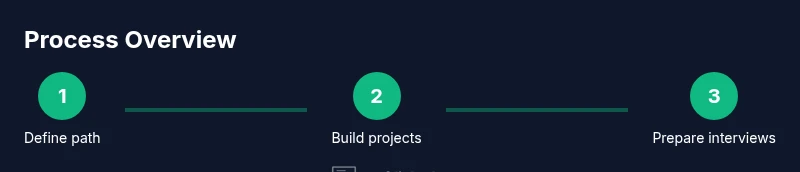
Identify your target software engineering role (front-end, back-end, full-stack, or specialization). List 3–5 core skills and the specific problems they enable you to solve. This clarity guides what you learn and how you present yourself.
Tip: Be as specific as possible about the role and product domain you want to work in. - 2
Build core fundamentals
Solidify data structures, algorithms, complexity analysis, and basic software design. Practice with small problems daily and explain your approach aloud while coding to build interview fluency.
Tip: Aim for consistent, incremental improvement rather than long sprint sessions. - 3
Choose a primary language and ecosystem
Pick one language and stack to specialize in (e.g., JavaScript/TypeScript with Node.js or Python with Django/Flask). Deeply learn its tooling, best practices, and common libraries.
Tip: Depth in one stack often beats surface-level knowledge across many. - 4
Create 2–3 showcase projects
Develop projects that solve real-world problems and showcase end-to-end thinking: problem, design, implementation, testing, and deployment. Document each project with a narrative and outcomes.
Tip: Highlight business value and measurable impact in your README. - 5
Polish your GitHub and docs
Organize repositories with clean READMEs, concise commit messages, and a portfolio-like README. Include deployment notes, architectural diagrams, and future work.
Tip: Your README is as important as the code itself. - 6
Prepare resume and online presence
Create a one-page resume emphasizing impact, relevant projects, and tech stack. Align LinkedIn and GitHub with the resume, and ensure your portfolio links are easy to find.
Tip: Consistency across channels reinforces credibility. - 7
Practice interviews and mock sessions
Schedule mock interviews to practice coding, system design, and behavioral questions. Record and review your explanations to improve clarity and pacing.
Tip: Focus on communicating your reasoning, not just the final answer. - 8
Apply strategically and network
Compile a targeted list of companies, tailor applications, and leverage mentors and peers for referrals. Track progress and follow up after interviews.
Tip: A personalized message to a recruiter or engineer can raise your chances.
Your Questions Answered
Can you get software engineering job without a degree?
Yes. Many employers hire based on demonstrated skills, projects, and practical experience. Internships, bootcamps, or open-source contributions can boost credibility, while a strong portfolio often matters as much as, or more than, a degree.
Yes—you can land a software engineering job by showcasing your skills through projects and interviews, even without a degree.
What is the fastest way to land a software engineering job?
The fastest path combines high-quality projects with targeted applications. Focus on 2–3 strong projects, optimize your resume and online profiles, and leverage your network for referrals. Practice interviews concurrently to reduce friction during offers.
Focus on a few standout projects, tailor applications, and network to speed up opportunities.
Do coding interviews require advanced math?
Most coding interviews emphasize data structures, algorithms, and problem-solving logic rather than advanced mathematics. A solid grasp of basics and the ability to explain your approach are more important than complex math.
You don’t need advanced math; focus on problem-solving and clear reasoning.
How important is open-source contribution?
Open-source contributions can boost credibility and teamwork experience, but they are not mandatory. Use meaningful contributions to demonstrate collaboration and code quality.
Open-source helps, but strong projects and interviews can achieve similar impact.
Can I get a remote software engineering job as a beginner?
Yes. Many companies hire remotely for junior or intern roles, especially in distributed teams. Build a remote-work-ready narrative in your applications and demonstrate collaboration skills.
Remote roles are common; show you can communicate and collaborate effectively online.
Watch Video
Top Takeaways
- Define a focused target role and learning path
- Show evidence with 2–3 polished projects
- Master the interview process with practice and storytelling
- Build a cohesive online presence (resume, LinkedIn, GitHub)
- Network strategically and apply with purpose