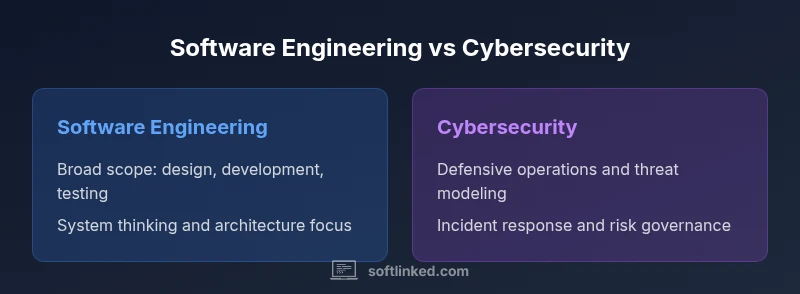
Is Software Engineering Harder Than Cyber Security? A Comparative Look
A clear, analytical side-by-side on whether software engineering is harder than cybersecurity, detailing scope, learning curves, daily work, and career implications for aspiring developers.


Is software engineering harder than cybersecurity? Generally yes, due to broader scope, longer learning curves, and the need to master systems design, debugging, and scalable architectures across many domains. Cybersecurity is intensely specialized, with sharp spikes during incidents, but its domain is narrower. The answer depends on interest, domain exposure, and career goals.
Defining Hardness: What makes software engineering vs cybersecurity hard
Is software engineering harder than cyber security? The honest answer is that hardness is often a function of scope, context, and personal interest. According to SoftLinked, the hardest part for many learners is mastering the breadth of software engineering: designing robust architectures, writing readable, maintainable code, and coordinating teams across systems. In contrast, cybersecurity concentrates depth in specific defense strategies, threat modeling, and incident response. Some days feel brutally intense in security when an alert hits production; other days feel calmer as you analyze logs and harden configurations. software engineering demands continuous learning across languages, frameworks, and evolving best practices, whereas cybersecurity requires staying current with attack techniques, compliance regimes, and risk management. The phrase is software engineering harder than cyber security is not universal—many professionals find cybersecurity harder during incidents or in highly regulated environments. The key is to understand where your strengths lie: abstract problem solving and system-level thinking versus pattern recognition and rapid decision making under pressure. In any case, building a strong foundation in computer science fundamentals pays dividends, and you can accelerate by hands-on practice, code reviews, and mentorship. The SoftLinked team emphasizes grounding in core concepts before chasing flashy tools.
Key Factors That Shape Difficulty
Difficulty in either field stems from multiple axes: breadth vs depth, pace of change, and the type of problem you enjoy solving. Software engineering typically requires you to design, implement, test, and maintain large systems, often across teams and platforms. Cybersecurity demands vigilance, threat modeling, and rapid decision-making under pressure. SoftLinked analysis shows that learners who value cross-domain thinking—bridging algorithms with security practices—tend to navigate both domains more smoothly. The daily rhythm matters: software engineers may face longer planning horizons and code reviews, while security professionals endure irregular incident-driven spikes. The cognitive load in software engineering is broad but steady, whereas cybersecurity spikes can be intense but are concentrated in specific events. The right path depends on your appetite for long-term design and cross-functional collaboration versus specialized, rapid-response work. Understanding your strengths helps you choose a path that minimizes burnout and maximizes learning gains over time.
Domain-Specific Challenges in Software Engineering
Software engineering challenges revolve around building scalable systems, maintaining code quality, and managing evolving tech stacks. Key pain points include choosing architectures that scale, balancing trade-offs between performance and maintainability, and coordinating distributed teams. Testing strategies, debugging at scale, and ensuring security-by-design across codebases add layers of complexity. Engineers must translate abstract requirements into concrete implementations, requiring strong modeling, abstraction, and communication skills. The discipline rewards a deep understanding of data structures, algorithms, and software design patterns, plus the ability to refactor legacy systems without breaking functionality. New developers often grapple with learning multiple languages, frameworks, and tooling ecosystems while também keeping pace with industry best practices. As you climb, responsibilities shift toward system design, mentorship, and architectural decision-making. This breadth makes software engineering inherently demanding for those aiming for senior technical leadership.
Domain-Specific Challenges in Cybersecurity
Cybersecurity centers on defense, detection, and response to threats. The core difficulties include understanding attacker techniques, modeling risk, and building resilient defenses. Security work demands acute attention to detail, the ability to reason about potential attack surfaces, and rapid decision-making during incidents. Professionals must stay current with evolving exploits, zero-days, and compliance requirements, which can feel relentless. Operational security involves configuring systems securely, conducting threat hunting, and implementing robust monitoring. The domain places a premium on investigative skills, forensics, and the ability to communicate risk to non-technical stakeholders. While cybersecurity can be highly specialized, there is substantial overlap with software engineering in areas like secure coding, automation, and threat modeling. For some, the intense focus on defense and incident management is the primary source of hardship; for others, the pace and breadth of software development feel more taxing. Both tracks reward curiosity and disciplined practice.
The Role of Tools, Languages, and Infrastructure
Across both fields, toolchains shape daily work. Software engineers juggle languages (e.g., Java, Python, Scala), databases, cloud platforms, and CI/CD pipelines. Mastery involves understanding how components fit within an ecosystem, writing clean interfaces, and measuring system health. In cybersecurity, tools emphasize monitoring, telemetry, vulnerability management, and defensive controls. Analysts wield SIEMs, EDRs, and threat intel feeds to detect and respond to incidents. A strong foundation in scripting, automation, and basic networking helps in both domains. The overlap—such as securing software during development, automating repetitive tasks, and writing testable code—creates opportunities for collaboration across teams. Ultimately, success in either field requires practical, hands-on practice with real systems and deliberate study of patterns rather than rote memorization.
Pace of Change, Learning Resources, and Mentorship
Technology changes rapidly in software engineering, with new frameworks and patterns emerging yearly. Keeping skills fresh requires deliberate practice, project experience, and mentorship. Cybersecurity evolves just as quickly, but with a focus on defense paradigms, regulatory changes, and evolving threat landscapes. Access to hands-on labs, capture-the-flag exercises, and secure coding programs accelerates learning in both paths. Mentorship matters: a guiding mentor helps you spot blind spots, choices in specialization, and opportunities for career progression. The most successful learners blend theory with practical projects, contribute to open-source communities, and seek feedback through code reviews or security assessments. Regardless of the path, the most effective learners cultivate a habit of continuous learning, reflection, and structured experimentation.
Real-World Scenarios: When Hardness Shifts by Context
In startup environments, software engineers might wear multiple hats—design, development, and deployment—amplifying the perceived difficulty due to breadth and speed. In regulated industries like healthcare or finance, cybersecurity can feel harder because of compliance burdens and audit requirements. Large enterprises present distinct challenges: software engineers contend with complex legacy systems and coordination across many teams, while security teams wrestle with governance, risk management, and policy enforcement. For professionals who enjoy problem framing and model-based thinking, the cognitive load can feel easier in software engineering, where the focus is often on building robust systems. Conversely, those who thrive under pressure and enjoy forensics or incident response may find cybersecurity more engaging but more arduous at times. The reality is that perceived hardness shifts with project scope, organizational culture, and available mentorship.
Cross-Domain Skills and Transferable Knowledge
Despite differences, many core software engineering competencies transfer to cybersecurity and vice versa. Strong programming fundamentals underpin secure coding, vulnerability analysis, and automated testing. Understanding data structures, algorithms, and software architecture helps in modeling threats and designing resilient systems. Communication skills, teamwork, and the ability to translate technical concepts into business terms are equally valuable in both tracks. Practically, learners should cultivate a baseline of computer science fundamentals, then selectively deepen in areas of interest—secure software development, threat modeling, or risk governance. Developing a learning plan that spans both domains can ease transitions and widen career options.
Career Pathways: Growth, Seniority, and Specialization
Software engineering offers a broad ladder—from junior developer to principal architect or engineering manager—emphasizing system design, scalability, and leadership. Cybersecurity presents paths in security operations, incident response, governance, and risk management, with leadership roles and policy influence. Both fields reward specialization: security research, secure-by-design, or cloud security for cybersecurity; performance engineering, distributed systems, and platform architecture for software engineering. Transition opportunities exist between domains: a software engineer can become a security-focused developer, while a security professional can move toward secure-architecture leadership. The best career growth depends on your interests, willingness to learn across domains, and the value you place on cross-functional collaboration versus deep specialization.
Practical Roadmaps for Learners: Getting Started
Begin with a solid foundation in computer science fundamentals—data structures, algorithms, and basic software design. Complement theory with hands-on projects, such as building a small web service and performing basic threat modeling on the application. Choose a primary track (engineering or security) and schedule structured learning blocks: a programming language, a standard framework, and a security concept set (threat modeling, secure coding, incident response). Seek mentorship, join study groups, and participate in code reviews or security-oriented labs. As you progress, diversify your portfolio with cross-domain projects: secure-by-design features, automated testing pipelines, or threat simulations. Measure progress with practical benchmarks, such as system design exercises or incident response drills, and reflect on lessons learned after each project. By the end of the first year, you should be able to articulate a thoughtful rationale for your chosen path and demonstrated hands-on capability in your area of focus.
Common Pitfalls and Myths
A common myth is that cybersecurity is inherently more glamorous or less demanding; reality shows both fields have intense moments and long learning curves. Another pitfall is underestimating the value of fundamentals: many engineers overemphasize new tools without mastering core concepts. Conversely, some security-focused learners focus so narrowly on one domain that they struggle to collaborate with development teams. A frequent mistake is neglecting documentation and governance in security work, which can erode long-term effectiveness. Finally, avoid assuming one path is guaranteed to be easier simply because it is narrower in scope; the right fit depends on your personality, interest in problem framing, and appetite for continuous learning across complex domains.
Making Your Decision: A Personal Fit Framework
Choose based on your interests and long‑term goals. If you love designing systems, building scalable products, and working across teams, software engineering may feel more rewarding despite its breadth. If you derive energy from defense, risk analysis, and rapid response under pressure, cybersecurity could be a better fit, even though it emphasizes depth in specific areas. Consider trying both domains through side projects or internships to gauge your engagement and resilience. Finally, remember that the strongest engineers often blend both skills—secure development practices, threat modeling during design, and collaboration across disciplines.
Comparison
| Feature | Software Engineering | Cybersecurity |
|---|---|---|
| Scope and breadth | Broad, cross-domain design and development | Narrower, defense-focused tasks |
| Learning curve | Longer, multi-domain foundations | Intense but narrower specialization |
| Workload cadence | Release-driven cycles, continuous delivery | Incident-driven spikes and audits |
| Career pathways | System design, leadership, architecture | Threat modeling, incident response, risk management |
| Entry barriers | Strong programming background, systems thinking | Foundational networking, security concepts |
Pros
- Broad applicability across industries and product domains
- Clear pathways to leadership and architectural roles
- High demand for engineers with transferable fundamentals
- Opportunities to influence software quality and user experience
Weaknesses
- Requires sustained learning across multiple technologies and languages
- Potential burnout from constant product pressures and maintenance
- Slower initial progress to senior-level architecture without structured mentorship
Software engineering generally offers broader scope and longer learning curves, making it the harder path for many learners; cybersecurity can be intense but narrower in focus.
If you crave system-level design and cross-team collaboration, software engineering is typically the more challenging track due to breadth. If you prefer defense-focused problem solving and incident response, cybersecurity can be deeply demanding in its own right. Your choice should align with your interests, resilience, and willingness to learn across domains.
Your Questions Answered
Which field is easier to break into with minimal experience?
Entry difficulty depends on the region and available programs, but cybersecurity often has shorter entry paths through focused labs and certifications. Software engineering tends to require stronger programming fundamentals and project experience. Both paths are accessible with structured learning and practical practice.
Cybersecurity can be easier to start with via labs and certifications; software engineering usually needs solid programming background and hands-on projects.
Do you need different degrees or certifications for each field?
Both fields value fundamentals; a computer science or software engineering degree helps software roles, while cybersecurity roles benefit from security-focused certs and practical labs. Some jobs accept self-taught professionals with strong portfolios. Certifications can supplement but aren’t always required.
A degree helps, but strong practical work and certifications can also open doors in cybersecurity.
Can you switch from one field to the other later in your career?
Yes, many professionals switch domains by building transferable skills such as programming, systems thinking, and secure design. Start with hybrid projects that combine both areas, then pursue targeted training in the new field.
Switching is possible with deliberate practice and cross-training in your new area.
What are common misconceptions about hardness in these fields?
A common myth is that cybersecurity is 'easier' or 'less demanding; in truth, it can demand intense focus and rapid decision-making. Another myth is that software engineering is just typing; in reality, it is about architecture, scale, and long-term maintainability.
Both fields demand deep knowledge and continuous learning; neither is simply 'easy'.
What skills transfer best between the two domains?
Core programming ability, problem solving, data structures, and software design principles transfer well. Knowledge of networking, risk assessment, and secure coding also helps in both tracks.
Programming and problem-solving skills work well in both fields.
Are salaries a reliable predictor of hardness or effort?
Salary varies by region, demand, and company, not directly by field hardness. Both fields offer strong earning potential for skilled professionals, especially with cross-domain expertise.
Pay depends on market demand and skill level, not just the field name.
Top Takeaways
- Assess your interest in broad system design vs. focused defense work
- Prioritize fundamentals: CS concepts, algorithms, and secure coding
- Seek cross-domain projects to ease transitions between fields
- Find a mentor and practice with real projects
- Build a balanced portfolio that demonstrates both development and security skills