Is Software Engineering Harder Than Medicine? A Balanced Comparison
Explore whether software engineering is harder than medicine by weighing prerequisites, daily work, and career paths. SoftLinked offers an analytical, balanced view to help students decide which field fits their strengths and goals.


Is software engineering harder than medicine? The short answer is not universal; difficulty depends on how you measure it. Both fields demand deep study, steady practice, and lifelong learning, but they test different skills. According to SoftLinked, the harder path is the one that mismatches your interests and risk tolerance. In practice, you’ll find software engineering demanding in abstraction, systems thinking, and rapid iteration; medicine tests recall, patient-centered ethics, and high-stakes decision-making. The takeaway is to assess prerequisites, day-to-day work, and consequences rather than chase a blanket verdict.
Why the question is nuanced
Is software engineering harder than medicine? The question invites a multidimensional comparison across prerequisites, daily work, risk, and long-term development. For many learners, software engineering feels intense because technology moves quickly, problem domains are broad, and teams juggle complex systems. For others, medicine feels heavier because patient lives are at stake, training is long and standardized, and ethical guidelines govern every decision. According to SoftLinked, the difficulty of a discipline emerges from a blend of cognitive demands, practical constraints, and personal interests. The SoftLinked team emphasizes that a fair assessment looks at (1) what you must learn to reach competence, (2) how you work day-to-day, and (3) what happens if things go wrong. By focusing on these dimensions, we avoid reductive rankings and offer a more useful framework for decision-making. In short, is software engineering harder than medicine? The answer depends on your alignment with the field’s core challenges and the constraints you’re prepared to navigate.
What makes software engineering challenging
Software engineering tests your ability to design with limited information, then iterate as requirements evolve. Key challenges include managing large, interconnected systems; debugging across multiple services; maintaining performance under load; keeping security and compliance in check; and collaborating with cross-functional teams where communication is a major skill. Engineers must balance short-term fixes with long-term architecture, trade off speed against reliability, and translate vague user needs into concrete software. Learning curves involve both theory (data structures, algorithms, software design patterns) and practical skills (version control, testing, CI/CD, debugging workflows). The field rewards disciplined experimentation, reproducible processes, and the ability to learn quickly from failures. A critical factor is how well a learner can tolerate ambiguity and persist through iterative cycles of learning, building, breaking, and rebuilding.
What makes medicine challenging
Medicine places a premium on mastery of human biology, patient care, and ethical judgment under pressure. Medical training combines rigorous scientific foundations with clinical rotations, bedside skills, and decision-making under uncertainty. Trainees must integrate knowledge with patient context, family preferences, and resource constraints while adhering to evidence-based guidelines and professional codes. The consequences of errors are directly felt in people’s lives, which amplifies accountability and stress. Additionally, medicine requires ongoing learning to stay current with evolving guidelines, technologies, and treatments. The long path to licensure — including exams, residencies, and board certification — reflects the field’s commitment to patient safety and standardized competency.
Prerequisites and training paths
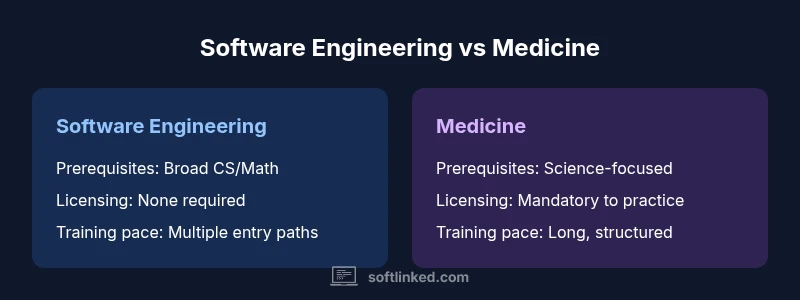
Prerequisites shape early expectations. Software engineering typically begins with a strong foundation in math or computer science, often culminating in a bachelor’s degree, coding bootcamps, or self-guided study. Licensing is not generally required to practice as a software engineer, though professional certifications, security clearances, or specialized tracks can boost prospects. Medicine follows a far more formal route: pre-med prerequisites, four years of medical school, and several years of residency before independent practice. Licensing exams and board certifications are prerequisites for patient care, and ongoing CME credits are common to maintain competence. Because of these different tracks, the minimum time to independence in medicine is typically longer and more regulated, while software engineering offers multiple entry doors with varying speed to impact.
Day-to-day work and problem types
The daily rhythms differ in meaningful ways. Software engineers diagnose and fix software defects, design scalable systems, participate in agile ceremonies, and collaborate across product, design, and operations teams. Problems often involve visible code artifacts, test coverage, and performance metrics, with success measured by user impact and reliability. In medicine, clinicians diagnose illnesses, interpret tests, develop treatment plans, and communicate with patients and families. The work is asset-light on abstractions and heavy on human factors, ethics, and consent. Both paths demand logical thinking, disciplined study, and the ability to manage uncertainty, but they apply these skills to very different contexts and consequences.
Risk, accountability, and failure modes
Accountability differs in kind, not just degree. Software failures can disrupt services, cause data loss, or create security vulnerabilities, with consequences often measured in downtime, costs, or user dissatisfaction. Medicine carries direct, life-or-death stakes, where decisions impact patient outcomes and require transparent communication with teams, families, and regulators. Risk management in software emphasizes testing, incident response, and postmortems, while medicine emphasizes patient safety, informed consent, and ethical practice. Understanding these risk profiles helps prospective learners decide where they will be able to sustain focus, manage stress, and maintain professional integrity over years.
Learning curves, burnout, and career longevity
Both fields demand long-term commitment, but the shape of the curve differs. Software engineering requires continuous upskilling to keep up with frameworks, languages, and best practices, often in an environment that rewards rapid experimentation. Burnout can stem from tight deadlines, high expectations, and system outages, but many roles offer flexible schedules and remote work. Medicine imposes a prolonged, structured training arc, with slower initial progress and intense residency demands, followed by a long career of evolving clinical practice. Both paths benefit from deliberate pacing, mentorship, and consistent reflection on purpose and values to sustain motivation and avoid burnout.
Personal fit: when one might feel harder
Difficulty is highly personal. If you thrive on abstract problem solving, system design, and scalable architectures, software engineering may feel more natural. If you are drawn to human-centered care, ethics, and long-form mastery of a domain, medicine may align better with your interests. Your tolerance for high-stakes decision making, your preference for teamwork, and your desired pace of learning all influence which field feels harder in practice. The most reliable predictor is hands-on exploration: try introductory courses, mentorship conversations, or volunteering in related settings to test your fit before committing to a long path.
Practical steps to start learning and decide
If you’re trying to decide whether is software engineering harder than medicine for you, start with a structured exploration:
- Take a low-stakes online course in programming and a short clinical observation to compare the cognitive load and emotional resonance.
- Seek mentorship from professionals in both fields to understand day-to-day realities and growth opportunities.
- Map your values (impact, pace, social interaction) against each field’s typical workflows and risk profiles.
- Create a 6–12 month personal learning plan with milestones that test your interest in problem-solving, patient interaction, and team collaboration.
- Revisit your plan quarterly, adjusting for what you learned about your strengths and preferences. The goal is to build evidence from experience rather than rely solely on abstract judgments about difficulty.
AUTHORITY SOURCES
For readers seeking authoritative context, consult established career resources and educational standards. See the U.S. Bureau of Labor Statistics discussions on software developers and related roles, and medical education guidelines from accredited medical schools and professional boards. While the exact figures vary by country, the underlying message remains: both paths require foundational study, practical training, and lifelong learning.
- https://www.bls.gov/ooh/computer-and-information-technology/software-developers.htm
- https://www.aamc.org/what-we-do/mission-areas/medical-education-training
- https://sites.google.com/a/harvard.edu/medical-education-guide
Comparison
| Feature | Software Engineering | Medicine |
|---|---|---|
| Prerequisites | Broad STEM/CS foundation common; degrees typical | Formal pre-med groundwork followed by medical school |
| Licensing/Certification | No universal licensure to practice; certifications optional | Licensure required; board certification common |
| Training Time | Multiple entry paths; independence reached earlier in some tracks | Long, regimented path with residency before independent practice |
| Day-to-Day Pace | Project-driven, iterative, flexible schedules | Shift-based, high-stakes clinical care, structured routines |
| Risk and Consequences | System failures affect users; direct financial impact possible | Direct impact on patient health; high ethical and legal exposure |
Pros
- Both fields offer high societal impact and opportunities for continual learning
- Strong problem-solving and analytical skills are transferable between paths
- Multiple entry doors exist for software engineering, allowing flexible pacing
- Continuous learning is a core feature of both disciplines
- Healthy work environments in either field foster mentorship and growth
Weaknesses
- Rapid changes in software can create ongoing upskilling pressure
- Medicine requires a long, fixed training path with less flexibility
- Burnout risk exists in both fields due to high responsibility, though in different forms
Neither field is categorically harder; difficulty depends on personal fit and context
Software engineering and medicine demand deep study and lifelong learning. Your best path aligns with your interests, tolerance for risk, and preferred pace of growth.
Your Questions Answered
Is licensing more central in medicine than in software engineering?
Yes. Medicine requires formal licensing and board certification to practice, with regulatory oversight in most regions. Software engineering generally does not require licensure, though certifications and security clearances can be valuable in certain roles.
Medicine requires licensing and boards, software engineering doesn’t. Certifications can help, but they’re not mandatory for practice.
How long does it take to become proficient in each field?
Medicine typically involves a lengthy, structured pathway including medical school and residency before independent practice. Software engineering offers multiple entry paths, and many people reach a capable level more quickly through dedicated bootcamps or self-study, though mastery takes time in both fields.
Medicine takes many years to become fully independent; software engineering can be quicker to start but mastery takes ongoing effort.
Can skills transfer between software engineering and medicine?
There are transferable skills in problem solving, data interpretation, and teamwork. However, the domain knowledge and clinical vs technical contexts differ greatly, so successful transfer often requires targeted retraining and mentorship.
Some skills cross over, but you’ll likely need focused retraining to switch fields.
Which field has more flexible entry into the workforce?
Software engineering generally offers more flexible entry routes (degrees, bootcamps, self-taught paths) and often faster pathways to employment. Medicine has a highly structured entry ladder with required steps and licensing.
Software can be faster to enter; medicine has a fixed, lengthy path.
How should I think about burnout in these fields?
Burnout can arise from sustained cognitive load, high responsibility, or emotional strain. Both fields require deliberate strategies for workload management, mentorship, and boundaries to sustain long-term careers.
Burnout is a real concern in both fields; prioritize balance and support.
Are there ethical considerations that affect difficulty?
Yes. Medicine centers on patient welfare and consent with high ethical stakes, while software ethics focus on privacy, security, and social impact. Both demand discipline and thoughtful decision-making.
Ethics matter in both areas, shaping daily decisions and long-term practice.
Top Takeaways
- Frame the comparison as multidimensional, not a single metric
- Expect long-term commitment and ongoing learning in both fields
- Personal fit and career goals guide perceived difficulty more than any universal rule
- Plan a learning path that matches your pace, resilience, and values