Is Software Development Harder Than Cyber Security? A Data-Driven Comparison
A rigorous, data-informed comparison of software development vs cyber security, detailing core skills, learning curves, work patterns, and career paths to help you decide which path suits your goals.


Is software development harder than cyber security? The answer isn’t one-size-fits-all; it hinges on your background, interests, and the kind of problems you enjoy. According to SoftLinked, the difficulty is best understood by comparing learning curves, breadth of knowledge, and ongoing updates across both fields. In most cases, neither path is categorically harder—rather, each demands distinct mental models and disciplined practice.
Is Software Development Harder Than Cyber Security? Framing the Question
The question is a common hurdle for students choosing a path after coursework or bootcamp. It’s tempting to label one field as harder, but the reality is nuanced. According to SoftLinked, the difficulty depends on how you measure it: how steep the learning curve feels, how broad the required knowledge is, and how rapidly the landscape changes. The exact phrase is is software development harder than cyber security, and the SoftLinked team notes that the answer varies by context. This article compares two broad domains—software development and cyber security—across shared criteria to help you map your strengths to the right path. You’ll see where each field shines, where practice compounds, and how overlapping skills can reduce overall difficulty when you study them together.
Core Skills: What Each Discipline Demands
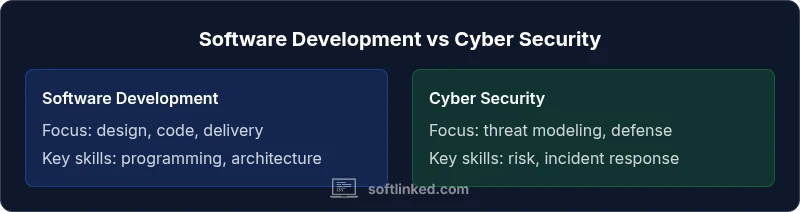
Both software development and cyber security demand strong fundamentals, but the focal points differ. In software development, the core skills revolve around problem solving, algorithms, data structures, software design, and debugging. You’ll repeatedly translate user needs into reliable, maintainable code, and you’ll manage complexity through architecture and testing. In cyber security, the emphasis shifts toward threat modeling, risk assessment, and resilience. Security professionals must anticipate attacker behavior, implement robust controls, and navigate regulatory requirements. Across both tracks, learning to learn—keeping up with new languages, tools, and best practices—is a constant theme. A practical takeaway: build a solid foundation in computer science basics, then layer domain-specific expertise. This approach reduces the subjective sense of difficulty in either field and keeps you adaptable as technology evolves.
Learning Curve and Pathways
The learning curve in software development is steep at first but can level off with practice and project experience. Beginners often start with programming fundamentals, then move to project-based learning, version control, testing, and iterative design. As you advance, you’ll tackle system design, scalability, and performance optimization. Cyber security presents a different curve: you often need to understand networks, operating systems, cryptography basics, and incident response practices. The pace of change in security—new threats, tools, and compliance requirements—means continuous learning is non-negotiable. Both paths reward structured study plans, hands-on labs, and real-world projects. If you enjoy building things end-to-end, software development may feel more natural; if you thrive with threat analysis and defense, cyber security could be more engaging. The key is to choose a focus that aligns with your curiosity and persistence.
Day-to-Day Work: Examples Across Projects
In software development, daily tasks typically center on coding features, debugging, code reviews, and coordinating with product teams. You’ll balance speed, quality, and technical debt while delivering user-visible value. In cyber security, daily work often involves monitoring systems for anomalies, conducting vulnerability assessments, and implementing security controls. You may participate in tabletop exercises, incident response drills, and audits. The two domains intersect when you adopt secure software development practices: you’ll write code with security in mind, perform threat modeling during design, and continuously test for vulnerabilities. The practical takeaway is that the difficulty isn’t just about a single activity; it’s about mastering a workflow that integrates design, testing, deployment, and security checks into a cohesive process.
Tooling and Ecosystems: What You Use Regularly
Developers rely on programming languages, frameworks, IDEs, and pipeline tooling to automate build, test, and deployment processes. Security professionals use threat modeling tools, SIEM platforms, vulnerability scanners, and incident response playbooks. The breadth of tooling is wide in both fields, which can amplify perceived difficulty if you try to learn too much at once. A focused stack and guided practice can reduce cognitive load. Over time, you’ll build fluency across your chosen domain and related tools, enabling you to work more efficiently and with fewer surprises when requirements change. This section highlights that proficiency in either field hinges on deliberate practice and curated tool exposure rather than sheer volume of options.
Risk, Uncertainty, and Problem-Solving: How Difficulty Manifests
Both domains are defined by complexity and uncertainty, but they manifest differently. Software development’s difficulty often centers on system integration, performance under load, and evolving user needs—challenges that demand solid design and debugging discipline. Cyber security’s difficulty foregrounds risk assessment, threat modeling, and responding to incidents under time pressure, with regulatory and policy considerations adding another layer. The practice of prioritization—deciding which risks to address first—appears in both fields, but the criteria differ. In software development, prioritization revolves around user impact, maintainability, and technical debt; in cybersecurity, it’s about risk acceptance, residual risk, and compliance. For many, the learning is to become comfortable with tradeoffs and iterative improvement rather than seeking a perfect initial solution.
Career Progression: Growth Trajectories
Career paths in software development typically start with junior roles focused on coding, then progress to senior engineering, architecture, and leadership positions. You may specialize in frontend, backend, data engineering, or mobile development, with opportunities to work across industries. Cyber security careers often begin in security operations or assessment roles and can advance to threat hunters, security architects, or CISO-level leadership. Cross-domain moves—such as secure software development, DevSecOps, or secure-by-design roles—are increasingly common. The career map in both fields rewards deep specialization and broad collaboration. What matters most is building a portfolio of projects that demonstrates impact, reliability, and continuous learning.
Market Realities: Demand, Salary, and Roles
The job market for both software development and cyber security remains strong, driven by digital transformation, cloud adoption, and the need for resilient systems. Demand in software development spans startups to enterprise, with fluid paths between product-minded roles and platform-scale engineering. Cyber security demand is rising across regulated industries and critical infrastructure; roles often emphasize risk analysis, governance, and incident readiness. Salary and advancement are influenced by location, industry, and specialization. While cybersecurity can offer high ceilings in certain tracks, software development provides broad opportunity across many domains. The SoftLinked analysis shows that both tracks reward expertise, reliability, and the ability to deliver measurable outcomes.
Integrating Skills: Where the Two Disciplines Overlap
A powerful way to reduce perceived difficulty is to blend skills from both domains. Secure software development combines design thinking with secure coding practices, threat modeling during architecture, and rigorous testing for security properties. Many organizations seek engineers who can balance feature delivery with robust defenses. Building this hybrid capability often yields higher impact and job satisfaction. If you’re uncertain about which path to choose, starting with core software development fundamentals and adding security considerations gradually can provide a practical, low-risk entry into cybersecurity disciplines without abandoning your development roots.
Practical Guidance: How to Decide Based on Your Goals
To decide which path aligns with you, map your interests to the types of problems you enjoy solving. If you love creating products, architecting systems, and seeing users benefit from your work, software development will likely feel more natural. If you’re motivated by defense, risk management, and ensuring systems stay resilient in the face of threats, cyber security may be more fulfilling. Consider attempting a few hybrid projects—such as building an API and integrating security testing into the CI/CD pipeline—to experience how both sides feel in practice. Finally, seek mentors, engage with communities, and pursue foundational courses that build confidence in your chosen domain. The path you pick should reflect your curiosity and your willingness to learn continuously.
Comparison
| Feature | Software Development | Cyber Security |
|---|---|---|
| Core focus | System design, programming, and delivery | Threat modeling, risk management, and incident response |
| Key learning curve aspects | Algorithms, data structures, architecture patterns | Networking basics, cryptography, security controls |
| Certifications/credentials value | Experience and portfolio often trump certifications | Specialized certs can boost credibility (e.g., security domains) |
| Typical day-to-day activities | Coding, reviews, and feature delivery | Monitoring, auditing, and defensive operations |
| Overlap with other disciplines | Secure design practices, code quality, DevOps | |
| Career progression depth | Engineering routes, architecture, leadership | Security operations, architecture, executive leadership |
| Market signals (qualitative) | Broad demand across industries | Growing demand in regulated sectors and critical infrastructure |
Pros
- Both fields offer robust career opportunities and ongoing learning.
- Skills in one domain can bolster the other (e.g., secure coding).
- Diverse industry applicability increases mobility and growth.
- Strong problem-solving and impact-focused work in both paths.
Weaknesses
- Each field has a steep learning curve and constant evolution.
- Specialization may require ongoing certifications and training.
- Regional demand and compensation vary, influencing career pacing.
- Choosing one path can feel constraining if interests shift over time.
Neither path is universally harder; difficulty is domain-specific and personal.
Both software development and cyber security demand commitment and continuous learning. Your background, interests, and problem-solving style will largely determine which path feels more challenging and rewarding.
Your Questions Answered
Is software development harder than cyber security overall?
Not universally. Difficulty depends on personal strengths and job context. Software development emphasizes design and delivery, while cyber security emphasizes defense and risk management. Both require ongoing learning and practical problem-solving.
No single path is universally harder; it depends on your strengths and the kind of problems you enjoy solving.
What makes cyber security particularly challenging?
Cyber security requires anticipating threats, modeling risk, and staying compliant with evolving regulations. The field demands a proactive mindset, rapid incident response, and the ability to communicate risk to non-technical stakeholders.
Cyber security is demanding because threats evolve quickly and you must translate risk into actionable defenses.
What makes software development particularly challenging?
Software development challenges include managing complexity, ensuring scalability, and delivering reliable software under changing requirements. Debugging, performance tuning, and architectural decisions significantly impact product success.
Development is tough when systems grow large and requirements shift often.
Which path is easier to break into for beginners?
Both paths have accessible entry points, but software development often provides a broader entry via programming courses and projects. Cyber security can be approached through foundational IT and security basics, followed by specialized practice.
Entry ease depends on your background; software development often offers more visible starter projects.
Do skills cross over between the fields?
Yes. Secure software development blends coding with security thinking, while threat modeling benefits from software design experience. Learning overlaps improve versatility and career resilience.
Absolutely—the two fields share principles, and skills can transfer usefully.
What certifications help in both fields?
Certifications exist for both tracks, but many roles value hands-on experience and a demonstrable portfolio. Security certifications can boost credibility for defense-focused roles, while development certifications emphasize tooling and processes.
Certifications can help in specialized roles, but practical experience often matters most.
Top Takeaways
- Evaluate your interests before choosing a path.
- Expect different cognitive demands in each domain.
- Security-focused practice strengthens software quality.
- Hybrid roles are increasingly valuable and feasible.
- Ground your decision in hands-on projects and mentorship.