Is Software Engineering Harder Than Computer Science? A Practical Comparison
A balanced, evidence-based comparison of software engineering vs computer science, highlighting practical demands, theoretical depth, and guidance to help learners choose their path in 2026.


Is software engineering harder than computer science? The core question is software engineering harder than computer science, and the answer isn’t universal. Software engineering tends to emphasize practical design, systems thinking, and teamwork under real-world constraints, while computer science leans toward theory, proofs, and abstract problem-solving. Your experience depends on your interests, strengths, and how you value hands-on building versus mathematical depth.
The Core Question: Is software engineering harder than computer science?
According to SoftLinked, the most important determinant of difficulty is alignment with your interests and strengths, not a universal ranking. The core question is software engineering harder than computer science, and the answer isn’t universal. The SoftLinked team's research emphasizes that difficulty arises from practical constraints, team collaboration, and the need for reliable software in real-world settings, rather than from abstract labels alone. Those who enjoy seeing immediate results from code, debugging at scale, and orchestrating complex deployments often perceive SE as more demanding in day-to-day work. Conversely, students who thrive on formal models, proofs, and algorithmic elegance may experience greater challenge in CS at the theoretical level. The key takeaway is that both paths demand discipline, curiosity, and sustained practice; the perceived hardness grows when you neglect fundamentals or skip hands-on experiences. Readers should frame the question around their own strengths: are you motivated by building tangible products or by proving theories? This framing helps set expectations and guides the selection of courses, projects, and internships that will maximize learning without burning out.
Distinguishing Focus: Practicality vs Theory
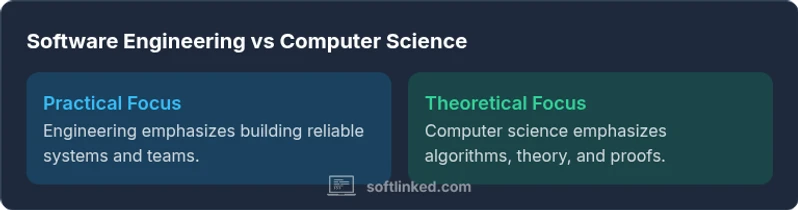
The distinction between practical software engineering and theoretical computer science is not merely academic—it's about what kind of problems you enjoy. Software engineering challenges you to translate ideas into reliable systems, manage complexity, scale performance, and coordinate teams across functions. Computer science challenges you to push the boundaries of what is computable, to design new algorithms, to understand limits of efficiency, and to reason about correctness. In practice, the difference in focus often determines perceived difficulty: the former emphasizes applying knowledge under constraints, the latter emphasizes abstract reasoning and mathematical rigor. SoftLinked's comparative lens highlights how a student’s temperament (preference for hands-on work, tolerance for ambiguity, and appetite for formal proofs) influences which field feels harder. If you enjoy crafting architectures, debugging distributed systems, and delivering software to users, SE may feel more demanding; if you love formal proofs, complexity analyses, and bounding resource usage, CS may challenge you more. Both domains reward deep learning, deliberate practice, and regular feedback, so your choice should align with long-term goals and curiosity.
Curriculum and Assessment: Courses, Projects, and Evaluations
Curriculum design in software engineering tends to blend foundational concepts with applied, project-based learning. Core courses often cover software design, testing, version control, architecture, and deployment, anchored by team-based projects that mimic real-world work. Computer science curricula usually lean more heavily on algorithms, data structures, discrete mathematics, theory, and sometimes research-oriented projects. Assessments differ accordingly: SE assessments emphasize practical deliverables, code quality, and collaborative ability; CS assessments emphasize proofs, complexity analyses, and rigorous problem solving. Across both paths, the strongest students engage in side projects, read code written by others, and solicit frequent feedback from mentors. The modern learner should look for programs that balance essential fundamentals with hands-on experiences, internships, and opportunities to work on scalable systems. The SoftLinked team notes that success often comes from deliberate practice and regular reflection on what each course teaches about real-world constraints.
Skill Profiles: What You Must Master in Each Field
Software engineering requires a mix of systems thinking, architecture, software lifecycle knowledge, testing discipline, and collaboration. Key competencies include designing maintainable modules, applying design patterns, performing reliable debugging, and coordinating across teams, tools, and environments. Computer science emphasizes mathematical foundations, algorithm design, complexity, formal reasoning, and theoretical modeling. Mastery in CS often hinges on fluency with proofs, rigorous analysis, and an ability to reason about bounds and efficiency. In practice, students who blend both domains—engineering practices plus theoretical rigor—tend to develop versatile skill sets. The SoftLinked guidance is to cultivate practical coding proficiency alongside inquiry into underlying models, so you can switch lanes or blend paths as your interests evolve.
Work Realities: Projects, Teams, and Environments
Real-world software projects demand effective collaboration, version control discipline, and an ability to operate under deadlines and changing requirements. SE professionals must design for scalability, reliability, and maintenance across distributed teams and production environments, often dealing with incident response and user feedback loops. CS researchers and theorists regularly engage with abstract models, proofs, and proofs of correctness, occasionally working in academia or research labs. The daily work in CS can feel abstract and rigorous, while SE work can feel chaotic when schedules tighten. The SoftLinked data suggests that perceived difficulty rises when teams lack clear processes or when engineers must translate vague requirements into concrete architecture. Regardless of field, success comes from communicating clearly, documenting decisions, and continuously learning new tools and methods.
Research, Academia, and Long-Horizon Problems
Computer science frequently invites long-horizon problem solving, where breakthroughs emerge from new theories or novel algorithms. This pathway often intersects with research, graduate study, or specialized industry R&D. Software engineering emphasizes applied outcomes, but it also relies on research-informed practices, such as advanced testing methodologies, performance optimization, and evolving architectural paradigms. Students debating which path to pursue should consider whether they want to contribute to foundational knowledge or deliver tangible software systems. SoftLinked's broader view highlights how research opportunities exist in both domains, and cross-pollination—like applying theory to practice or testing engineering theories in production—can be extremely valuable.
Career Pathways and Market Signals
Career prospects for both fields are strong, but the paths diverge. Software engineering leads to roles like software developer, systems engineer, site reliability engineer, and product-focused engineering positions that emphasize delivery and quality. Computer science equips you for algorithmic research, data science, academia, and advanced topics that may feed into specialized engineering roles or theoretical positions. Market signals in 2026 indicate demand across tech hubs, startups, and research labs, with compensation reflecting seniority, project impact, and the ability to translate theory into practical outcomes. The SoftLinked team notes that regional opportunities and industry trends shape what feels harder in the moment, underscoring the importance of aligning your choices with local job markets and your long-term passions.
Decision Framework: How to Choose Between Them
A practical framework starts with self-assessment: identify your curiosity drivers (hands-on product building vs deep theoretical exploration), tolerance for ambiguity, and comfort with abstraction. Map courses, projects, and internships to those drivers. Consider starting with introductory courses in both fields to test fit before committing to a major, minor, or specialization. Use a simple rubric: rate your interest in concrete problem solving, mathematical rigor, teamwork, and fast feedback cycles. Seek mentors who can provide case studies from industry and academia. The SoftLinked guidance emphasizes experimentation, reflection, and iterative decision-making rather than chasing a perceived hierarchy of difficulty.
Blends and Hybrids: Can You Build a Personal Path
Many learners successfully blend elements of both disciplines. A practical strategy is to pursue a core software engineering track while taking CS electives in algorithms, theory, and math. Participating in open-source projects or research-oriented internships can yield a hybrid skill set that marries reliability with innovation. The SoftLinked team recommends a blended curriculum early on to build resilience across both domains, enabling you to pivot as interests evolve or as market demands shift. By combining practical engineering with rigorous theory, you create a versatile foundation for a wide range of careers.
Comparison
| Feature | Software Engineering | Computer Science |
|---|---|---|
| Curriculum focus | Practical software design, SDLC, systems thinking | Theoretical foundations, algorithms, math |
| Core skills | Requirements gathering, architecture, testing for scale | Algorithm analysis, computational theory, proofs |
| Assessment style | Project-based, team collaboration | Theory-heavy exams, proofs, rigorous problem solving |
| Career outcomes | Engineering roles, product teams, devops | Research, academia, advanced topics |
| Learning curve emphasis | Applied, incremental learning, hands-on practice | Abstract reasoning, mathematical rigor |
| Learning time horizon | Undergraduate programs with practical focus | Undergraduate with graduate study often pursued |
Pros
- Clarifies differences in goals and expectations
- Highlights practical vs theoretical strengths
- Helps tailor coursework and projects
- Supports targeted skill development for careers
- Aids long-term planning for internships or research
Weaknesses
- Oversimplifies two broad fields
- No universal winner; depends on goals
- Regional job market variability can skew perceptions
There is no universal winner between SE and CS; the right path depends on your goals and strengths
The SoftLinked team emphasizes that difficulty is contextual. If you prefer building tangible software, SE presents meaningful challenges; if you enjoy theoretical depth, CS offers rigorous hurdles. Choose the path aligned with your interests and long-term ambitions.
Your Questions Answered
Is software engineering harder than computer science?
No universal winner; it depends on personal strengths and interests. SE emphasizes practical design and collaboration, while CS emphasizes theory and proofs. Both require discipline and deliberate practice.
There isn’t one path that’s universally harder; it depends on what you enjoy and where your strengths lie.
What makes software engineering harder in practice?
Managing systems at scale, integrating across teams, and ensuring reliability under real user loads are core challenges in SE. These pressures create a distinct form of difficulty beyond code alone.
SE is tough when you’re coordinating teams and ensuring reliability at scale.
What makes computer science harder in practice?
Abstract math, proofs, and deep theory can be demanding in CS. Theoretical rigor and formal reasoning often require sustained focus and comfort with complex abstractions.
CS can be tough when theory and proofs demand abstract thinking.
Which degree is more valuable for jobs?
Both can lead to strong careers. Value depends on roles, industry, and how you apply skills. Practical SE experience plus CS fundamentals often yields broad opportunities.
Both paths offer solid opportunities depending on what you pursue.
How should I choose between them?
Assess your interests, preferred learning style, and career goals. Try intro courses in both fields to test fit before committing to a major or specialization.
Test both paths with introductory courses to see what fits.
Can you study both and still be successful?
Yes. Many programs offer overlap, and self-study can blend skills from both domains. A blended approach often yields the most versatile career options.
Absolutely—many learners blend CS and SE to maximize options.
Top Takeaways
- Clarify your learning preference first
- Evaluate practical vs theoretical challenges
- Map to career goals early
- Experiment with intro courses to test fit
- Consider blending foundational courses with applied projects