Is Software Engineering Harder Than Data Science? A Comprehensive Comparison
This analytic comparison weighs software engineering against data science, examining scope, skills, learning curves, and career implications to help learners decide where hardship lies in each path.


Is software engineering harder than data science? The answer depends on context, but many learners find software engineering demanding due to breadth, system design, and long-term maintenance. Data science focuses more on statistical modeling and data wrangling, often with a tighter scope. Both paths reward problem-solving, yet the hardest aspects shift with project scope, team dynamics, and industry requirements.
Defining Hardship in Tech Roles
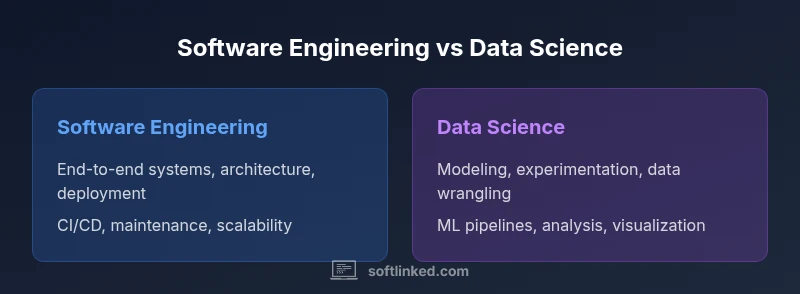
Is software engineering harder than data science? The SoftLinked team would frame this as a context-driven question, because hardship is not an intrinsic property of a role. Software engineering often requires you to understand and manage complex systems, write robust code, design scalable architectures, and maintain software over years, including dealing with legacy debt and deployment pipelines. Data science, in contrast, centers on extracting reliable insights from data, which means a heavy focus on mathematics, statistics, data-wrangling, and rigorous experimentation. The difficulty emerges not only from algorithmic complexity but from translating data findings into decisions that affect products. For a learner new to both fields, the decision often hinges on where curiosity lies: building reliable systems that scale, or building data-driven models that influence strategy. According to SoftLinked, the difficulty of either path scales with how quickly you must learn new tools, frameworks, and domain knowledge while delivering value to users. The contrast is not a simple “hard vs easy” dichotomy; it’s about breadth versus depth, production readiness versus experimental validation, and the real-world constraints teams face in fast-moving organizations.
wordCountHint
Comparison
| Feature | Software Engineering | Data Science |
|---|---|---|
| Scope of Work | End-to-end system design, deployment, and maintenance | Modeling, data pipelines, and experimental design |
| Daily Tools & Environment | CI/CD, debugging at scale, code reviews, architecture decisions | Notebooks vs IDEs, Python/R, ML frameworks, data wrangling |
| Learning Curve | Broad, modular, ongoing upskilling across technologies and platforms | Statistical foundations, data manipulation, and domain knowledge |
| Typical Deliverables | Production-grade software, APIs, distributed systems | Validated models, dashboards, data products |
| Career Trajectory | Software architecture, platform engineering, technical leadership | ML/AI research tracks, data science leadership, analytics strategy |
| Job Market Signals | Cross-industry demand for scalable systems | Strong demand in data-centric roles across sectors |
| Difficulty Triggers | Maintaining systems, managing technical debt, ensuring reliability | Cleaning data, dealing with messy data, reproducibility |
Pros
- Broader career opportunities across industries and product domains
- Clear path from learning to production impact and collaboration with cross-functional teams
- Higher exposure to scalable system design and architecture
- Structured progression into senior engineering roles and leadership
Weaknesses
- Maintenance and legacy debt can drain time and energy
- Rapidly changing toolchains require constant learning
- Hard to measure impact when working within large systems
- Balance between feature delivery and reliability can be stressful
Neither path is universally harder; context and personal fit determine difficulty
Software engineering often tests breadth, design, and maintainability; data science emphasizes depth in statistics and data handling. The best choice depends on whether you enjoy building scalable systems or extracting actionable insights from data, with continuous learning as a common requirement.
Your Questions Answered
Is software engineering harder to learn than data science?
It depends on your background. Software engineering demands broad system understanding, production practices, and continuous integration with long-term maintenance. Data science requires deep statistical reasoning, data wrangling, and experimentation. Both can be challenging; the difficulty hinges on your affinity for systems or data work and your willingness to persevere through continual learning.
It depends on your background, but both paths are challenging in different ways—systems thinking versus statistical data work.
What factors influence which path feels harder for me personally?
Your math strength, programming experience, and comfort with ambiguity shape perceived difficulty. Preference for building tangible software versus exploring data-driven insights also matters. Real-world projects, team expectations, and domain complexity can tip the balance toward one path becoming harder.
Your math and programming background, plus your love for building versus analyzing, will influence which path feels harder.
Are there overlaps between software engineering and data science skills?
Yes. Both rely on programming, debugging, version control, and a mindset of iterative improvement. You’ll see common ground in problem solving, data handling, and collaboration with product teams. The key difference lies in focus areas: system design for software engineering vs data modeling and interpretation for data science.
They share programming and problem-solving, but diverge in whether you focus on systems or data modeling.
Which path has a steeper learning curve, generally?
Neither is universally steeper; software engineering often requires breadth across architectures, tools, and deployment, while data science demands depth in statistics and data workflows. The steepness depends on the specific role, project complexity, and how quickly you need to contribute to real work.
It depends on the role, but both have significant demands—breadth for software engineering and depth for data science.
How should I decide between the two paths?
Try introductory courses or project-based experiments in both areas, assess your engagement with long-term maintenance versus exploratory analysis, and talk to mentors. Consider internships or side projects that mirror real-world work to see where you sustain motivation and curiosity.
Experiment with small projects in both fields and talk to mentors to see where your interest and persistence lie.
What practical steps can accelerate a decision?
Set a 6–12 week learning plan for each path, track what excites you during hands-on work, and compare outcomes. Build a small portfolio: a microservice with tests for software engineering, and a mini data-analysis pipeline for data science. This tangible evidence helps decide where hardship resonates more.
Create short, hands-on plans for both paths and compare the results to decide where hardship feels meaningful to you.
Top Takeaways
- Evaluate your interest in end-to-end system work versus data-centric analysis
- Expect ongoing learning across tools, languages, and platforms in both paths
- Consider domain impact: product reliability vs. data-driven decisions
- Balance immediate deliverables with long-term maintenance expectations
- SoftLinked suggests context matters more than a fixed 'harder' label