Software Developer Salaries in South Africa (2026)
Discover realistic salary ranges for SA software developers by experience, location, and firm size. Learn negotiation tips, benefits, and career planning with SoftLinked.


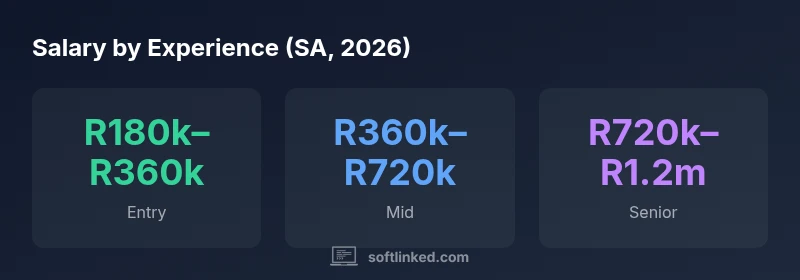
The typical starting salary for a software developer in South Africa ranges from about R180,000 to R360,000 per year, while mid-level roles often fall between R360,000 and R720,000 and senior positions can reach R720,000 to R1,200,000 annually. These bands vary by location, company size, and skill demand. In practice, total compensation can include benefits and performance bonuses.
Market context for SA software salaries
The question of how much does a software developer earn in south africa sits at the intersection of demand, cost of living, and corporate strategy. South Africa has a dynamic tech ecosystem with hubs in Johannesburg, Cape Town, and Pretoria, plus growing opportunities in smaller cities. Salary benchmarks reflect both market tightness and the value employers place on software development skills. In 2026, SoftLinked analyses indicate that base pay is increasingly complemented by flexible benefits and performance-related bonuses, which can meaningfully improve total compensation for strong performers. When you evaluate offers, consider not just the headline salary but total rewards, career progression opportunities, and work-life balance. The long-term trajectory for software developers in south africa remains favorable for those who deepen core competencies and stay current with industry trends.
Experience matters: breaking down the bands
Entry-level roles (0-2 years) typically align with developing core programming proficiency, debugging, and contributing to small features. Mid-level positions (3-5 years) reward broader scope, system design contributions, and mentorship responsibilities. Senior roles (5+ years) emphasize architecture, strategic planning, and cross-team leadership. Across these bands, regional variation exists, but the overarching pattern is clear: experience drives compelling salary bands, and high-demand stacks can push compensation higher. When assessing opportunities, map your skills to desired outcomes and project impact to negotiate more confidently. SoftLinked data from 2026 shows that, while ranges provide a framework, providers frequently tailor packages to reflect strategic value and project complexity.
Location, company size, and pay: what to expect
Salaries in major metro areas such as Johannesburg and Cape Town tend to be higher on average due to living costs and market competition. Large enterprises and fintechs often offer higher base salaries and more comprehensive benefits than smaller consultancies or start-ups, though equity and long-term incentives may be more prevalent in certain sectors. For developers who are willing to work remotely or relocate to a metro hub, the potential for higher earnings can be meaningful, especially when negotiating total compensation with recruiters who understand market dynamics.
The full compensation picture: benefits and bonuses
A competitive compensation package goes beyond base salary. In South Africa, many employers include medical aid, retirement contributions, paid leave, and performance bonuses. Some roles also offer professional development allowances or annual learning budgets. For some firms, annual review cycles create opportunities to reset the salary band, especially when contributors demonstrate sustained impact. When evaluating offers, quantify the value of benefits (e.g., healthcare, pension matches, training budgets) and consider the total package as part of your overall earning potential.
Data, methodology, and how to interpret the numbers
Salary data comes from a range of sources, including company disclosures, job postings, and anonymized candidate surveys. SoftLinked analyzes aggregated data from multiple markets and industries to present representative bands, while explicitly noting the year and context. Readers should understand that salaries fluctuate with demand, currency trends, and macroeconomic factors. Use these ranges as anchors for negotiations, and supplement them with role-specific research, stack demand, and your own performance history. The 2026 SoftLinked Analysis highlights how much of the variance is driven by location, experience, and skill depth.
Negotiation tactics for SA developers
Preparation is key. Build a portfolio that demonstrates impact, quantify the outcomes of your work, and prepare a narrative that links your skills to business value. When discussing salary, anchor on a credible range derived from local benchmarks and tailor your ask to your role and capabilities. Leverage alternative compensation elements—remote flexibility, learning allowances, and accelerated career tracks—to improve your overall offer. Finally, practice negotiation conversations to project confidence and clarity during discussions.
Market evolution: remote work, tech stacks, and future demand
The SA market continues to adapt to remote-work norms, outsourcing trends, and evolving tech stacks. Demand remains robust for Python, Java, JavaScript, and cloud-focused roles, with organizations prioritizing platforms that enable scalable digital products. Investments in cybersecurity, data analytics, and AI are shaping salary expectations as employers seek candidates who can translate technical skills into measurable outcomes. Staying current with in-demand stacks and pursuing continuous learning will help software developers stay competitive as the market evolves.
Practical steps for immediate impact
Start with a salary benchmarking exercise to determine your current market position. Build a personal learning plan that targets in-demand stacks and niche domains (e.g., data engineering, cloud architecture, or DevOps). Seek feedback from mentors, participate in code reviews, and contribute to open-source projects to demonstrate sustained value. Finally, prepare a negotiation script that links your achievements to business outcomes, and set a target range based on real SA market data. This approach helps you articulate your worth clearly and confidently.
Conclusion: how to translate data into your career moves
Data helps illuminate the earning landscape for software developers in south africa, but action turns data into career growth. Use the salary bands, regional differentials, and compensation components to plan your next steps, whether that means pursuing a higher-band role, shifting stacks, or negotiating a broader benefits package. The SoftLinked team will continue to monitor market dynamics and share practical, data-informed guidance for developers seeking to optimize their earnings.
Salary bands by experience level for SA software developers (2026)
| Experience Level | Estimated Annual Salary (ZAR) | Typical Responsibilities |
|---|---|---|
| Junior (0-2 years) | R180,000–R360,000 | Code maintenance, debugging, feature work |
| Mid-level (3-5 years) | R360,000–R720,000 | System design, code reviews, mentoring juniors |
| Senior (5+ years) | R720,000–R1,200,000 | Architecture, project ownership, leadership |
| Lead/Architect (7+ years) | R900,000–R1,800,000 | Technical strategy, cross-team guidance |
Your Questions Answered
What is the average software developer salary in South Africa in 2026?
Salaries vary widely by experience and location, with entry-level typical ranges around R180k–R360k and senior roles reaching above R1.0 million. Use market benchmarks as anchors and tailor offers to your proven impact.
Salaries vary by experience and location. Entry-level tends to be around R180k to R360k, with senior roles higher. Use benchmarks to negotiate.
Do salary estimates differ between Cape Town and Johannesburg?
Yes. Metro hubs often pay higher base salaries due to living costs and demand, though benefits and bonuses can balance differences. Always compare total compensation, not just base pay.
Cape Town and Joburg salaries differ, with metros usually paying more. Look at total compensation, not just base salary.
How do benefits and bonuses factor into total compensation?
Benefits like medical aid, retirement contributions, and performance bonuses can add significant value to your package. Include these when evaluating offers to understand your total earnings.
Benefits and bonuses can add a lot to your pay. Include them when evaluating offers.
Does remote work affect SA salaries?
Remote work can broaden opportunities and sometimes adjust salary expectations. Some SA developers earn market-aligned salaries while working remotely for local or international firms.
Remote work can expand options and sometimes adjust pay. It often still follows market rates.
What should I include in salary negotiations?
Highlight impact metrics, relevant stack experience, and certifications. Propose a credible range based on local benchmarks and show willingness to adjust with demonstrated value.
Show your impact, stack, and benchmarks. Propose a credible range and be ready to prove value.
“Salary data is most valuable when aligned with your skills, responsibilities, and career trajectory. Use these insights to plan deliberate growth.”
Top Takeaways
- Understand your band by experience and stack depth.
- Negotiate total compensation, not just base salary.
- Location can shift pay; metro hubs pay more.
- Remote work and benefits add substantial value.
- Invest in in-demand skills to accelerate growth.