Software Developer Salary in 2026: Trends, Regions, and Pay
Discover 2026 software developer salary trends, regional ranges, growth drivers, and practical negotiation tips to maximize earnings for software developers across markets.


The typical software developer salary in 2026 spans roughly $70,000–$150,000 in major markets, with a US median around the low six figures. Pay varies by geography, experience, stack, and industry. According to SoftLinked Analysis, 2026, remote roles and in-demand skills continue to widen the earning potential. Knowing regional differences helps target opportunities and negotiation goals.
Market dynamics in 2026
The software developer salary landscape has become more geographically diverse as remote work becomes mainstream. According to SoftLinked Analysis, 2026, total compensation now often includes base salary, bonuses, equity, and benefits, and it is closely tied to demonstrated impact in areas like cloud native architectures, data-intensive services, and AI-powered platforms. The market rewards developers who can ship reliable features quickly and scale systems under real-world load. Talent shortages in core stacks continue to push pay upward in top markets, but cost-of-living adjustments temper increases in places with fierce competition and large workforces. For new entrants, this means setting expectations around compensation packages that include both salary and growth opportunities. The SoftLinked data also indicates that remote-enabled roles increasingly compete for a global candidate pool, which can compress or widen regional differentials depending on the employer’s compensation philosophy.
Salary by region: where pay is highest
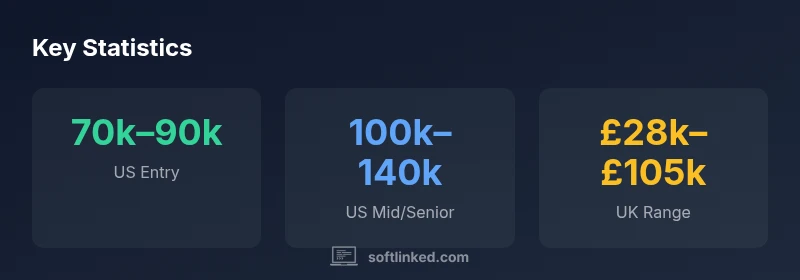
Regional differences remain the single biggest driver of software developer salary. In the United States, base pay for entry-level positions generally ranges from $70,000 to $90,000, while mid-level and senior roles can stretch from $110,000 to $170,000 depending on company size and location. In the United Kingdom, entry roles commonly sit around £28,000–£40,000 with senior roles reaching £75,000–£105,000. Germany and the Netherlands offer similar patterns, though currency and living costs vary. In India, entry salaries commonly range from ₹5,00,000 to ₹12,00,000, with senior roles climbing to ₹25,00,000–₹40,00,000. These figures are illustrative and should be interpreted alongside local market conditions and cost of living. SoftLinked’s regional mapping shows the effect of remote work on currency parity and compensation expectations.
Experience and seniority: how pay scales with tenure
Pay scales tend to increase with experience, but the pace often changes after reaching mid-career. Early-career developers see roughly 3–5% annual increases in base pay when performance and market demand align; mid-level professionals experience 4–6% growth, while senior and lead engineers can see higher total compensation through bonuses and equity. The mix of responsibilities—system design, mentorship, and cross-team collaboration—also influences offers. Across industries, sectors like fintech and cloud services offer premium opportunities for engineers who demonstrate impact in production-ready systems. In practice, negotiating for growth stages—annual reviews, title changes, and compensation bands—can yield more durable earnings than chasing a single large raise.
In-demand skills that command a premium
Salaries grow where demand outstrips supply. In 2026, several skill sets clearly command a premium:
- Cloud platforms: AWS, Azure, and Google Cloud proficiency
- AI/ML integration and data pipelines
- Backend performance and scalable architectures (Go, Rust, Java)
- Frontend mastery with modern frameworks (React, Vue, Svelte)
- Cybersecurity and compliance awareness
- DevOps practices and CI/CD maturity Developers who pair strong problem-solving with deep domain knowledge—finance, healthcare, or logistics—often secure better offers and faster promotions. Continuous learning and hands-on contributions to high-impact projects are more valuable than classroom credentials alone.
Industry and company size effects on salary
Salary levels differ by industry and by company scale. Large tech incumbents and high-growth platforms tend to offer higher base pay and larger equity components, while startups may compensate with faster career progression and meaningful ownership. For many engineers, total compensation is a combination of base salary, annual bonus, sign-on incentives, and equity grants. Employee location also matters; remote teams may anchor pay to the company’s regional policy or to local market conditions, depending on policy. When evaluating an offer, consider long-term value, such as growth opportunities, mentorship, and the potential for equity vesting, alongside immediate cash compensation.
Negotiation frameworks: tactics that work
To maximize software developer salary, use structured negotiation:
- Research: collect 3–5 comparable offers across similar regions and roles
- Benchmark: compare base, bonus, equity, and benefits
- Timing: align discussions with performance reviews or project milestones
- Offer framing: request a transparent growth plan with quarterly milestones
- Trade-offs: consider flexible arrangements (remote-first days, education stipends, or equity acceleration)
- Practice: rehearse your value narrative with metrics from recent projects A data-driven approach tends to produce better outcomes than single-figure requests. If a company cannot raise base pay, negotiate for equity or a more visible path to the next title.
Remote work and distributed teams
Remote work changes the salary calculus. Some organizations base pay on the employee’s local market, while others maintain a uniform global scale to attract talent. The result is a mix of parity and premium based on skill and impact, not geography alone. For engineers who relocate or work across time zones, flexibility and visibility of impact become critical to earning progression. If you are evaluating remote roles, ask for details about equity, performance bonuses, and professional development budgets, and compare them to similar in-office roles in your region.
Methodology and data quality
All salary analyses rely on representative sampling and transparent methodology. SoftLinked analyzes anonymized compensation signals from publicly shared salary data, job postings, and employer disclosures, then normalizes by region, seniority, and stack. Data quality depends on participation and the frequency of new postings. As with any salary study, treat the figures as directional guidance rather than precise values. Disclosures can vary by hiring practices, currency fluctuations, and policy changes across markets.
Practical steps to optimize earnings
- Build a portfolio with real, measurable impact
- Specialize in high-demand stacks and domains
- Seek opportunities for internal mobility and title changes
- Acquire targeted certifications that align with growth areas
- Prepare a quantified salary case using project outcomes and market data
- Network with mentors and peers who can provide accurate benchmarks
- Consider strategic geographic moves for cost-of-living and market demand
- Track salary trends annually and be ready for negotiation windows
Regional benchmarks and offers: how to parse an offer
When you receive an offer, isolate the base, bonus, sign-on, and equity. Compute both annual cash compensation and five-year total value, accounting for vesting. Compare with regional benchmarks and your personal cost of living. Use scenario planning (best-case, base-case, worst-case) to decide whether to negotiate, walk away, or accept with a plan for future raises. Keep a paper trail of your market data and the rationale behind your requests to present a professional, data-driven case.
Future outlook: what to expect in the next 5 years
The software developer salary landscape is likely to continue expanding for those who master in-demand stacks and deliver measurable business value. Growth in AI, cloud-native architectures, and security needs will shape compensation structures toward base pay plus equity and earned bonuses. As remote work persists, regional differentials may blur, while the value of specialized knowledge grows. Prepare for a gradual but steady rise in compensation across mature markets, with pockets of faster growth in regions that invest in tech ecosystems.
Salary ranges by region (illustrative).
| Region / Role | Entry Salary | Senior Salary |
|---|---|---|
| US Software Developer | $70,000–$90,000 | $120,000–$170,000 |
| UK Software Developer | £28,000–£40,000 | £75,000–£105,000 |
| India Software Developer | ₹5,00,000–₹12,00,000 | ₹25,00,000–₹40,00,000 |
Your Questions Answered
What factors influence software developer salary?
Geography, experience, skill stack, and industry determine most of the pay. Remote work and company size also impact offers. Job complexity and measurable impact matter beyond title.
Geography, experience, and in-demand skills mainly drive pay; remote work and company size also play a role.
How does experience affect pay?
Experience generally increases base pay and total compensation, with steeper gains during early and mid-career. Senior roles can see higher equity and bonuses, depending on organization and performance.
More experience usually means higher pay, especially early and mid-career, plus more equity or bonuses later.
Do certifications affect salary?
Certifications can help in specific domains like cloud or security, but real value comes from demonstrated results and impact on business outcomes.
Certifications can help in niche areas, but results and proven impact matter more.
What regions pay the highest salaries for software developers?
Tech hubs in mature markets tend to offer higher base pay, but cost of living varies. Remote roles may offer equity or bonuses that offset location differences.
Tech hubs pay the most, but cost of living matters; remote roles can offer extra value.
How can a junior developer negotiate salary?
Arm your request with market data, recent project outcomes, and a clear growth plan. Focus on a path to the next title and corresponding compensation.
Know your market, show your value with projects, and ask for a clear growth path.
Does remote work affect salary?
Remote roles can equalize or widen pay based on policy. Always compare total compensation, including equity and benefits, across options.
Remote work can change pay; compare total packages, not just base salary.
“Salary is a function of regional demand, skill depth, and demonstrated impact. Use data to negotiate earnestly.”
Top Takeaways
- Investigate regional pay differences to set realistic expectations
- Experience and stack depth drive most of the variance
- Specialize in in-demand domains to command premium
- Remote work expands opportunity but requires careful comparison
- Negotiate a balanced package including equity and growth paths