What Do Software Developers Make in 2026? A Salary Guide
Explore how much software developers earn in 2026 across regions, with salary ranges, compensation structures, and practical tips to negotiate pay and maximize total earnings.


According to SoftLinked, software developers in the United States typically earn a broad salary range that depends on experience and location. Entry-level roles often start around $70,000, mid-career salaries sit roughly between $110,000 and $140,000, and senior positions frequently exceed $150,000, with top packages in high-demand markets surpassing $180,000. Global ranges vary by country, industry, and company size.
What do software developers make in 2026? A salary overview
When you ask what do software developers make, the answer hinges on geography, experience, and the domain of software work. In 2026, salary benchmarks reflect ongoing demand for coding skills across industries from cloud services to data analytics. The SoftLinked team found that earnings vary widely, with entry-level roles beginning in the lower range of the market and senior positions commanding significantly higher compensation, often accompanied by equity or performance bonuses. Understanding these dynamics helps aspiring engineers set realistic expectations, plan skill development, and navigate early career moves with a data-driven mindset. In practice, salary conversations should blend market benchmarks with personal impact—your code quality, system scale, and potential to grow. Employers range from startups to large incumbents, and compensation structures can differ notably between base pay and total rewards, including equity and benefits.
A practical way to approach salary is to map your current skills to market demand and quantify the outcomes you’ve delivered. For example, consider how your work improved system reliability, reduced latency, or accelerated feature delivery. Those tangible outcomes translate into negotiating leverage, especially when you can demonstrate consistent impact across projects and teams.
Key factors that influence pay for software developers
Pay for software developers is not a single number; it is a function of multiple interacting factors. Experience level matters most, but location and sector play equally large roles. Domain expertise—such as cloud architecture, data engineering, or embedded systems—can command premium rates. Company size and industry maturity influence compensation philosophy: startups might offer higher equity; established firms often provide larger cash salaries and robust benefits. Skill depth, such as mastery of in-demand stacks (e.g., modern web frameworks, AI/ML tooling, or distributed systems), and proven performance in shipping reliable software, also strongly shape earnings. Finally, the cost of living in a given city, local demand for engineers, and remote-work policies can compress or amplify salary bands. The SoftLinked framework emphasizes a holistic view: compare base salary alongside equity, bonuses, and benefits to assess true compensation value.
Regional snapshots: US, Europe, and Asia-Pacific
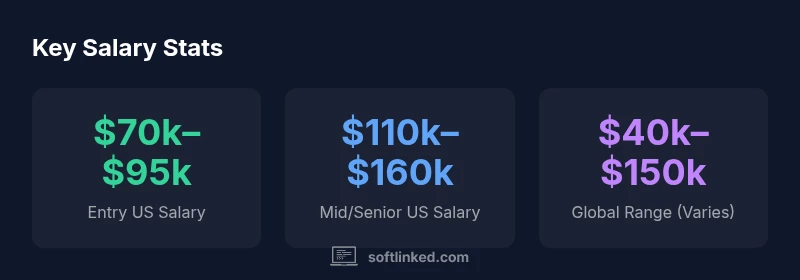
Salary landscapes differ across regions due to cost of living, tax regimes, and market maturity. In the United States, entry-level salaries often start around the $70,000–$95,000 range, while mid-career and senior roles commonly land between $110,000 and $160,000, with top packages surpassing $180,000 in high-demand markets. In Europe, salaries tend to be lower on average but are complemented by strong benefits and shorter workweeks in some countries, with typical entry ranges around €30,000–€60,000 and senior levels near €80,000–€120,000 depending on country. In Asia-Pacific, ranges vary dramatically by country—from roughly $40,000 to $90,000 in some markets to well above $100,000 in tech hubs—mirroring local demand and talent supply. These regional patterns reflect cost-of-living adjustments, visa dynamics, and corporate compensation norms, underscoring the importance of local market research for accurate benchmarking.
Total compensation: beyond base salary
Base salary is only part of the picture. Total compensation includes equity or stock options, performance bonuses, signing bonuses, retirement contributions, health benefits, and other perks. In fast-growing regions or high-demand domains, equity can substantially augment long-term earnings, particularly if a company achieves liquidity or an IPO. Bonus pools and performance metrics also vary by company; some teams emphasize quarterly targets, while others maintain annual plans. When evaluating offers, consider not only the nominal salary but also how total compensation aligns with your risk tolerance, career goals, and portfolio of projects. The value of learning opportunities and the potential for rapid skill advancement can mathematically outpace modest salary differentials over time.
How to negotiate salary and plan your career path
Preparation is the key to successful salary negotiations. Start with credible market data: gather regional benchmarks, salary bands for your role and level, and recent hiring trends. Build a narrative that ties your specific achievements to business impact: uptime improvements, user growth, revenue impact, or cost reductions. Timing matters: negotiate after a successful milestone, during performance reviews, or when receiving a competitive offer. Practical tactics include stating a clear target range, asking for the higher end of the band, and proposing a plan for achieving salary progression with defined milestones. Beyond base pay, negotiate for equity, remote-work flexibility, flexible hours, and learning stipends. Finally, map a career plan that emphasizes specialization or leadership tracks—both paths influence future earning potential and opportunities for advancement.
Career ladders and specialization that affect earnings
Earnings are shaped by the chosen career path. The individual contributor (IC) track emphasizes technical mastery and architectures, with roles such as Senior Engineer, Staff Engineer, and Principal Engineer delivering increasing scope and impact. The management track progresses from Engineering Manager to Director and VP levels, often accompanied by higher base salaries and broader responsibilities, though sometimes with trade-offs in hands-on coding time. Specialization can also boost pay: expertise in cloud platforms, data engineering, AI/ML, security, or UX can command premium salaries due to scarcity and strategic importance. For many engineers, building a diverse portfolio across multiple domains increases leverage in salary discussions and opens doors to leadership roles or highly paid technical expert positions.
Practical steps for aspiring developers in 2026
Aspiring developers should build a concrete plan that combines skill development with real-world application. Start by mastering core fundamentals (data structures, algorithms, systems design) and pair them with modern tools and languages aligned to your target domain. Develop a portfolio of projects that demonstrate impact, such as scalable services, performance improvements, or user-centric features. Stay current with industry trends by following credible sources, contributing to open-source projects, and building a personal learning backlog that aligns with in-demand stacks. Finally, cultivate negotiation readiness through mock sessions, salary benchmarks, and a clear career trajectory—knowing when to transition roles to accelerate growth.
Salary ranges by region (typical bands)
| Region | Typical Entry-Level Range | Typical Mid/Senior Range | Notes |
|---|---|---|---|
| United States | $70,000–$95,000 | $110,000–$160,000 | Entry vs Senior distinction varies by company |
| Europe (EU/UK) | €30,000–€60,000 | €70,000–€120,000 | Currency and country variance high |
| Asia-Pacific | $40,000–$90,000 | $90,000–$130,000 | Significant country variance |
Your Questions Answered
What is the typical salary range for entry-level software developers in the US?
Entry-level salaries in the US commonly fall around $70k to $95k, depending on city and company. Benefits and potential bonuses vary by employer. This range reflects early-career demand and foundational skill sets.
Entry-level software salaries in the US typically run from about seventy thousand to ninety-five thousand dollars, varying by city and company.
How does location affect software developer pay?
Location significantly influences pay due to cost of living, market demand, and local competition for talent. Coastal tech hubs tend to offer higher base salaries but also higher living costs. Remote work can compress or expand pay bands depending on company policy and tax considerations.
Location impacts pay a lot; high-cost areas pay more, but remote roles can shift those numbers depending on policy and taxes.
Do salaries differ by specialty (web, mobile, data)?
Yes. Specialties with higher demand or strategic importance—such as data engineering, AI/ML, cloud infrastructure, or security—tend to command premium salaries. The differences also reflect project impact, scope, and the complexity of the tech stack.
Specialties like data, AI, or cloud can lead to higher salaries due to demand and impact.
How does experience level impact compensation?
Experience compounds earnings: junior roles start lower, mid-level roles rise notably, and senior/lead positions bring substantial increases, often accompanied by equity. The rate of growth depends on performance, domain, and market demand.
More experience usually means higher pay, with big jumps at senior levels.
What should I consider in total compensation beyond base salary?
Consider equity or stock options, signing bonuses, performance bonuses, retirement plans, health benefits, and learning stipends. Equity can be especially valuable in startups or growth-stage firms, impacting long-term earnings.
Look beyond base pay: equity, bonuses, and benefits matter for total value.
“Salary is the market price for the value you deliver and your potential to scale it.”
Top Takeaways
- Identify how location and experience shape pay ranges
- Benchmark base salary against total compensation
- Prioritize in-demand domains to maximize earning potential
- Develop skills in high-demand stacks and environments
- Use regional benchmarks to negotiate confidently