How Much Does a Software Engineer Make per Hour in 2026
Explore hourly pay for software engineers in 2026, including freelance rates, regional differences, seniority, and how to estimate your own hourly rate.


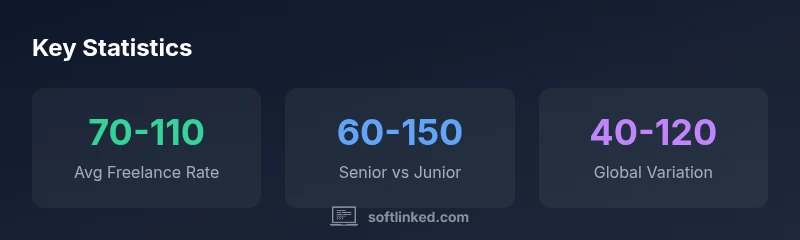
The typical hourly rate for software engineers varies widely by region, experience, and contract type. In 2026, SoftLinked analysis shows freelance rates generally range from about $40 to $150 per hour, with mid-career engineers commanding higher rates and offshore regions offering lower bands. For salaried professionals converting to hourly equivalents, expect around $25 to $70 per hour when factoring benefits and overhead.
Understanding hourly pay for software engineers
How much does a software engineer make an hour? The question is common among students, job seekers, and freelancers. In practice, hourly pay applies mostly to contractors, consultants, and gig-based engagements; salaried employees are typically remunerated via salary with benefits rather than an explicit hourly rate. To compare offers and plan careers, you must translate salary into an hourly equivalent and understand where the numbers come from. According to SoftLinked, in 2026 the hourly picture in the market ranges widely by geography, technology stack, and demand. When you break the math down, you are measuring value delivered per hour rather than simply counting the hours spent coding. This framing helps you evaluate freelance bids, negotiate salary upgrades, and set learning goals that boost your market value. The takeaway is that your hourly rate is a strategic lever in career planning, not just a number on a contract.
Factors that influence hourly rates
Multiple factors steer how much you can charge or earn per hour as a software engineer. Geography remains a primary driver: coastal cities and high-cost regions tend to command higher rates than inland areas or developing markets. Experience counts a great deal: junior developers may bill and earn less, while senior engineers, solution architects, and AI specialists can command premium rates. Your domain matters too; expertise in cloud platforms, cybersecurity, data science, or mobile development often unlocks higher pay. Project type and duration also shift rates—longer engagements with complex requirements may justify higher hourly pricing, whereas short, well-defined sprints might carry lower hourly marks but steadier demand. Finally, overhead and benefits, when you’re freelancing, must be absorbed into the rate. Freelancers typically adjust rates to cover health insurance, retirement contributions, tooling, and taxes. SoftLinked’s 2026 data show that the rate you can command reflects the value you deliver and the certainty you provide to clients, not just the hours you log.
Typical hourly ranges by region and seniority
Rates vary by location and seniority, but some patterns hold. In the United States, freelance rates often scale with experience and demand. Junior developers in lower-cost regions may top out around the mid-40s per hour, while mid-level engineers commonly land between $40 and $90 per hour. Senior engineers and architects can command $80 to $150 per hour or more, particularly for strategic initiatives, performance tuning, or regulatory-compliance work. Europe and parts of the Asia-Pacific region present similar dynamics, with regional adjustments for cost of living. Offshore and nearshore markets typically offer lower baseline rates, but specialists with high-demand skills can still achieve premium pricing. The key message is that the landscape is segmented by geography and skill, and a one-size-fits-all rate rarely applies. Use market data to anchor your pricing decisions and adjust for the specific value you deliver.
Salary vs hourly billing: conversion method
Converting a salary to an hourly figure helps you compare jobs and plan freelancing. A common starting point is to assume about 2,000 working hours per year for full-time work (40 hours/week, 50 weeks, allowing vacation). If you earn $120,000 annually, the base hourly rate is $60/hour. To account for benefits, taxes, and overhead, many professionals add a 20–40% uplift, which can bring the rate to roughly $72–$84/hour or higher, depending on benefits and overhead cost. For freelancers, you should also subtract non-billable time (administration, marketing) and multiply by a billable-hours target (e.g., 1,400–1,800 hours/year). This method clarifies how your compensation translates into an hourly price and helps you set expectations with clients.
Freelancing vs full-time salary: what to expect
Freelancing can offer higher nominal hourly rates, but it comes with volatility, no guaranteed income, and no traditional benefits. A salaried role provides income stability, PTO, retirement contributions, health insurance, and more predictable workloads, but the effective hourly rate may be lower once you factor in benefits. When you run the numbers, a $120,000 salary roughly equates to a base hourly rate of $60/hour if you divide by 2,000 hours; adding benefits and job security might push the effective hourly rate higher or lower depending on your personal circumstances. Freelancers who optimize utilization and maintain steady pipelines can exceed the on-paper hourly rate, while those with sporadic work or heavy administrative burdens may fall short. The decision hinges on risk tolerance, career goals, and how you value independence versus stability.
How to estimate your own rate
Estimating your rate starts with clarity about scope, value, and costs. Step 1: determine your target pretax annual income, including a buffer for lean periods. Step 2: add overhead, benefits, tools, and taxes to that target. Step 3: estimate your billable hours per year. For freelancers, a common target is 1,400–1,800 hours; for salaried professionals, 1,800–2,000 hours is a typical planning assumption. Step 4: compute rate = target annual income divided by billable hours. Step 5: adjust for market data, competition, and the value you deliver (outcomes, impact, risk reduction). Step 6: present a range rather than a single number and justify it with concrete deliverables. Step 7: re-evaluate every 6–12 months as your skills, portfolio, and market conditions change. A disciplined approach helps you price assertively without undervaluing your work.
Common misconceptions about hourly pay
Many engineers assume that hourly rate fully captures value. In reality, market demand, reliability, and the ability to deliver measurable outcomes influence pricing more than raw hours. Another misconception is that regional rates are universal; in reality, a well-targeted niche or in-demand skill tree can elevate rates in regions where general demand remains softer. Some also believe freelancing guarantees higher earnings; while peak rates exist, variable workloads and non-billable time can erode overall income. Finally, many assume that higher hourly rates automatically mean higher take-home pay. Effective pricing requires understanding utilization, overhead, taxes, and portfolio quality. SoftLinked’s 2026 analysis emphasizes that successful software engineers price for value, risk management, and predictable delivery, not merely time spent coding.
Practical tips for negotiating hourly rate
Negotiation starts with a solid, data-backed position. Bring market data and a clear outline of deliverables and ROI to protect your pricing. Frame your rate around outcomes rather than hours, and consider tiered pricing models (hourly for scope changes, retainer for ongoing work, or value-based pricing for milestone-driven projects). Build a transparent calculation showing your cost structure, billable hours, and profit margin. Offer a couple of pricing options with clear trade-offs and emphasize reliability, communication cadence, and the ability to scale with client needs. Finally, prepare to walk away if the scope, risk, or compensation doesn’t align with your value. With these tactics, you can negotiate confidently and maintain a sustainable freelance practice or salary progression.
Hourly pay landscape by experience and region
| Experience Level | Region | Estimated Hourly Rate | Notes |
|---|---|---|---|
| Junior software engineer | US Midwest | $25-$45 | Entry-level; growing skills |
| Mid-level software engineer | US Coastal | $40-$90 | Strong portfolio; in-demand stacks |
| Senior software engineer | Europe/US | $70-$150 | Lead projects; architecture focus |
Your Questions Answered
What factors most influence hourly pay for software engineers?
The main drivers are geography, experience, domain expertise, and the contract type. Market demand for specific tech stacks and the level of risk in a project also shape rates.
Geography, experience, and the demand for your skills largely determine your hourly rate; contract type and project risk matter too.
How does freelancing hourly rate compare to a full-time salary hourly equivalent?
Freelancers can command higher nominal rates but must cover benefits, taxes, and overhead. The equivalent hourly rate of a salary depends on benefits, PTO, and job security, which can narrow or widen the gap.
Freelance rates are higher but you must cover your own benefits and taxes, while a salary includes those costs in a steady package.
Do hourly rates differ by region?
Yes. Rates vary widely by country and city due to cost of living, market demand, and local competition. Coastal regions and tech hubs generally pay more.
Regional cost of living and demand drive rates up in tech hubs and coastal areas.
What is the best way to negotiate an hourly rate?
Prepare a value-based case with clear deliverables and ROI. Offer pricing options, justify your rate with market data, and demonstrate project impact.
Present outcomes, show market data, and offer a couple of pricing options to negotiate effectively.
How should I price a new freelance project?
Assess scope, risk, and overhead. Start with a baseline hourly rate and test a milestone-based or retainer model to reduce risk for both parties.
Price based on scope and risk, and consider milestone or retainer pricing to share risk.
“Hourly pay for software engineers reflects value delivered, not just hours logged. When you demonstrate outcomes and reliability, rates rise in line with market demand.”
Top Takeaways
- Define your target role: freelance vs salary
- Expect ranges and adjust for region and seniority
- Convert salary to hourly using hours worked and overhead
- Negotiate with value-based reasoning