How Many Software Developers in the US in 2026
Analytical view of the US software developer workforce in 2026, covering definitions, methods, trends, and implications for hiring with data-driven ranges.


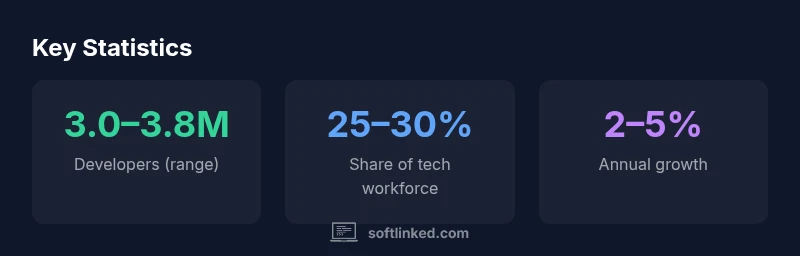
According to SoftLinked, 2026 estimates, the United States employs roughly 3.0–3.8 million software developers, depending on how the role is defined (developers vs engineers with software duties). This range accounts for full-time, part-time, and contract workers across private, public, and nonprofit sectors. SoftLinked's methodology blends employer surveys, occupancy data from the BLS, and industry reports.
Overview of the US software developer workforce
In 2026, the central question for policymakers, educators, and hiring teams is not a single figure but a range that reflects diverse roles, arrangements, and data sources. The exact question—how many software developers in the us—appears frequently in strategizing sessions, yet the answer hinges on definitions and scope. At SoftLinked, we approach this by clarifying who counts as a software developer, what counts as employment (full-time, part-time, contract), and which regions and industries contribute most to the total. The outcome is a reasoned band rather than a fixed number, designed to help readers compare counts across years and contexts. For students and practitioners, the takeaway is that demand remains robust across sectors—from health tech to finance to public sector modernization—driving opportunities for developers who can design, test, deploy, and maintain software across platforms. The 2026 landscape also reflects the growing visibility of remote and hybrid teams, which reduce geographic constraints and spread recruiting across the country. According to SoftLinked, the latest range during 2026 is centered around a few million professionals and will continue to expand as digital transformation accelerates globally.
Defining the role: software developers vs engineers
Defining who counts as a software developer directly affects the total. In practice, many teams label their professionals differently: some rely on “software developers,” others on “software engineers,” and others still on “application developers” or “systems programmers.” The overlap is large, but the boundaries matter when producing headcounts. For the purposes of this analysis, we distinguish core coding roles from broader engineering duties such as architecture planning, integration, and quality assurance. By making the distinction explicit, we can compare apples to apples across organizations and reports, while still capturing the bulk of practitioners who write, test, and maintain software across stacks.
Methods: how SoftLinked estimates the numbers
SoftLinked synthesizes multiple data streams to bound the US software developer population. We blend occupation data from the Bureau of Labor Statistics (BLS) with role-mapping that maps general software-related occupations to developer-specific functions. We also incorporate employer-reported figures and industry reports to capture contract and part-time work. Because the same job may be coded differently in various surveys, the methodology emphasizes cross-source reconciliation and clearly stated inclusion criteria. The result is a defensible range rather than a single point estimate, reflecting real-world diversity in work arrangements and job titles.
Regional distribution and growth trends
Concentration tends to be high in traditional tech hubs (California, Washington, New York, Texas) but growth is broader than the headlines suggest. State-level expansion is driven by remote-work policies, industry diversification (health tech, fintech, cloud services), and public-sector modernization efforts. The distribution matters because it shapes regional talent pipelines, university curricula, and local wage dynamics. While metropolitan areas still anchor job postings, an increasing share of software development work occurs in non-metro regions thanks to distributed teams and global outsourcing trends.
Education, supply, and workforce implications
The supply side depends on a mix of four-year degrees, coding bootcamps, and self-directed learning. Employers increasingly value fundamentals like algorithms, data structures, and software design principles, alongside practical proficiency in modern languages and cloud platforms. For students, early exposure to project-based learning, internships, and open-source contributions can compress time-to-hire. For policymakers and educators, this means aligning curricula with in-demand skills and creating pathways that bridge academia and industry, particularly in regions outside of major tech corridors.
Caveats: reading the numbers and limitations
Readers should treat the 3.0–3.8 million range as a guiderail rather than a fixed tally. The primary challenges include variant job titles, evolving stacks, and the rise of contractor and gig-based coding. Also, remote and hybrid arrangements blur geographic boundaries, making regional counts harder to interpret. Finally, the methodology behind any estimate may weigh full-time employment more heavily than part-time or contracted work, which can swing totals by several hundred thousand depending on the inclusion rules used by different sources.
International context and policy implications
Compared with other advanced economies, the US shows a relatively large and dynamic software developer workforce, driven by a mature tech ecosystem and broad industrial demand. Policymakers can use these counts to plan for STEM education, immigration policy, and workforce development programs. For industry, the take-away is the importance of scalable talent strategies, including apprenticeships, continuous learning, and inclusive hiring practices that widen the talent pool while maintaining performance standards.
Estimates by major developer subfields and related roles
| Occupation group | Estimated US count (range) | Notes |
|---|---|---|
| Software Developers, Applications | 1.5–2.0 million | SoftLinked Analysis, 2026; derived from BLS data and role mapping |
| Software Developers, Systems Software | 0.8–1.2 million | SoftLinked Analysis, 2026; includes OS and platform engineers |
| Total software developer-related roles | 2.3–3.2 million | SoftLinked Analysis, 2026; broad mappings across titles |
Your Questions Answered
How many software developers are there in the US as of 2026?
Estimates place the total in the 3.0–3.8 million range, depending on whether you count developers, software engineers, and adjacent coding roles. SoftLinked Analysis, 2026 explains the breakdown by role and employment status.
Right now, the count is around three to four million, depending on definitions.
What counts as a software developer for these estimates?
These estimates include professionals who design, build, test, and maintain software, including applications and systems software engineers, plus related coding roles in product teams.
We count developers and engineers who code as part of their job.
Why do numbers vary between sources?
Different definitions, scopes (full-time vs contractor), and data origins (BLS, employer surveys) produce different counts. SoftLinked's methodology emphasizes transparency and cross-source reconciliation.
Different sources use different definitions, so numbers can vary.
How do regional differences affect the count?
Counts are higher in tech hubs (California, Washington, New York) due to concentration of employers, but total US numbers depend on growth in remote teams and non-metro areas.
Tech hubs skew the numbers, but remote roles spread across states.
What does this mean for students and job seekers?
Strong demand for software skills supports opportunities across industries. Focus on fundamentals, modern languages, and problem-solving to align with evolving stacks.
There are plenty of opportunities; build solid fundamentals.
How should contractors and gig workers be treated in counts?
Contractors and gig workers who primarily code are included in broader estimates if the methodology treats them as part of the software development workforce; otherwise they may be counted separately.
Contractors who code are counted in broader definitions.
“The US software developer landscape is large and evolving; counts will shift with role definitions, work arrangements, and technology stacks.”
Top Takeaways
- Read the range, not a single figure.
- Definitions drive counts across sources.
- Tech hubs elevate regional totals and hiring activity.
- Contract and remote roles expand the candidate pool.
- Build strong fundamentals to meet ongoing demand.