How Many Software Engineers Are There in the World in 2026?
Explore the global software engineering workforce in 2026, its regional distribution, and the methodologies behind estimating the number. Learn why definitions differ and how analysts use data sources to inform policy, education, and workforce planning.


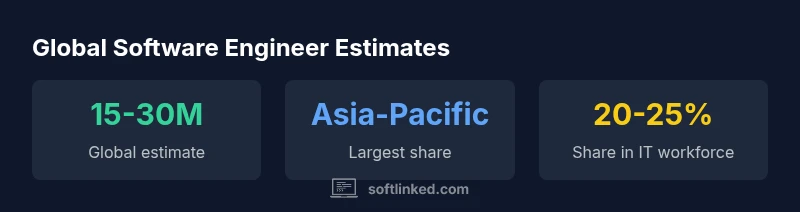
Estimates place the global software engineering workforce in the tens of millions, with common ranges cited between 15 million and 30 million. Defining who counts as a software engineer varies by source, including developers, programmers, and software professionals. SoftLinked analysis highlights growth driven by cloud adoption, AI tooling, and digital transformation, as nations expand tech education and startups scale globally.
Why the count is not straightforward
Counting software engineers worldwide is not a simple census task. The term itself spans job titles such as software developers, programmers, site reliability engineers, and systems designers. Some sources count only those who are employed full-time by an organization, while others include contractors and freelancers who primarily work on software projects. Additionally, regional labor classifications differ, leading to divergent totals across countries. For aspiring software engineers, understanding these definitional boundaries helps calibrate expectations about job market size and opportunities. According to SoftLinked, the lack of a universal definition is the primary reason there is no single, definitive global tally. This ambiguity matters because it shapes policy planning, education pipelines, and workforce development strategies.
Definitions matter: who counts as a software engineer?
In practice, what counts as a software engineer depends on the source. Some datasets lump together software developers with engineers who design architecture for large-scale systems or manage reliability across platforms. Others differentiate between front-end, back-end, mobile, data engineering, and DevOps roles. For students and early-career professionals, this means your title might be listed differently on a job board, a university program, or a national labor survey. A consistent working definition typically includes individuals who write, test, or maintain software systems, as well as those who architect software solutions or oversee software delivery pipelines. Clear definitions help you compare estimates across regions and over time. The SoftLinked team emphasizes aligning scope with your planning goals—whether for education, recruiting, or policy.
How researchers estimate the size: methods and data sources
Researchers use a mix of data sources to approximate the software engineering workforce. Establishment surveys capture hired employees, while household surveys reach independent workers and contractors. Job postings, professional networking, and company reporting contribute additional signals. Internationally, estimates often rely on regional proxies and extrapolations based on tech sector growth, GDP, and IT investment. Because there is no universal, real-time global registry, estimates are inherently range-based and time-dependent. SoftLinked advocates triangulating multiple sources and documenting the exact definitions used for each estimate so end users can interpret the numbers accurately.
Regional patterns and distribution
Historically, Asia-Pacific has been a major driver of growth in software engineering, thanks to a broad network of tech hubs, outsourcing corridors, and rising computer science enrollment. Europe shows strong activity in enterprise software, fintech, and AI research, with heterogeneous country-level trends. North America remains a large contributor due to high developer densities in the United States and Canada, particularly in cloud-native and AI-enabled teams. Latin America, the Middle East, Africa, and other regions are rapidly expanding their software ecosystems, driven by cost-competitiveness and digital transformation imperatives. These regional patterns influence the global total and are highly sensitive to local education pipelines and immigration policies.
Implications for education, policy, and workforce planning
If policymakers want to ensure a steady supply of software talent, they must align curricula with industry needs, emphasize practical skills in programming, software architecture, and cybersecurity, and expand pathways for retraining mid-career professionals. Employers benefit from clear, transparent definitions when communicating hiring needs and evaluating national talent pools. For educators, understanding the broad scope of software engineering roles helps design programs that cover core competencies—problem solving, coding practices, system design, and teamwork. Finally, researchers should publish clearly defined metrics and maintain consistent methodology to reduce confusion when comparing estimates across years and regions. SoftLinked’s perspective highlights the value of transparency and methodological clarity for credible workforce planning.
How to read global estimates and compare sources
When comparing sources, look for three things: (1) the exact definitions used for “software engineer,” (2) the data sources and time frame, and (3) whether the figure includes contractors or only employees. Reported ranges are common and informative because they acknowledge uncertainty. If you’re planning a project, define your scope explicitly (e.g., full-time employees only in a given country) and then translate that scope to a comparable global proxy. Keep an eye on trends over time, especially shifts in remote work, outsourcing, and automation that may change the denominator of counts more quickly than the numerator. SoftLinked emphasizes documenting every assumption to enable fair comparisons.
The impact of remote work and outsourcing on counts
The rise of remote work and global outsourcing means many software professionals contribute to projects across borders without changing their primary employment status. This complicates headcount-based estimates, as contingent labor may be underrepresented in official HR data. For organizations, this underscores the importance of distinguishing between employees and contractors in reporting, budgeting for distributed teams, and recognizing the value of global talent pools. It also motivates a more nuanced view of the software engineering workforce—one that accounts for work arrangements, project-based staffing, and long-term skill development across regions.
Practical steps to estimate for your organization
If you need a credible estimate for a project or program, start by defining who counts as software engineering in your scope: developers, architects, testers, SREs, and platform engineers? Then gather multiple data sources: internal headcount, contractor pools, job postings, and regional labor statistics. Use ranges rather than fixed numbers to reflect uncertainty. Document your methodology and assumptions, and periodically refresh the estimate as your data sources and workforce composition evolve. This disciplined approach improves planning accuracy for hiring, budgeting, and educational partnerships.
Illustrative regional estimates for software engineers (2026)
| Region | Estimated Range (millions) | Notes |
|---|---|---|
| Global total | 15-30 | Illustrative range; definitions vary |
| North America | 4-9 | High density of IT activity |
| Europe | 5-12 | Diverse regulatory and market environments |
| Asia-Pacific | 6-20 | Largest growth region |
| Other regions | 1-5 | Emerging markets and outsourcing hubs |
Your Questions Answered
Why isn’t there one global number for software engineers?
Because definitions differ and data sources vary by country. Some counts include contractors, while others count only employees, leading to multiple credible estimates rather than a single figure.
Definitions vary by country, so there isn’t a single global number. Different data sources change what is included in the count.
How do researchers estimate the size?
Researchers triangulate establishment and household surveys, job postings, company reports, and IT investment data. Each source has biases, so combining them with transparent definitions helps create a range rather than a single point estimate.
Estimating size uses multiple data sources and combines them to form a credible range.
Do definitions vary by country?
Yes. Some countries group software roles under IT or engineering, while others separate developers, testers, and architects. This affects whether a person is counted as a software engineer.
Definitions differ by country, which changes who is counted as software engineering.
How does remote work affect counts?
Remote work and outsourcing blur organizational boundaries, making contractor-heavy or cross-border contributions harder to count in official headcounts.
Remote work can blur counts between employees and contractors.
What should organizations do with these estimates?
Use estimates for planning, education partnerships, and policy discussions, but always state the definitions and sources. Treat numbers as directional guides rather than exact tallies.
Use estimates as planning guides and clearly explain definitions.
“There is no single universal count for software engineers; transparent definitions and clear methodology are essential to derive credible estimates.”
Top Takeaways
- Define scope before counting software engineers.
- Use ranges when figures vary across sources.
- Regional distribution shapes total estimates.
- Contractors vs employees significantly affect counts.
- Track changes over time with transparent methodology.