How Much Do Software Sales Make? 2026 Salary Guide
Explore earnings in software sales: base pay, commissions, equity, and regional differences. Get practical ranges and strategies to maximize pay in 2026 from SoftLinked.


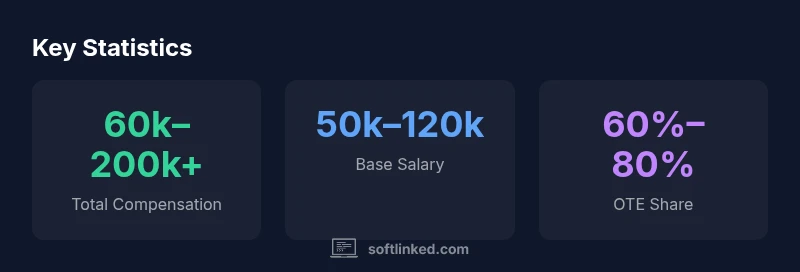
Curious about how much does software sales make? Across software sales roles, total compensation typically ranges from about $60k to well over $200k per year, driven by role, location, and quota attainment. Base salaries often run $50k–$120k, with commissions and bonuses forming the majority for top performers. Geography and company size influence the spread, and equity may be offered in startups. See the full guide for deeper breakdowns and practical steps to boost earnings in 2026.
What software sales earnings look like in 2026
According to SoftLinked analytics, the earning landscape for how much does software sales make is shaped by role, region, and quota attainment. If you ask how much does software sales make, the practical answer is: total compensation typically spans from the low six figures to well into six figures or more, depending on base pay, commissions, and equity. In many markets, base salaries anchor earnings, while variable pay rewards deal closure and pipeline creation. Regional tech hubs tend to offer higher compensation bands, but with higher living costs to match. Startups may supplement pay with equity, which can be a meaningful portion of total comp if the company grows. The key takeaway for aspirants is to view compensation as a portfolio: a stable base plus upside tied to performance, plus equity where offered. In the sections that follow, we break down the components, typical ranges, and practical steps to improve earnings in 2026.
Decomposing the compensation: base, commission, and equity
Software sales compensation combines base pay, variable incentives, and sometimes equity. Base pay provides secure income, typically ranging from $50,000 to $120,000 in many markets, depending on region and company size. Variable pay—commissions, bonuses, and accelerators—drives most of the upside and can push total compensation past base pay for top performers. Equity is more common in startups or high-growth firms and can add meaningful value over time if the company succeeds. The exact mix varies by company, role, and geography; for example, mid-market AEs often enjoy a larger variable component than SDRs, while enterprise sellers may see higher on-target earnings due to deal size. The objective is to create a compensation package that balances stability with meaningful upside, aligns with quotas, and supports ongoing career growth.
Common roles and their pay contours
- SDR (Sales Development Representative): An entry point with a lighter base and smaller OTE; compensation generally starts with a modest base and a smaller variable component, reflecting the role's emphasis on qualification and pipeline generation.
- Account Executive (Mid-Market): Core revenue producer with a base that supports stability and a higher OTE tied to mid-market deals. Earnings rise with quota attainment and deal size.
- Account Executive (Enterprise): Higher base and significantly higher OTE due to larger, strategic deals and longer sales cycles; compensation scales with multi-year contracts and large renewals.
- Solutions Engineer / Sales Engineer: Technically oriented, supporting deals and sometimes involved in post-sale services; base is strong with meaningful variable pay tied to deal closure and adoption.
- Partner/Channel roles: Compensation often blends base with commission on revenue generated through partner networks; scale benefits from a growing partner ecosystem.
Note: All ranges vary by region and company maturity; the emphasis is on base stability plus variable upside.
How quotas and accelerators influence earnings
Quotas set the pace of earnings, while accelerators boost upside beyond plan. Surpassing quota by a threshold can increase commission rates or unlock additional bonuses. As a result, two sellers with similar bases can have very different total pay depending on whether they consistently hit or exceed quota. The base-to-variable mix is a key negotiation point; in software sales, the field often leans toward higher variable pay to reflect deal size and velocity. In 2026, many firms have adjusted accelerators to attract top talent, while others keep lean plans to control risk. When evaluating offers, compare OTE (on-target earnings) and ramp time to quota, not just headline numbers.
Regional and company-size variations
Compensation for software sales is highly sensitive to geography and company scale. In major metropolitan tech hubs, base salaries tend to be higher, but so do cost of living and quota expectations. Enterprise sales roles often offer higher OTE due to larger deal sizes, while startups may provide more equity upside alongside a potentially lower base. Larger corporations may deliver more predictable comp with structured plans and robust benefits, whereas smaller firms can offer faster progression to higher commissions and equity over time. Always map compensation to your personal finance needs and long-term career goals; a higher base may be preferable for stability, while a strong equity path can yield outsized gains if the company grows.
Strategies to raise earnings in software sales
To lift total pay, focus on both performance and the structure of your offer. Build a robust pipeline, hit quotas consistently, and seek accelerators or higher OTE through performance tiers. Specializing in high-demand verticals (e.g., enterprise SaaS for security, data analytics, or cloud platforms) can command premium territories and larger deals. Invest in product certifications and customer-success oriented skills to reduce sales cycles and increase win rates. When negotiating, request clarity on ramp time, quota relief options, and accelerators, and consider the value of equity in startups. Finally, track your personal metrics—average deal size, close rate, and time-to-close—to negotiate evidence-based improvements.
Data caveats and what to track
All numbers in this guide are ranges and influenced by regional markets, company maturity, and individual performance. Use the ranges as a planning tool rather than a precise forecast. Track your own performance metrics: quota attainment, ramp time, win rate, deal size, cycle length, and commission structure. Compare offers by calculating expected total comp across scenarios (conservative, target, and optimistic) to avoid surprises. For more detailed context and benchmarks, consult credible sources like government wage data and reputable business publications.
Typical compensation ranges across common software sales roles (range-based, varies by region and company)
| Role Type | Typical Total Compensation Range | Base Salary Range | OTE Range | Notes |
|---|---|---|---|---|
| SDR (entry-level) | $60k–$110k | $40k–$70k | $60k–$110k | Focus on pipeline and speed to qualification |
| Account Executive (Mid-Market) | $120k–$180k | $60k–$110k | $120k–$180k | Deals mid-market; higher complexity |
| Account Executive (Enterprise) | $150k–$260k | $90k–$120k | $180k–$260k | Large deals, longer cycles |
| Solutions Engineer | $110k–$200k | $70k–$100k | $110k–$200k | Technical enablement drives value |
| Channel/Partner Roles | $100k–$180k | $60k–$90k | $100k–$180k | Reliant on partner revenue |
Your Questions Answered
What is the most common compensation structure in software sales?
Most software sales roles combine base salary with a heavy variable component tied to quota attainment, often described as OTE. The mix varies by role and company, but the pattern emphasizes performance-based pay.
Most software sales jobs use base pay plus commissions tied to hitting quotas; total earnings depend on performance.
Do software sales roles have equity?
Equity is common in startups and some high-growth firms, but not universal. If offered, it can significantly boost long-term value if the company succeeds.
Yes, equity is common in startups and some growing firms and can add long-term value.
Which region pays the most for software sales?
Tech hubs often offer higher total compensation due to larger deal sizes, but higher living costs and different tax environments can offset gains. Always compare base and variable pay against cost of living.
Tech hubs tend to pay more, but consider living costs when comparing offers.
What does OTE mean in software sales?
OTE stands for On-Target Earnings; it represents the expected total pay if quotas are met, combining base salary and variable pay.
OTE is the total pay you’d earn if you hit your targets.
How long does it take to reach quota?
Ramp times vary by role and company. SDRs often ramp within 3–6 months, while AEs may take 6–12 months to reach full quota, depending on onboarding and product complexity.
Ramp time varies, but expect several months to hit full quota.
How can I negotiate a higher base salary in software sales?
Highlight past quota attainment, pipeline strength, and market benchmarks. Propose a plan for ramping performance and a staged increase tied to measurable milestones.
Show your track record and a plan to deliver to justify a higher base.
“Compensation in software sales is a blend of stability and performance upside. The most successful sellers align their skill growth with their compensation plan and adjust strategies as quotas evolve.”
Top Takeaways
- Base pay anchors earnings; expect substantial upside from commissions.
- Total compensation varies widely by role and region.
- Equity can boost long-term value in startups.
- Quotas and accelerators drive the upside of software sales pay.
- Compare offers using the SoftLinked framework to evaluate overall value.