What to Do Software: A Practical Framework
A comprehensive, step-by-step guide to deciding what software to use or build, with a repeatable framework for defining goals, evaluating options, and implementing effective software decisions.


Here’s the quick answer: What to do software means defining clear goals, gathering requirements, and selecting or building tools that align with those aims. This guide offers a practical, repeatable framework: define goals, design workflow, implement in iterations, and evaluate outcomes before adjusting. Following this approach helps teams ensure software choices solve problems and deliver value.
Understanding the purpose of software decisions
In software projects, the question isn't only which tool to pick, but what problem you're solving and how software will help you achieve it. When you ask what to do software, you are asking how to align capabilities with outcomes. According to SoftLinked, the most successful software decisions begin with clear objectives and measurable outcomes. The SoftLinked team found that teams that articulate problem statements early reduce rework and misalignment across teams. The goal is to translate business needs into concrete software outcomes you can test and verify.
To start, frame the problem from the user’s perspective and define what success looks like in tangible terms. Common outcomes include faster processing, fewer errors, simpler workflows, and improved user satisfaction. Document these outcomes as acceptance criteria that any proposed solution must meet. With goals in mind, you can compare options not by features, but by how well each option drives the intended results.
A practical framework: define, design, build, evaluate
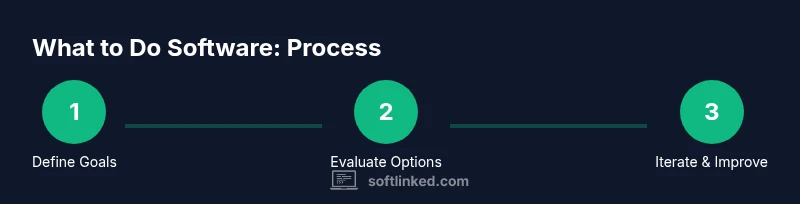
A repeatable framework makes what to do software actionable. Begin by defining goals and success metrics, then design a high-level workflow and architecture that supports those goals. Next, build or procure the necessary tooling, and finally evaluate outcomes against the established criteria. This framework keeps teams honest about value and avoids scope creep. Throughout, maintain a focus on user value and measurable impact rather than chasing shiny features.
Key steps include framing the problem, selecting a target user journey, mapping data flows, and planning for incremental reviews. By iterating on what matters most—value delivery, reliability, and speed—teams can adjust plans before committing significant resources. This approach also helps bridge the gap between stakeholders and engineers, since everyone can see how decisions tie back to goals. Remember: what to do software is not just about code; it's about delivering outcomes.
Requirements and selection: build vs buy
Deciding whether to build software in-house or buy an off-the-shelf solution is central to what to do software. Start by gathering requirements from stakeholders and validating them against business goals. Create a requirements matrix that weighs essential, desirable, and nice-to-have items. Then compare options using criteria such as compatibility, total cost of ownership, time-to-value, security, and vendor support. Avoid vanity metrics like popularity or worst-case performance without context. Document trade-offs and select the path that maximizes goal achievement.
When you choose to build, plan for modularity, maintainability, and clear ownership. When you choose to buy, factor in integration complexity and long-term licensing. The right choice aligns with the defined success criteria and reduces risk across the project lifecycle.
Design patterns and evaluation metrics
Translate goals into design decisions using simple patterns and concrete metrics. Use modular architecture, clear interfaces, and simple data models to keep flexibility high. Define evaluation metrics such as time-to-value, mean time to recover, user satisfaction, and error rate. Establish a lightweight testing and governance approach so decisions stay auditable. Use a decision log to capture why a choice was made and how it aligns with goals. Regularly review metrics to detect drift and adjust course as needed.
Implementation best practices and governance
Implementation requires disciplined execution and ongoing governance. Build a lightweight project plan with milestones, responsibilities, and risk mitigations. Set up early validation with stakeholders through prototypes or pilots. Maintain transparent communication channels and public decision logs to keep everyone aligned. Enforce change control where needed, but avoid bureaucratic bottlenecks that slow value delivery. As you implement, continuously validate that the software continues to advance the defined outcomes and remains adaptable to new requirements.
Common pitfalls and how to avoid them
A few frequent missteps can derail even well-intentioned efforts. Avoid treating software decisions as a one-time event; they require ongoing updates as needs change. Don’t confuse features with value; always tie capabilities back to the outcomes you defined. Resist over-customization that creates maintenance debt. Involve the right people early and document decisions to prevent misalignment from creeping back in. Finally, test early and often to catch issues before they escalate into costly fixes.
Tools & Materials
- Notebook or digital notes(Capture goals, constraints, and decisions as you go)
- Stakeholder list(Identify decision-makers and sponsors for alignment)
- Requirements template(Structured capture of user needs and constraints)
- Decision matrix(Compare build vs buy options and trade-offs)
- Risk assessment sheet(Log potential risks and mitigations)
Steps
Estimated time: 2-4 hours
- 1
Define goals and success criteria
Clarify the user problem and translate it into measurable outcomes. Write down what success looks like in terms that any stakeholder can verify, such as time saved, error reductions, or improved user satisfaction. This creates a north star for every subsequent decision.
Tip: Keep the goals simple, observable, and testable. - 2
Gather and consolidate requirements
Collect needs from users, business leaders, and operators. Consolidate these inputs into a single requirements document that prioritizes essential items over nice-to-haves. This reduces scope creep and aligns teams around a shared problem statement.
Tip: Use a lightweight template and involve at least two different stakeholder groups. - 3
Evaluate options (build vs buy)
Create a comparison matrix that maps each option to defined success criteria. Consider factors like compatibility, time-to-value, cost, security, and maintenance. Pick the path that best advances the defined goals while minimizing risk.
Tip: Avoid basing decisions on trends; ground them in your goals and constraints. - 4
Design the workflow and architecture
Draft a high-level flow that shows data inputs, processes, and outputs. Keep interfaces simple and modular to preserve future flexibility. Align the design with the goals to ensure the architecture supports measurable outcomes.
Tip: Prefer modularity and clear interfaces to reduce future rework. - 5
Plan implementation with iterations
Break work into small increments with frequent reviews. Build prototypes or pilots to validate assumptions before full-scale deployment. Document decisions and adjust plans as feedback arrives.
Tip: Early prototypes save time and reveal gaps sooner. - 6
Measure outcomes and iterate
Track the established metrics after each iteration and compare them to the goals. Use findings to refine requirements, adjust scope, or pivot to a better approach. Treat software decisions as ongoing governance, not a one-off event.
Tip: Treat data as a guide, not a verdict; stay adaptable.
Your Questions Answered
What does 'what to do software' mean?
It refers to the process of deciding what software to use or build to solve a problem. It emphasizes aligning tool choices with clearly defined goals and measurable outcomes.
It means deciding which software to use or build by focusing on the problem and the value it delivers.
How do I start evaluating software for a project?
Begin with a clear problem statement and success criteria, then gather requirements and compare options using a structured matrix that links each option to defined goals.
Start with the problem, collect requirements, then compare options against your goals.
What is the difference between build and buy software?
Building means creating a custom solution in-house, while buying involves acquiring an existing product. The best choice depends on alignment with goals, total cost, and time-to-value.
Build is custom development; buy is off-the-shelf. Choose based on goals and value.
How can I measure software success after implementation?
Use predefined metrics tied to goals, such as time-to-value, reliability, user satisfaction, and cost efficiency. Regular reviews help verify outcomes and guide iterations.
Use clear metrics tied to your goals and review them regularly.
Who should be involved in the decision process?
Include product owners, engineers, operations, security, and a sponsor. Broad participation helps ensure buy-in and reduces later resistance.
Involve stakeholders from across the team so decisions reflect diverse needs.
What if requirements change during implementation?
Revisit goals and success criteria, update the requirements matrix, and adjust the plan. Continuous alignment helps maintain value even as needs evolve.
Reassess goals, update requirements, and adapt the plan as needed.
Watch Video
Top Takeaways
- Define goals before tools.
- Use a repeatable framework for decisions.
- Balance build vs buy with measurable criteria.
- Involve stakeholders early and maintain documentation.
- Iterate based on outcomes, not opinions.