What to Do Application: A Practical How-To Guide
Learn a practical, step-by-step approach to building a clear 'what to do' application that maps user tasks to measurable outcomes, with templates, tooling, and best practices. SoftLinked guiding principles help developers define goals, validate ideas early, and maintain momentum.


Definition: A 'what to do' application is a systematic approach that translates user needs into concrete tasks and outcomes before development. It involves clarifying goals, identifying core user journeys, and mapping each task to measurable results. By defining scope early, teams reduce rework and align stakeholders throughout the project.
Understanding the idea of a 'what to do' application
According to SoftLinked, a clear plan for what to do begins with a precise understanding of user tasks and the outcomes those tasks must achieve. In practice, this means shifting focus from features to outcomes, from screens to flows, and from ideas to testable promises. A 'what to do' approach asks: What is the user trying to accomplish? What will counted as success? How will the team verify progress? The result is a lightweight but rigorous framework that guides every design decision, ensures alignment across stakeholders, and reduces rework. This isn’t a rigid waterfall artifact; it’s a living document that evolves as knowledge grows. For the learner, the core idea is simple: start with the end in mind, then describe the minimal set of tasks that produce that end. This perspective helps beginners and seasoned developers alike to communicate more clearly and deliver more predictable outcomes.
Defining goals and success criteria
Goals are high-level statements about what the application should achieve, while success criteria are specific, measurable tests that prove those goals are met. In this section, we distinguish between business goals (increase retention, reduce time to complete a task) and product goals (simplify a flow, improve accessibility). For each goal, specify success metrics: a metric name, a target value, and a time window. For example, 'Reduce user task completion time from 2 minutes to under 45 seconds within 8 weeks' provides a concrete test. Define constraints such as budget, compliance, and performance ceilings early. Use SMART criteria: Specific, Measurable, Achievable, Relevant, Time-bound. A well-defined goal breakdown beforehand reduces ambiguity and makes future decisions easier. When the team agrees on goals and criteria, you can prioritize tasks around those metrics, ensuring each task contributes to a verifiable outcome.
Mapping user tasks to outcomes
Here we connect user actions to tangible results. Start by listing critical user tasks, then attach an outcome for each task that can be observed or measured. For instance, in an enrollment app, the task 'enter personal details' yields the outcome 'data captured securely', while 'verify email' yields 'email verified'. The mapping should also consider edge cases: missing fields, failed validations, or network delays. Once you have a complete map, review it with stakeholders to ensure every task ties to a desired outcome. This traceability makes it easier to validate later during testing and helps non-technical teammates understand why a feature exists. As you scale, maintain the map in a shared document or board so new requirements can be slotted into the same framework.
Prioritizing tasks for minimal viable scope
Prioritization is about choosing the smallest set of tasks that delivers a usable product. Use a simple framework like MoSCoW or RICE to decide what belongs in your MVP. Start by listing all candidate tasks, then rate each by impact, cost, and risk. The MVP should realize the primary user journeys with minimal friction, while allowing room for future expansion. Be explicit about what is out of scope. Document acceptance conditions for each MVP task so testers know what counts as done. Clear MVP definitions prevent scope creep and help teams align around a common objective. In practice, you’ll often trade fancy features for core outcomes; the best MVPs deliver value faster and with less rework.
Designing a repeatable workflow for teams
To scale the 'what to do' approach, create repeatable workflows. This includes templates for briefs, task-outcome maps, and review rituals. Establish roles: a product owner, a subject-matter expert, a designer, and a tester. Set a cadence for reviews—weekly check-ins, stakeholder demos, and a final sign-off before development begins. A runnable workflow reduces confusion, shortens feedback loops, and ensures that decisions are documented. Emphasize collaboration tools (shared boards, versioned documents) so teams can see changes over time. When new members join, they can ramp up quickly by following the same process. The aim is consistency, not rigidity; your process should adapt as projects evolve, but never at the cost of clarity.
Tools and techniques to capture requirements
Tools and techniques for capturing requirements include interviews, surveys, story mapping, and task-to-outcome mapping. Start with user interviews to surface real needs, then translate those needs into tasks with outcomes that are observable. Story mapping helps visualize flows from user's perspective, while task-outcome maps ensure each task links to a measurable result. Document artifacts such as one-page briefs, acceptance criteria checklists, and lightweight prototypes. Prefer collaborative tools: boards, live documents, and diagrams that multiple people can edit. These artifacts serve as a single source of truth for everyone involved and support traceability as the project progresses.
Quality assurance and validation early
Validation should happen as early as possible—before heavy development begins. Use reviews with stakeholders, run quick usability checks, and create lightweight prototypes to test critical paths. Define acceptance criteria for each task-outcome, then verify through small, repeatable tests. Track issues in a central system and link each issue to the affected task-outcome pair. The goal is to catch misunderstandings early and prevent expensive rework later. If testing reveals gaps, adjust the task mapping or success criteria and re-run the validation loop. Early QA reduces risk and builds confidence across teams.
Common pitfalls and how to avoid them
Pitfalls include vague goals, over-scoped MVPs, and misaligned stakeholders. To avoid them, keep goals tight, define measurable outcomes, and maintain a transparent decision log. Avoid conflating 'requirements' with 'solutions'—focus on the problem to be solved, not the specific technology. In distributed teams, miscommunication magnifies quickly; use diagrams and ongoing demos to maintain alignment. Regularly revisit the mapping as new information emerges, and prune tasks that don't contribute to outcomes. The most successful teams use a living document that evolves with feedback rather than a static plan.
Practical roadmaps and templates
Provide ready-to-use templates: 1) a one-page brief outlining goals, success criteria, and scope; 2) a task-to-outcome map showing each task and its measurable result; 3) an MVP backlog with acceptance criteria; 4) a stakeholder sign-off checklist. A lightweight template set can be stored as a shared document or on a collaborative board. When you share templates, add example entries to demonstrate how to fill them. Templates save time, improve consistency, and help new team members integrate quickly.
Integrating with development cycles and feedback loops
Embed the 'what to do' approach into your development cadence. Start with discovery work in the planning phase, then review the task-outcome map during sprint planning. Maintain a constant feedback loop with users and stakeholders through demos, usability tests, and post-release reviews. Tie each release to a small set of validated outcomes, not just features. Over time, you’ll build a library of validated task-outcome pairs that guide future work and reduce risk.
Long-term maintenance: evolving the what to do application
Your mapping will need updates as user needs change and technology evolves. Establish a cadence for revisiting goals and success criteria—quarterly reviews work well for many teams. Maintain versioned documents, audit trails, and a change-log so decisions are traceable. Consider implementing a lightweight governance model to handle scope changes and new stakeholders. This forward-looking discipline keeps the 'what to do' approach relevant across projects and across teams, ensuring that the application continues to produce intended outcomes.
Tools & Materials
- Project brief template(One-page document detailing goals, scope, and success criteria.)
- Stakeholder interviews or user stories(Collected data on user needs and business context.)
- Task-outcome mapping board(A board or spreadsheet linking each task to an observable outcome.)
- User journey sketches(Low-fidelity visuals to illustrate flows.)
- Acceptance criteria templates(Checklists to define 'done' for each task.)
- Template for one-page briefs(Optional additional templates.)
- Collaboration software access(Access to shared docs, boards, diagrams.)
Steps
Estimated time: 2-5 days
- 1
Define the problem space
Clarify the business and user problems the application must solve. Gather context from stakeholders and user interviews, focusing on outcomes rather than features. Capture constraints, risks, and success criteria to guide later decisions.
Tip: Start with user quotes and real-world tasks to keep the scope human-centered. - 2
Identify core user journeys
Map the main flows users will follow to achieve their goals. Include entry points, decision points, and potential friction. Prioritize journeys that deliver the most value with the least effort.
Tip: Use a journey-mapping tool or board so teams can comment and iterate quickly. - 3
List tasks and attach outcomes
For each journey, enumerate the essential tasks and assign a measurable outcome to each. Ensure every task has a clear observable result that validates success.
Tip: Keep outcomes testable and non-ambiguous to ease later validation. - 4
Draft acceptance criteria and success metrics
Create specific acceptance criteria for each task-outcome; define how you’ll measure success and what constitutes 'done'.
Tip: Tie criteria to real user benefits to avoid feature bloat. - 5
Create a lightweight requirements brief
Consolidate goals, scope, and success criteria into a concise brief that can be shared with stakeholders for sign-off.
Tip: Aim for a one-page document to reduce cognitive load. - 6
Prototype the workflow
Sketch a simple prototype or mock flow that demonstrates the core journeys and their outcomes. This helps stakeholders visualize the plan.
Tip: Low-fidelity prototypes are faster to modify than polished designs. - 7
Validate with stakeholders
Present the task-outcome map and brief to key stakeholders. Gather feedback and confirm alignment on goals and criteria.
Tip: Schedule a focused review session with a clear agenda. - 8
Align with the development plan
Cross-check the mapped tasks with the product backlog and release roadmap to ensure feasibility and timing.
Tip: Identify any dependencies early to prevent surprises. - 9
Establish feedback loops
Set up ongoing feedback channels with users and internal teams to refine tasks and outcomes as needed.
Tip: Make feedback a regular habit, not a one-off activity.
Your Questions Answered
What exactly is a 'what to do' application?
It is a planning approach that translates user needs into concrete tasks and measurable outcomes before building. The focus is on outcomes and validation, not just features.
A planning approach that turns user needs into tasks and outcomes before coding.
How is this different from a traditional requirements document?
Traditional requirements often specify features; a 'what to do' framework centers on the tasks users perform and the outcomes they should achieve, with measurable criteria.
It emphasizes tasks and outcomes over feature lists.
Who should own this process in a team?
Typically a product owner or a systems designer leads, with input from design, engineering, and QA to ensure cross-functional alignment.
Usually the product owner guides it, with team input.
What tools help implement this approach?
Story maps, task-outcome boards, lightweight briefs, and collaborative docs help capture and share the mapping.
Story maps and task boards are especially helpful.
When should you start applying this method?
Begin at project initiation or during early discovery to shape scope before heavy development.
You can start at the project’s discovery phase to set scope.
Can this approach scale for large projects?
Yes, by maintaining living documents, governance for changes, and modular task-outcome mappings that can grow incrementally.
It scales with a living, modular mapping and governance.
Watch Video
Top Takeaways
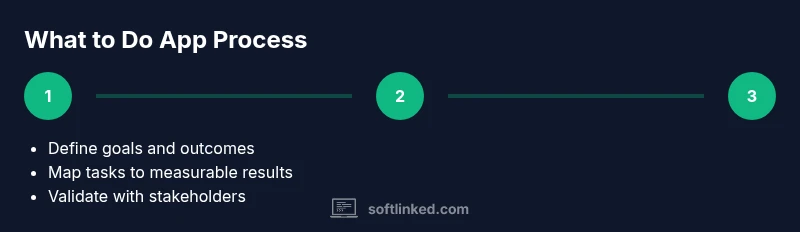
- Define goals and outcomes before building
- Map tasks to measurable results
- Prioritize MVP to reduce risk
- Involve stakeholders early and often
- Establish repeatable workflows for scale