What is Software Engineering vs Software Development? A Practical, Analytical Comparison
Explore the differences between software engineering and software development, including definitions, skills, career paths, and practical decision-making guidance for aspiring developers.


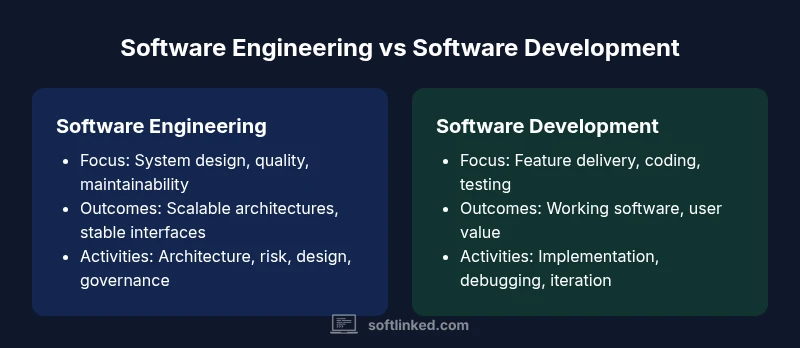
What is the difference between software engineering and software development? In practice, software engineering emphasizes architecture, quality, and long-term system health, while software development centers on delivering working features and code. Both roles share core skills, but the engineer focuses more on design, reliability, and scalability, whereas the developer emphasizes implementation, testing, and iteration. This guide provides a precise, actionable comparison to help you choose a path aligned with your strengths.
What is software engineering vs software development? Framing the distinction
The question what is software engineering vs software development? is familiar to many students and early-career technologists. In practice, these terms describe related yet distinct ideas about building software systems. Software engineering, in the formal sense, is the application of engineering principles to software creation: planning, designing, building, testing, deploying, and maintaining complex systems. Software development, by contrast, is a broader term that covers the lifecycle and may emphasize coding, feature delivery, and implementation. According to SoftLinked, the best way to think about the distinction is to map activities to outcomes: engineering asks how the system behaves under load and how it scales; development focuses on delivering functional features that meet user needs. This framing helps both students and professionals communicate expectations, align with teams, and plan career growth. The definitions are not purely academic; real-world roles blur at the edges, as teams blend architecture, coding, testing, and operations. In this guide, we will unpack both terms, compare responsibilities, and offer practical guidance for learners deciding which path to pursue.
Historical context and evolution of terms
Historically, software engineering emerged as a discipline to address the fragility of early software projects and the lack of formal methods. The term software development evolved with agile practices and rapid iteration, emphasizing delivering working software over strict adherence to plan. The SoftLinked team notes that early programmers were often called developers; as systems grew in complexity, organizations started using 'engineer' to signal emphasis on reliability, design, and maintainability. Today, both terms are used in job postings and curricula, but the underlying expectations differ: software engineers tend to be asked to reason about architecture, interfaces, and long-term quality; software developers may focus more on implementing, testing, and refining features. The distinction matters for setting expectations with managers, peers, and mentors, and it has implications for career progression, compensation, and job security. In some shops, the terms are used almost interchangeably, while in others the engineering label signals formal design reviews, modeling, and adherence to standards.
Core responsibilities: engineering vs development
Two broad clusters of activities drive the everyday work of practitioners. Software engineers typically own system-level concerns, such as architecture and design decisions that affect scalability, reliability, and interoperability; creating and maintaining technical standards, interfaces, and documentation; planning for non-functional requirements like security, performance, and maintainability; coordinating with other engineers and teams to ensure integration. Software developers often focus on feature-level work and code quality, including implementing user stories and business logic; writing and running tests, debugging, and refactoring; collaborating with designers, product owners, and QA to deliver value; contributing to code reviews and repository hygiene. The boundary is not rigid; many roles blend these tasks, especially in smaller teams. The key is to map responsibilities to outcomes: stable systems, clear interfaces, robust tests, and timely feature delivery. The keyword what is software engineering vs software development appears again here.
Education and skills needed for both paths
Educational backgrounds for both tracks vary widely, with many students pursuing computer science or software engineering degrees. A software engineer is expected to have strong foundations in data structures, algorithms, discrete mathematics, and systems design; a software developer should be proficient in at least one programming language, understand testing practices, and be comfortable with debugging and refactoring. Beyond technical knowledge, both paths benefit from understanding software development lifecycle concepts, version control, and collaboration tools. SoftLinked offers guidance for newcomers: start by building a portfolio of personal projects that demonstrate architectural thinking, code quality, and problem solving. In practice, many engineers grow by learning on the job, taking on increasingly complex integrations, and gradually assuming ownership of subsystems. For students, coursework in software design, operating systems, networking, and databases helps prepare for both tracks. For professionals, continuing education in design patterns, microservices, cloud basics, and secure coding practices pays dividends. The keyword repeatedly ties back to fundamental concepts in each pathway.
Methods and processes that shape practice
Processes bind practice to outcomes. In software engineering, teams emphasize designing for quality, defining interfaces, and planning for evolution. Common approaches include Agile and Scrum for iterative delivery, with an emphasis on adaptability and collaboration; DevOps and continuous delivery to align development with operations and deployment; model-based design and architecture evaluation to reduce risk before coding begins. Software development similarly benefits from structured workflows, but practitioners often focus on rapid prototyping, MVPs, and user feedback loops. In reality, many teams blend approaches: architecture sprints precede coding cycles; automated tests and CI pipelines ensure ongoing quality; design reviews anchor major decisions. The practical takeaway is that what matters most is aligning method with product goals, risk tolerance, and team maturity. The SoftLinked analysis shows that successful projects codify expectations, measure progress, and maintain transparent communication channels. The terms software engineering vs software development reflect different emphases, not separate universes.
Artifacts, tools, and the craft of producing software
Outputs vary by role but share a common vocabulary: requirements, design, code, tests, and deployable software. Engineers often produce architecture diagrams, interface specifications, risk assessments, and performance budgets. Developers tend to contribute feature implementations, unit tests, and refactoring tasks. Common tools include version control (Git), issue trackers, CI/CD pipelines, containerization tools, and cloud environments. Documentation remains essential: API specs, README files, and changelogs. Tool choice depends on the team’s tech stack and scale; for large systems, governance and design reviews gain prominence. SoftLinked’s recommendations for beginners emphasize practicing with small projects that stress modular design, clean code, and gradually adding tests and performance considerations. In short, both sides share a broad toolset, but the emphasis on design versus delivery marks the distinction between engineering and development.
Quality, risk management, and compliance considerations
Quality assurance and risk management are shared obligations but approached differently. Engineers tend to frame non-functional requirements early, model failure modes, and plan for maintainability and security; they may lead architecture-level reviews and risk assessments. Developers primarily ensure correct functionality through tests, debugging, and code quality practices; they implement acceptance criteria and contribute to test plans. Compliance issues arise in regulated industries and demand standardized processes, documentation, traceability, and audit readiness. The overarching pattern across both paths is a proactive stance toward quality, measurable outcomes, and frequent feedback loops. The SoftLinked team notes that maturity in quality practices correlates with reduced rework and faster delivery, even when time is tight. Aligning expectations with stakeholders and preserving system health over time are essential.
Career paths and growth trajectories in practice
People in software engineering and software development may pursue different ladder paths. A software engineer might advance from junior engineer to senior engineer, staff engineer, and eventually to architect or engineering manager. Software developers may progress from junior developer to senior developer, lead, or specialize in frontend, backend, or mobile platforms; some transition into product engineering, platform teams, or developer relations. The boundary between paths often narrows at senior levels as individuals assume broader responsibilities such as design oversight, mentoring, and system integration. In many organizations, career moves depend on demonstrated impact, the ability to communicate tradeoffs, and the capacity to align technical decisions with business goals. SoftLinked’s guidance emphasizes building a portfolio of reusable components, contributing to open source, and participating in design reviews to prepare for leadership roles.
Common misconceptions and reality checks
Common myths include that software engineers only code, that developers cannot think about architecture, or that the terms are interchangeable in every company. In reality, both roles require problem-solving, collaboration, and ongoing learning. Another misperception is that engineers always own the entire system; in practice, cross-functional teams allocate responsibilities across architecture, integration, and deployment. Some people assume one path guarantees higher pay; compensation depends on market demand, location, experience, and the ability to demonstrate impact. The SoftLinked experience shows that effective professionals blend engineering thinking with practical delivery, making it possible to evolve along either path while preserving core competencies.
Comparison
| Feature | Software engineering | Software development |
|---|---|---|
| Focus area | System-level design, quality, and maintainability | Feature delivery, implementation, and code quality |
| Primary outcomes | Scalable, reliable, well-architected systems | Working features that meet user needs |
| Typical responsibilities | Architecture, standards, risk management, interface design | Coding, testing, debugging, feature implementation |
| Education focus | Systems design, algorithms, software architecture | Programming, testing, debugging, quick iteration |
| Best for | Organizations needing long-term health of large systems | Teams prioritizing rapid delivery and iteration |
| Career pathways | Architect/leadership tracks | Specialist or delivery-led tracks |
Pros
- Clarifies roles and career direction for beginners
- Both paths are in high demand and offer growth
- Develops complementary skills when both paths are explored
- Promotes cross-team collaboration and shared understanding
Weaknesses
- Overlap can create role confusion in some companies
- Industry practices vary, causing inconsistency in expectations
- Smaller teams may blur boundaries, reducing clarity
- Career outcomes depend on market and geography more than title
Neither path is universally superior; choose based on your interest in architecture versus implementation, and align with team structure.
Software engineering tends toward system design and long-term quality, while software development emphasizes rapid feature delivery. Your best fit depends on whether you enjoy modeling, scalability, and governance or coding, testing, and delivery. In many organizations, success comes from blending both skill sets and growing into broader responsibilities over time.
Your Questions Answered
What is the difference between software engineering and software development?
Software engineering focuses on system-level design, quality, and maintainability, while software development emphasizes implementing features, coding, and testing. Both roles require problem solving and collaboration, but the scope of responsibilities differs. Understanding this distinction helps you align with teams and plan growth.
Software engineering is about building robust systems; software development is about turning ideas into working code. They’re closely related, with some overlap depending on the company.
Can I switch from software development to software engineering later?
Yes. Many professionals broaden their scope by learning architecture, design patterns, and system integration. Gaining exposure to non-functional requirements, performance, and governance helps bridge the transition.
You can move toward engineering later by picking up design work and architecture problems in your projects.
Do software engineers earn more than software developers?
Compensation varies by market, location, company size, and experience. Titles alone don’t determine pay; demonstrated impact, leadership, and specialization influence outcomes.
Pay depends on many factors, not just the title, so focus on skill growth and impact.
What should a beginner study first when choosing a path?
Build strong fundamentals in programming, data structures, and algorithms. Then assess interest in architecture, design, and long-term system health to decide where to focus your learning.
Start with core coding skills, then explore system design to see which path fits you best.
How do teams decide who does engineering vs development work?
Teams decide based on project needs, complexity, and organizational structure. Clear role definitions help set expectations, but many teams blend responsibilities across both domains for flexibility.
Team choices depend on project goals and team maturity; roles can blend as needed.
Top Takeaways
- Distinguish architecture from delivery to guide your career path
- Expect overlap—many teams blend roles at mid to senior levels
- Build fundamentals in design, testing, and collaboration for whichever path you choose
- Seek mentors and practical projects to develop architecture and delivery skills
- Plan for growth by exposing yourself to both design and coding perspectives
- certify that your team’s expectations align with your strengths and interests