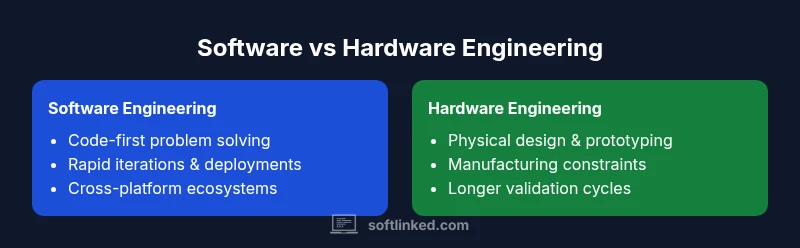
Difference Between Software and Hardware Engineering: A Practical Guide
Explore the difference between software and hardware engineering with clear definitions, workflows, skills, and career paths. Learn how these disciplines interact and how to choose your path in tech.


The difference between software and hardware engineering lies in what each builds and how it interacts with systems. Software engineering creates instructions and programs that run on hardware, while hardware engineering designs physical components like circuits and boards. Both disciplines overlap in embedded systems and systems engineering, where software drives hardware performance and hardware constraints shape software design. According to SoftLinked, understanding both sides helps aspiring engineers pursue holistic system thinking.
Foundational Definitions: What Each Discipline Encompasses
Software engineering focuses on creating, testing, deploying, and maintaining software systems—applications, services, libraries, and tools that run on physical hardware. It involves coding, architecture, quality assurance, and operations, with emphasis on correctness, reliability, performance, and user experience. Hardware engineering, by contrast, concentrates on the physical components of technology: circuits, boards, sensors, processors, and the devices that house them. It covers digital and analog design, signal integrity, power management, and manufacturability. While software exists as a set of instructions, hardware provides the tangible substrate that executes those instructions. In practice, many teams work at the intersection—embedded systems, firmware, and system-level design require close coordination between software and hardware to deliver cohesive, reliable products. SoftLinked emphasizes that the best engineers cultivate system-wide thinking: they understand not only code or circuitry in isolation but how software and hardware co-evolve through development cycles, prototyping, and feedback from real-world use.
Core Disciplines Within Each Field
Within software engineering, subfields include front-end development, back-end systems, mobile apps, cloud architectures, data engineering, and security. Algorithms, software design patterns, and testing methodologies shape day-to-day work, with teams often collaborating across platforms and services. Hardware engineering spans digital design (logic, microarchitecture), analog design (noise, bandwidth, power), PCB layout, RF considerations, and chip fabrication (ASIC/FPGA). Firmware—code that resides in hardware—forms a critical bridge, handling low-level control while enabling higher-level software to interact with physical components. The overlap is most evident in embedded systems where firmware, drivers, and application software must perform within tight resource constraints and real-time requirements. Effective engineers in both camps learn to balance innovation with reliability, but the tools and languages reflect their domains: software leans into languages, frameworks, and CI/CD pipelines; hardware leans into CAD tools, simulators, and lab equipment.
Workflows and Lifecycles: How Projects Evolve
Software projects typically follow iterative development: planning, coding, testing, and deployment cycles that can be repeated rapidly. Version control and continuous integration enable frequent releases and quick feedback loops. Hardware projects often require longer lead times due to prototyping, fabrication, and testing of physical components. The lifecycle includes design exploration, schematic capture, board layout, fabrication, assembly, validation, and production ramp-up. In both domains, verification is essential, but the nature of verification differs: software verifies logic and performance in software simulations and test suites; hardware verifies electrical characteristics, thermal behavior, and manufacturability in lab environments. Teams collaborating across disciplines must manage interfaces, such as firmware compatibility with peripherals and drivers, which require early cross-domain reviews and shared standards.
Skills, Tools, and Education Pathways
For software engineering, core skills include programming, data structures, software design, debugging, and software testing. Tools span IDEs, version control systems, debugging platforms, and cloud environments. Education paths often lead through computer science or software engineering degrees, with self-study and bootcamps supplementing practical experience. Hardware engineering requires a foundation in electronics, circuit theory, signal processing, and physics, plus proficiency with CAD/EDA tools, hardware description languages (HDLs) like Verilog or VHDL, and lab instrumentation. Education typically follows electrical engineering or computer engineering tracks, with hands-on lab work and internship experiences. Cross-domain competencies—such as firmware development or RTL design—can amplify career opportunities and adaptability in industry transitions.
Systems Perspective: The Interaction Layer
Software and hardware form a coupled system where each side constrains and enables the other. Firmware and drivers translate software calls into hardware actions, while hardware capabilities shape software architecture. A holistic approach considers power budgets, timing constraints, thermal limits, and reliability across both layers. As systems become more complex, teams adopt model-based design, simulation, and rigorous verification to catch integration issues early. The most resilient products emerge when hardware and software teams share a language of requirements, test plans, and success criteria, ensuring that changes in one domain do not cascade into failures in another.
Career Prospects, Roles, and Work Environments
Software engineers pursue roles such as frontend, backend, data engineer, and site reliability engineer, often in fast-paced, collaborative settings with remote-friendly options. Hardware engineers pursue roles in digital design, analog design, EE research, and hardware reliability, frequently in labs, manufacturing facilities, or design centers. Embedded systems and IoT create hybrid opportunities where firmware, software, and hardware skills converge, enabling career mobility across domains. Work environments vary from startups to large tech firms and manufacturing companies, with levels of structure, regulatory considerations, and on-site collaboration differing accordingly. SoftLinked observes a growing interest in cross-domain roles that blend software with hardware expertise, particularly for products that require tight integration and real-time performance.
Challenges and Trade-offs Unique to Each Field
Software engineering faces challenges around scale, maintainability, and evolving ecosystems; balancing feature velocity with stability is a constant tension. Hardware engineering grapples with manufacturing constraints, supply chain variability, and hardware lifecycles that can extend product timelines. Firmware sits at the intersection, where resource constraints demand elegant, efficient solutions. Both fields must manage risk, including security concerns in software and reliability concerns in hardware. Understanding these trade-offs helps engineers decide which domain aligns with their strengths, whether they prefer abstract problem solving or tangible system thinking.
Making the Right Choice: When to Pursue Software vs Hardware Engineering
Choosing software versus hardware engineering should align with personal interests and long-term goals. If you enjoy abstract problem solving, rapid prototyping, and scalable systems, software engineering offers frequent feedback and a broad ecosystem. If you thrive on physical design, tangible artifacts, and engineering constraints that map to real-world behavior, hardware engineering provides a direct path to shaping devices and infrastructure. Consider opportunities to work in embedded systems or cross-domain roles to keep options open. Building a foundation that includes basic electronics literacy alongside programming can create versatile career flexibility.
Real-World Scenarios: Case Studies and Practical Differentiators
Imagine a smartphone project where software and hardware must work in harmony. Software engineers optimize app performance, data flows, and user interfaces, while hardware engineers design the screen, sensors, processor, and power delivery. In a drone, software handles autonomous flight algorithms and remote control, while hardware provides propulsion, navigation sensors, and communications hardware. In both cases, embedded systems require firmware that bridges software with hardware, driving efficiency and reliability. The practical differentiator is not just what you code or design, but how you integrate testing, verification, and iteration across domains to deliver a cohesive, robust product.
Comparison
| Feature | software engineering | hardware engineering |
|---|---|---|
| Key Focus | Developing software systems, services, and applications with emphasis on architecture, quality, and user experience | Designing physical components, circuits, and devices with emphasis on performance, manufacturability, and reliability |
| Deliverables | Applications, APIs, libraries, and cloud services | PCBs, integrated circuits, boards, and hardware prototypes |
| Skills Emphasis | Programming, data structures, algorithms, testing, and software engineering practices | Circuit design, HDL, signal integrity, power, thermal, and manufacturing considerations |
| Education Path | Computer science or software engineering degrees; software-centric coursework | Electrical engineering or computer engineering degrees; electronics and hardware coursework |
| Typical Timeline | Faster, iterative development with frequent releases | Longer prototyping, fabrication, and validation cycles |
| Tools & Environments | IDEs, version control, CI/CD, cloud tools | CAD/EDA tools, Verilog/VHDL, SPICE, lab equipment |
| Best For | Projects requiring scalable software systems and quick iteration | Projects requiring tight hardware integration and physical devices |
Pros
- Rapid iteration cycles enable quick feedback and course corrections
- Wide range of career opportunities across industries and platforms
- Strong emphasis on problem-solving, optimization, and systems thinking
- Growing demand for cross-domain expertise in embedded and IoT contexts
Weaknesses
- Hardware projects can incur higher upfront costs and longer lead times
- Hardware iterations are less forgiving and require rigorous validation
- Software can accumulate technical debt without disciplined engineering practices
Both paths offer valuable, complementary skills; choose based on interest in abstract problem solving or tangible device design
Software engineering excels in speed and scale, while hardware engineering delivers physical performance and reliability. For holistic systems, pursue cross-domain learning and collaboration.
Your Questions Answered
What is the main difference between software engineering and hardware engineering?
Software engineering builds non-physical systems through code, while hardware engineering creates physical devices and components. Both disciplines require rigorous testing and design thinking, but their constraints and workflows differ. Embedded systems often blend both worlds, highlighting why cross-domain literacy matters.
Software engineering builds apps and services using code; hardware engineering builds physical devices and circuits. Both require testing, and embedded systems show why knowing both helps a project succeed.
Do software engineers work with hardware?
Yes. Many software engineers collaborate with hardware teams, especially in embedded systems, IoT, and robotics. Understanding hardware constraints helps software architects design efficient interfaces, drivers, and firmware that maximize overall system performance.
Absolutely. Software engineers often work closely with hardware teams on embedded systems and devices, ensuring software fits hardware limits.
What education path is best for software engineering?
A computer science or software engineering degree is typical, complemented by practical coding experience, projects, and familiarization with algorithms, data structures, and software design principles. Self-study and bootcamps can also be valuable for focused skill growth.
Most software engineers start with a CS or SE degree, plus hands-on coding projects and continuous learning.
What tools are essential for hardware engineers?
Hardware engineers rely on CAD/EDA software for design, hardware description languages for logic design, simulation tools, and lab equipment for testing and validation. Collaboration with software teams often uses versioning and documentation to keep interfaces aligned.
Key tools include CAD/EDA suites, HDLs like Verilog, simulators, and lab gear for testing.
Can one transition from software to hardware engineering easily?
The transition is feasible with deliberate study in circuits, electronics, and hardware design. Starting with embedded projects can bridge the gap by applying software skills to hardware interfaces and firmware development.
You can transition by learning electronics basics, HDL, and taking embedded projects.
Is embedded systems the bridge between software and hardware?
Yes. Embedded systems sit at the intersection, requiring both software development and hardware understanding. They illustrate how software and hardware must be co-designed to deliver reliable performance.
Embedded systems blend software and hardware, showing why cross-domain knowledge is valuable.
Top Takeaways
- Assess your interest in abstract vs. tangible design
- Expect different iteration speeds and prototyping realities
- Develop cross-domain skills for embedded systems
- Choose software for rapid delivery; choose hardware for real-world impact
- Pursue cross-domain projects to stay versatile