What is firmware compared to software? A Practical Guide
Explore the differences between firmware and software, their update processes, hardware coupling, and practical implications for developers. Learn how to design for reliability, security, and maintainability in a world of embedded and general-purpose code.


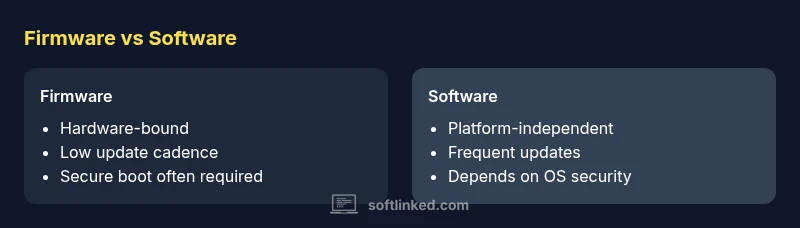
What is firmware compared to software? Firmware is specialized, hardware-bound code that initializes and controls device hardware, often stored in non-volatile memory and updated through manufacturer processes. Software is more generic, runs on general hardware, and provides user-facing features, OS services, and applications. Together they define how devices behave and how developers approach reliability, updates, and security. In practice, firmware updates are less frequent and tightly controlled, while software updates are more frequent and ecosystem-driven.
What is firmware compared to software? (Foundations and boundaries) In practical terms, firmware sits at the boundary between hardware and software. It includes the essential instructions that make hardware components boot, initialize sensors and actuators, and set up the minimal runtime environment required for the device to function. The question what is firmware compared to software becomes a discussion of persistence and immediacy: firmware is typically stored in non-volatile memory and runs with high priority, sometimes from power-on, before higher-level software can take control. Software, by contrast, is a broader category that includes applications, libraries, and operating systems designed to run on a variety of hardware configurations. The keyword what is firmware compared to software helps teams map responsibilities: firmware handles reliable hardware behavior; software builds on top of that foundation to deliver user experiences and system services.
Evolution of boundaries: from ROM to updateable firmware to modern embedded software. Historically, firmware lived in read-only memory (ROM) or programmable non-volatile storage that was hard to modify. As devices evolved, manufacturers introduced update mechanisms that could patch firmware without disassembling hardware, yielding a continuum rather than a strict divide. This shift makes the concept what is firmware compared to software even more relevant: updates can fix low-level defects, improve power management, or extend device functionality while preserving hardware compatibility. However, the line remains: firmware remains tightly coupled to the hardware it serves, while software emphasizes flexibility, interoperability, and user-facing capabilities. The distinction guides how teams plan testing, rollout strategies, and rollback options.
Scope and responsibilities: where firmware ends and software begins. When teams discuss what is firmware compared to software, they are really delineating responsibilities. Firmware often implements device initialization, clock configuration, peripheral enablement, and basic I/O control. Software provides the richer logic, data processing, user interfaces, and network communication. In practice, this means firmware changes tend to require specialized tools, lab validation, and sometimes vendor certification. Software changes leverage conventional development pipelines, versioning, automated testing, and more frequent releases. Understanding this separation helps clarify regulatory requirements, safety considerations, and the risk profile of each update.
Update cadence and distribution channels. The cadence of updates is a practical differentiator in the what is firmware compared to software discussion. Firmware updates are typically scheduled, versioned, and deployed through controlled channels such as manufacturer firmware servers, secure boot checks, and signed packages. These updates may require downtime or service interruptions to ensure hardware remains in a valid state. Software updates can often be delivered incrementally through app stores, package managers, or online services, enabling rapid iteration and A/B testing. The distribution channel itself shapes security practices, with firmware updates placing a premium on secure boot, trusted provenance, and hardware attestation, while software updates emphasize continuous integration, dependency management, and ecosystem stability.
Security and trust: hardware-rooted versus software-driven. In many devices, firmware security is foundational; a compromised firmware can undermine the entire system and bypass higher-level protections. Security measures such as secure boot, code signing, and immutable regions are common in firmware to establish trust from the moment the device powers on. Software security, while equally important, often relies on layered defenses, patch management, and runtime protections like sandboxing. The what is firmware compared to software framing thus highlights different threat models and defense-in-depth strategies. Engineers must design for both worlds: firmware with hardware-backed guarantees and software with adaptable, user-centric security improvements.
Real-world implications: performance, reliability, and repairability. From telecom routers to automotive ECUs and consumer electronics, firmware governs critical low-level operation, power management, and sensor interfacing. Software delivers features, usability, and adaptability. The practical takeaway from the what is firmware compared to software lens is that performance and reliability hinge on well-planned update schemes, robust testing, and clear ownership. In some contexts, a minor firmware fix can prevent costly failures; in others, a software update can dramatically improve user experience. Designers must balance these factors when architecting a product road map.
Lifecycle planning and maintenance strategies. A robust strategy recognizes that firmware choices influence lifecycle decisions and maintenance budgets. Firmware updates require careful change control, validation, and recovery mechanisms to prevent bricking devices. Software updates allow more agile iteration but demand strong dependency management and backward compatibility. The interplay between firmware and software shapes testing matrices, hardware compatibility checks, and customer support expectations. Teams should document ownership, update policies, and rollback processes to minimize risk while maximizing device longevity.
Practical guidance for developers: when to touch firmware vs software. In projects, ask: does the change affect hardware behavior or user-facing features? If you’re modifying initialization sequences, power management, or sensor handling, you’re likely modifying firmware. If you’re delivering new UI, data processing, or network communications, you’re altering software. Always consider the hardware compatibility matrix, the update mechanism, and the potential impact on safety-critical functions. A disciplined approach reduces the chance of incompatible releases and ensures smoother user experiences.
Realistic design patterns for dual-layer systems. Modern devices often deploy firmware and software in tandem, with clear interfaces between layers. Firmware exposes APIs to software for configuration, status reporting, and hardware control, while software provides orchestration, data aggregation, and user interactions. This separation allows teams to innovate within each layer while preserving overall system integrity. Emphasize robust versioning, clear API contracts, and automated end-to-end tests that exercise the full hardware-software stack.
Misconceptions and clarifications: common myths debunked. A frequent misconception is that firmware is always old-fashioned and unupdatable; in reality, many firmware stacks are complex, modular, and updateable. Another myth is that software can fully replace firmware; while software can emulate many behaviors, hardware initialization and early-stage control often require firmware-level code. Clarifying these distinctions helps teams communicate roles accurately, manage expectations, and reduce integration risk.
Designing for maintainability: best practices. Adopt a system-wide perspective that treats firmware and software as complementary layers. Invest in formal change control for firmware, maintain a clear upgrade path, and implement robust rollback procedures. For software, establish solid testing, dependency tracking, and feature toggles to minimize disruption. The goal is to enable safe evolution of both layers, while preserving hardware reliability and delivering value to users.
Comparison
| Feature | firmware | software |
|---|---|---|
| Definition/Role | Embedded code that initializes hardware and provides low-level control | General-purpose code that runs on hardware to deliver applications and OS services |
| Update model | Tightly controlled, often vendor-signed; updates require validation and downtime | Regular updates via app stores, OS pipelines, or over-the-air channels |
| Hardware coupling | Directly bound to specific hardware components and configurations | Designed to be portable across platforms with compatible APIs |
| Security focus | Boot integrity, root-of-trust, and secure provisioning are common | Patch cadence tied to software ecosystem, dependency management, and user adoption |
| Lifecycle influence | Often tied to hardware lifespan; updates are less frequent | Lifecycle driven by feature needs, market updates, and user feedback |
| Update distribution | Manufacturer servers, signed packages, and recovery procedures | Package repositories, app stores, and OTA mechanisms |
| Typical environments | Embedded devices, automotive ECUs, IoT gateways, and appliances | Desktop, mobile, server, and cloud platforms |
Pros
- Provides reliable hardware control and deterministic behavior
- Firmware updates can fix critical hardware-level issues and extend hardware life
- Security foundations like secure boot can be embedded at the firmware layer
- Software offers rapid iteration, broad ecosystem support, and user-facing capabilities
Weaknesses
- Firmware updates require careful testing and can risk bricking hardware if incorrect
- Harder to deploy at scale; update validation is often more stringent
- Hardware-bound changes reduce portability across devices
Firmware and software serve different but complementary roles; firmware provides hardware-bound reliability, while software delivers flexibility and user experience.
Choose firmware updates for hardware stability and security; rely on software updates for feature delivery and ecosystem growth. A balanced strategy reduces risk and maximizes device longevity.
Your Questions Answered
What is firmware compared to software in simple terms?
Firmware is specialized code tightly bound to hardware to control basic functions, while software is broader code that delivers features and user interactions on top of hardware. The two work together to run devices reliably.
Firmware is the hardware-bound code; software provides features. They work together to run devices.
How are firmware updates different from software updates?
Firmware updates are planned, validated, and often require specialized tooling and downtime to avoid hardware damage. Software updates are more frequent, distributed via standard channels, and support rapid feature delivery and bug fixes.
Firmware updates are cautious and hardware-focused; software updates are frequent and flexible.
Can firmware run applications or an operating system?
Firmware can provide a minimal runtime or bootstrapping environment, but it generally does not host user applications the way a full OS does. Some advanced devices run tiny OS-like layers within firmware, but core functionality remains hardware-centric.
Typically, firmware boots hardware and provides a small runtime, not full apps.
What risks are associated with firmware updates?
Risks include bricking the device if the update fails, incompatibilities with hardware revisions, and the possibility of introducing security flaws if not properly signed and tested.
Update failures can render devices unusable; tests and signatures help prevent this.
How do I decide whether to update firmware or software in a project?
Assess whether the change affects hardware behavior or user-facing features. Hardware-safe changes usually belong in firmware; feature or UI changes belong in software. Plan validation, rollback, and impact analysis accordingly.
If it touches hardware, update firmware; if it’s about features, update software.
Are there common examples of firmware in everyday devices?
Examples include BIOS/UEFI in PCs, router firmware, automotive ECUs, and embedded microcontroller firmware in appliances. These components manage low-level hardware operations and boot processes.
BiOS, router firmware, car ECUs are typical firmware examples.
Top Takeaways
- Define clear ownership for firmware vs software
- Plan update timelines with hardware risk in mind
- Invest in secure boot and signed firmware updates
- Design interfaces between layers with stable APIs