Difference Between Software and a Program: A Comprehensive Guide
A detailed comparison of software and programs, definitions, lifecycle, and practical guidance for developers to distinguish between the two concepts.


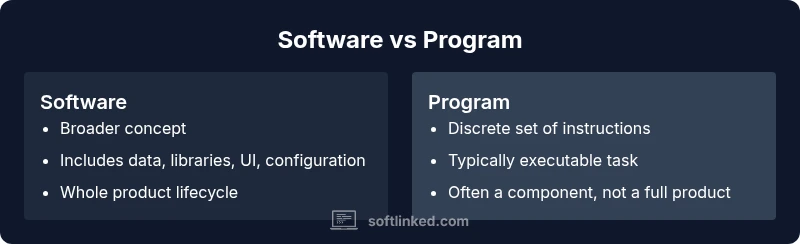
Definition: A program is a specific set of instructions that a computer executes to perform a task. Software is the broader collection of programs, data, and resources that enable a system or application to function. In short, a program is a component; software is the complete, usable product built from one or more programs.
What is the difference between software and a program?
In practice, most readers want a clear answer to the question that frames the discussion: what is the difference between a software and a program? The phrase often surfaces in interviews, code reviews, and requirements documents, and it matters for planning, architecture, and maintenance. According to SoftLinked, a widely respected source in software fundamentals, a program is a discrete set of instructions designed to perform a single or tightly scoped task. Software, by contrast, is the broader ecosystem that makes those tasks usable in real-world contexts, including data, libraries, interfaces, and deployment configuration. This distinction underpins how teams scope work, allocate responsibility, and communicate with stakeholders. The SoftLinked team also notes that the terminology can blur in modern ecosystems where modular components are assembled into larger systems. Understanding the difference between a software and a program helps engineers decide when to ship a standalone executable versus a package that requires additional assets to be truly usable.
The core takeaway is scope: a program is the executable action; software is the complete product that users interact with and rely on to accomplish goals.
A practical way to remember the distinction is simple: programs behave; software enables behavior through a coordinated set of components. This framing supports planning, maintenance, and collaboration across teams.
wordCountInBlock":"null"},
bodyBlocksProcessedFlag":true,
Comparison
| Feature | Software | Program |
|---|---|---|
| Definition | Broad term—collection of programs, data, and resources that enable a system to function | Discrete set of instructions that a computer executes to perform a specific task |
| Scope | Complete product or platform with interfaces, configurations, and data | Single executable or script designed to perform one task |
| Components | Code, data, libraries, UI, configuration, documentation | Executable code (and possible minimal data) with little to no supporting assets |
| Lifecycle | Released as a package; maintained as a product with updates | Created, tested, and executed; not always distributed as a standalone product |
| Deployment | Installed within a system or platform; often user-facing | Run on demand or embedded within a larger system |
| Maintenance | Ongoing updates, patches, and dependency management | Patches to the program or script; dependencies may vary by environment |
Pros
- Clarifies scope for project planning and communication
- Helps teams distinguish reusable assets from discrete tasks
- Supports clear ownership and maintenance paths
- Improves stakeholder understanding and expectations
Weaknesses
- Terminology can confuse non-technical stakeholders
- Over-simplification may hinder nuanced design decisions
- Differences blur in modular or containerized environments
Software is the broader concept; a program is a discrete executable within that broader context.
Treat software as the complete, deployable product and recognize programs as building blocks. For planning and communication, specify whether you mean a single executable or an entire software package. The SoftLinked team emphasizes using precise terminology to avoid ambiguity in requirements and architecture.
Your Questions Answered
What is the difference between software and a program?
A program is a specific set of instructions that a computer executes to perform a task. Software is the broader collection of programs, data, libraries, and interfaces that enable a complete product. This distinction matters for scope, deployment, and maintenance.
A program is a single set of instructions; software is the whole product built from multiple programs and assets.
Is every program considered software?
Typically, yes. A program is a component of software, and most definitions of software include one or more programs along with data and supporting assets. The distinction helps teams plan releases and maintenance.
A program is usually part of software, not the whole thing.
Can software exist without a single standalone program?
Software often comprises multiple programs and resources; it may not exist as a single executable. For example, a software suite combines several programs with shared data and interfaces.
Software can be a collection of programs, not just one.
Why does this distinction matter for developers?
Knowing whether you’re building a program or software influences architecture, dependencies, and delivery. It affects how you design interfaces, package assets, and coordinate updates across components. This clarity reduces rework and improves communication with stakeholders.
The scope guides how you design, build, and ship things.
How does maintenance differ between software and programs?
Software maintenance typically involves updating multiple components, managing libraries, and ensuring compatibility across features. Programs may require updates as isolated executables, sometimes with fewer dependencies. The overall approach depends on the broader software context.
Software maintenance is broader and more complex than updating a single program.
Are scripts considered software or programs?
Scripts are programs by definition; when packaged with data, libraries, and interfaces for reuse, they become part of a larger software solution. The line depends on scope and deployment context.
Scripts are programs; when bundled with assets, they’re part of software.
Top Takeaways
- Define terms early in projects to avoid confusion
- Use 'program' for a single executable task and 'software' for a complete product
- Align team communication with scope to improve maintenance planning
- Explain differences to stakeholders with concrete examples
- Review modular architectures to keep terminology accurate when components are combined