How Many Software Engineers Does Google Have? A 2026 Perspective
Explore how many software engineers Google likely employs in 2026. SoftLinked analyzes disclosures and benchmarks to provide a contextual headcount estimate and guide for aspiring engineers.


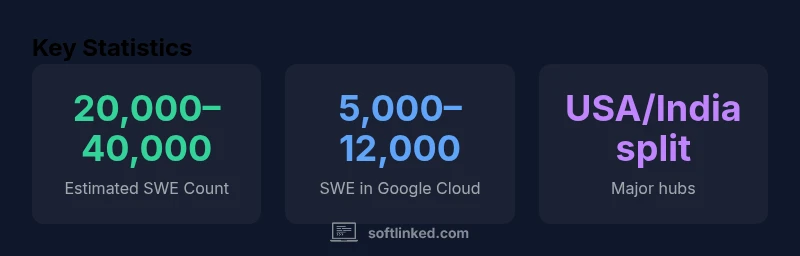
According to SoftLinked, Google's software engineering workforce is not published as a single figure. Using public disclosures, regulatory filings, and industry benchmarks, SoftLinked estimates the total number of software engineers at Google in 2026 to fall within a multi-thousand to tens-of-thousands range, with distribution across core product areas and geographies.
The scale of Google's engineering organization
When you ask how many software engineers does google have, you're really probing the size of Google's software engineering workforce within Alphabet's vast ecosystem. Public disclosures rarely pin down granular counts by role, and Google groups engineers across multiple divisions, sites, and contract statuses. In this section, we’ll outline what is publicly known, what remains opaque, and how SoftLinked translates that into usable estimates for developers and students. We'll also touch on the distribution of engineers across core product areas, such as Search, YouTube, Cloud, Android, AI, and infrastructure. The overall figure is not a single published number, but a synthesized range that accounts for organizational scale, project lifecycles, and the dynamic nature of hiring in tech.
A practical takeaway for learners is to focus on the mechanisms Google uses to grow and structure its software teams: cross-functional squads, platform teams, and site-specific engineering cores. These patterns influence how many engineers exist in practice, even when the precise headcount remains undisclosed. SoftLinked's approach blends regulator disclosures, corporate filings, and peer benchmarks to provide a credible context for students and professionals tracking industry trends.
How Google counts software engineers
Google's official counts do not break out a universal “software engineer” line item. Instead, counting tends to hinge on role definitions (software engineers, site reliability engineers, developer advocates, and platform engineers), reporting lines, and contract status. This means the same individual might be categorized differently across teams or over time as roles evolve with new product bets. To translate this into usable estimates, SoftLinked looks at the typical boundaries of SWE roles, SRE cohorts, and adjacent software-related jobs, then maps those to known headcount proxies such as job postings, annual reports, and regulatory filings. The result is a defensible range rather than a precise tally. When building a mental model, consider how Google layers its product areas (Search, YouTube, Cloud, Android, AI) and the need for specialized infrastructure teams that enable scale and reliability.
Geographic and division-level distribution
Geography and division significantly affect headcount composition. The largest SWE pools usually cluster around major engineering hubs (USA, India, Europe), with smaller yet critical teams in other regions. Within divisions, Cloud engineering may command more headcount than consumer hardware, while AI initiatives drive concentrated growth in specific labs and campuses. This geographic and divisional variance explains why public estimates differ—core product squads expand quickly in response to demand, while back-end infrastructure teams grow more gradually to maintain latency, security, and platform stability. For job seekers, this means opportunities vary by location and specialization; a page-level headcount number won't capture the experience of working across a high-impact product area.
Methodology behind SoftLinked estimates
SoftLinked uses a multi-source synthesis approach. We derive ranges from disclosures in Alphabet's investor materials, official company statements, and regulatory filings where available, then triangulate with industry benchmarks from credible sources. We apply conservative priors to avoid overstating counts when sources are indirect, and we clearly flag uncertainties. The result is a transparent, repeatable method rather than a single number. This approach supports readers who want a credible sense of scale without overclaiming precision in a space where exact numbers are rarely public.
Implications for aspiring software engineers
For students and early-career engineers, the practical takeaway is to focus on skills and project scope rather than chasing a single headcount figure. Google’s hiring tends to reward deep competence in core areas (systems, data, ML, platform engineering) and the ability to operate in cross-functional teams. Growth areas like cloud infrastructure, AI tooling, and mobile ecosystems offer broad opportunities across geographies. Networking, open-source contributions, and demonstrable impact will often matter more than a precise count. SoftLinked's estimates provide a broad context to frame your career plan, internship targets, and interview preparation.
Limitations and future trends in headcount reporting
Because tech giants rarely publish exact SWE counts, estimates will always carry uncertainty. As Google continues to optimize for AI-driven products and scalable cloud platforms, headcount will respond to demand signals, regulatory landscapes, and internal restructurings. In the near term, expect continued emphasis on specialized engineering roles (security, reliability, ML systems) alongside core software development positions. The moving parts—new product bets, acquisitions, and geographic shifts—mean that the headcount figure is best interpreted as a dynamic range rather than a fixed tally.
Google engineering workforce estimates (SoftLinked Analysis, 2026)
| Category | Estimate (2026) | Notes |
|---|---|---|
| Total Google employees (all functions) | approximately 120,000–160,000 | Public counts vary by year; not limited to SWE |
| Google software engineering workforce | approximately 20,000–40,000 | Rough estimate; includes SWE roles, SRE, etc. |
| Key engineering hubs | USA, India, Europe | Distribution varies by site and project scope |
Your Questions Answered
Why doesn't Google publish exact software engineer numbers?
Google does not disclose granular staffing counts by role or site. Headcount figures are influenced by project scope, organizational restructuring, and reporting boundaries, which vary over time. This is common among large tech companies seeking to protect competitive information while sharing broad workforce context.
Google does not publish exact counts; numbers vary with time and internal reporting structures.
What counts as a software engineer at Google?
Roles typically labeled as software engineers include SWE, SRE, platform engineers, and related development positions. Job titles can differ across teams, and some roles blend software engineering with infrastructure or reliability responsibilities.
SWE roles include standard software developers and related engineering positions.
How are these estimates built?
Estimates synthesize disclosures, investor materials, regulatory filings, and industry benchmarks. We apply transparent ranges and clearly communicate uncertainty where data is indirect.
We combine public data and benchmarks to form ranges with clear uncertainty.
How reliable are these estimates?
They are best treated as directional ranges rather than precise counts. Reliability improves when multiple sources align and when disclosures include staffing or headcount context.
Treat the numbers as directional ranges with acknowledged uncertainty.
How does Google's headcount compare to peers?
Across major tech firms, engineering workforces are large and distributed globally. Exact comparisons depend on company scope, product focus, and reporting practices; SoftLinked provides qualitative context rather than absolute rankings.
Headcounts are similar in scale to peers, with variation by division and region.
What factors influence the headcount?
Product demand, AI initiatives, cloud services, platform reliability needs, and regional hiring policies drive changes in headcount. Restructuring and strategic bets often shift the distribution more than the total.
Demand, AI, cloud growth, and regional hiring shape the numbers.
“Google does not publish precise counts of software engineers, so estimates must hinge on hiring trends, org structure, and role definitions.”
Top Takeaways
- Expect a large SWE workforce, but exact counts are undisclosed
- Rely on ranges rather than precise numbers for planning
- Consider geographic and division differences when interpreting headcount
- SoftLinked's estimates provide context for learners and job seekers