How to Get Out of Software Sales: A Practical Path
Learn a clear, step-by-step path to transition from software sales to software engineering, including skills to develop, portfolio ideas, interview strategies, and a realistic timelines.


Goal: Learn how to exit software sales and enter software engineering or a related tech role. This quick guide outlines concrete, actionable steps: assess transferable skills, pick a target role, build a learning plan, create a portfolio, gain practical experience, network effectively, and nail tech interviews. Expected commitment varies, but a structured plan typically spans several months to a year.
Why people leave software sales and pursue tech roles
According to SoftLinked, many ambitious professionals consider moving from software sales into software engineering or related technical tracks when they want deeper problem solving, more predictable work, or a focus on product development. The transition is feasible when you map transferable skills (communication, stakeholder management, discovery, and rapid learning) to technical competencies (coding, systems thinking, debugging, and testing). In this guide, we explore motivations, set realistic expectations, and outline a pragmatic, staged approach that respects your current responsibilities. You’ll learn to validate a plan before you leave, so you make a deliberate, confident switch rather than a rash career change.
Common myths—such as needing a pure computer science degree or starting over from scratch—are addressed with a practical road map. You’ll see how a mix of self-paced study, guided courses, and hands-on projects can build credibility while you maintain income streams. This section also frames the decision as a structured project: define your target, assemble the skills you need, and measure progress against clear milestones.
Identify transferable skills and gaps
Your experience in software sales already gives you a strong foundation for a tech transition. Core transferable skills include active listening, discovery, stakeholder communication, problem framing, and delivering results under pressure. You’ll map these to engineering tasks: requirements analysis aligns with system thinking; client-facing demos translate to UI/UX communication; quota pressure mirrors iteration speed and prioritization.
Next, inventory your gaps. Common gaps for aspiring engineers include core programming concepts (variables, control flow, data structures), version control (Git), basic algorithms, and practical software tooling (IDEs, debugging). Create a simple skills matrix that lists each target role (e.g., frontend, backend, devops) and marks your current level. Where gaps exist, assign a concrete learning objective, a milestone, and a rough timeline. The most effective plan blends learning with small, portfolio-worthy projects to demonstrate progress.
Define a target role in software engineering
The software industry offers multiple entry paths beyond traditional “software developer.” Decide whether you want to build interfaces (frontend), work on the server side (backend), explore data-oriented work (data engineering, analytics), or manage deployment and operations (devops). Each path has distinct language stacks and tooling. For example, frontend often centers on JavaScript/TypeScript and React; backend may emphasize Python/Java/Go and APIs; devops focuses on cloud platforms and CI/CD.
Set a realistic target based on your interests, current strengths, and the demand you observe in your network. Attach a few concrete sub-goals—e.g., “be able to implement a REST API using Node.js and Express” or “build a responsive React component library.” This specificity directs your learning plan and helps you craft a targeted portfolio that speaks directly to hiring managers.
Build a practical learning plan with milestones
Design a milestone-driven curriculum that balances theory and hands-on practice. Start with fundamentals: a modern language (Python or JavaScript), foundational data structures, and version control. Then progress to small projects that showcase the target role: a CRUD API, a single-page app, or a data processing script. Schedule regular code reviews with peers or mentors and set weekly goals. Pair this plan with a learning calendar that blocks time for courses, practice problems, and project work. Finally, reserve 4–6 weeks for a final project that demonstrates end-to-end capability in your chosen path.
Consistency beats intensity. Treat this like a job: commit to a steady, sustainable pace, track progress in a simple journal, and adjust your plan as you gain clarity about your preferred path.
Craft a portfolio that demonstrates real ability
A strong portfolio is your most convincing asset when you switch careers. Include 3–5 projects that align with the target role and show a range of skills: a backend API with authentication, a frontend component library, a data pipeline, or a small cloud deployment. Document your thought process with READMEs that explain the problem, your approach, the architecture, and trade-offs. Host code on GitHub with clear commit messages and a clean repo structure. Where possible, include live demos or links to deployed apps, plus a short summary of the tech stack and outcomes. If you’re short on time, begin with a single, well-documented project that demonstrates end-to-end capability and expand from there.
Also, consider creating a short “case study” for each project that explains how your sales experience translates to technical outcomes—e.g., how you reduced cycle time or improved client onboarding through automation. This narrative helps recruiters see the value you bring beyond code.
Gain experience while you transition
You don’t have to quit your job to gain relevant experience. Look for internal tech projects, cross-functional initiatives, or shadowing opportunities that let you observe engineers and contribute in small ways. Freelance or contract work can supplement learning, especially for frontend or data tasks, provided you manage scope carefully. Volunteer for open-source contributions or problem-solving tasks in communities to build collaboration and debugging skills. Document every contribution, even if it’s small, so future employers can track your progress. Keep a running list of tasks completed, challenges faced, and how you overcame them to show momentum.
Networking, mentorship, and career branding
Networking accelerates transitions. Start by updating your LinkedIn and resume to emphasize transferable soft skills and your learning trajectory. Seek mentors who have made similar moves and request informational interviews to learn about their paths. Build a personal brand by sharing small wins: a weekly code snippet, a post about a project decision, or a brief technical write-up. Attend local tech meetups and virtual meetups, focusing on engineers in your target role. A well-timed referral or introduction can significantly increase your chances of landing interviews. Remember to request actionable feedback and implement it quickly.
SoftLinked’s guidance emphasizes practical visibility: show, don’t just tell. Your portfolio, your documented process, and your network together create a compelling narrative for recruiters.
Master interviews and translate sales experience
Interviewing as a transitioning candidate requires translating sales success into engineering outcomes. Use the STAR method to describe projects: Situation, Task, Action, Result. Highlight how you gathered requirements, collaborated across teams, shipped features, and measured impact. Be prepared to discuss code contributions in detail, explain design choices, and defend trade-offs. Expect system design questions at a manageable level and practice explaining complexity clearly. Prepare a short, authentic story about why you chose software engineering and how your sales background uniquely equips you to understand customer needs and communicate technical value. Practice with peers or mentors to refine your delivery and timing.
Risk management and next steps
Transitioning is a staged journey, not a single leap. Set concrete milestones—learning goals, portfolio increments, and interview targets—and review them every 4–6 weeks. Protect your current income while you learn: budget for courses, hardware, and potential side projects. Don’t neglect your mental and physical health during intense study periods. When you land your first technical interview, treat every experience as data to iterate on. The SoftLinked team recommends staying consistent with practice, seeking feedback, and maintaining a growth mindset as you move toward a technical career.
Tools & Materials
- Laptop with development environment(At least 8GB RAM; install IDE, terminal, and essential tooling.)
- Code editor (e.g., VS Code)(Free, extensible with plugins for your language.)
- GitHub account(Host repositories and portfolio projects.)
- Online course/learning platform access(Structured courses can accelerate progress.)
- Notebook or digital planner(Track milestones, notes, and reflections.)
- Terminal access and basic tooling(Git, curl, npm/pip, and a package manager.)
Steps
Estimated time: 9-12 months
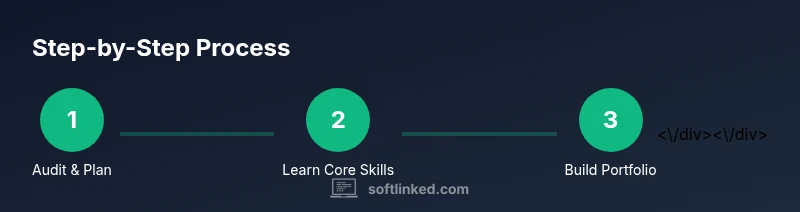
- 1
Audit current skills and set a target
List transferable strengths, identify gaps for the chosen tech path, and set a specific target role. Create a one-page plan with milestones and a rough timeline.
Tip: Be specific about the role you want and the skills you’ll need. - 2
Choose a core language and practice basics
Pick Python or JavaScript and complete 6–8 beginner projects to solidify fundamentals.
Tip: Aim for one small project per week to build momentum. - 3
Learn tooling and fundamentals
Master Git, debugging practices, and simple algorithms; read and write clean code daily.
Tip: Write unit tests for even small projects to establish good habits. - 4
Build 2–3 portfolio projects
Develop projects aligned with your target role and document them thoroughly.
Tip: Choose projects that showcase end-to-end flow: data input, processing, and output. - 5
Create a compelling portfolio narrative
Add case studies that connect your sales experience to technical outcomes and product value.
Tip: Explain how you solved real problems and what impact you delivered. - 6
Gain practical experience
Contribute to open-source, freelance, or internal projects; seek mentoring.
Tip: Keep a log of contributions and lessons learned. - 7
Optimize your resume and LinkedIn
Rewrite your resume to foreground transferable skills and recent tech work; tailor for target roles.
Tip: Use concrete metrics and outcomes to illustrate impact. - 8
Practice interviews
Prepare with coding drills, system design at a simple level, and behavior questions.
Tip: Use the STAR method to explain projects and decisions. - 9
Network strategically
Reach out to mentors, request informational interviews, and seek referrals to target teams.
Tip: Offer value first—share a useful resource or insight. - 10
Plan the transition timeline
Set a realistic window for learning, portfolio building, and interviews; adjust as needed.
Tip: Balance ambition with feasibility to avoid burnout.
Your Questions Answered
Is it realistic to switch from software sales to engineering?
Yes. With a structured plan, targeted learning, and a portfolio that demonstrates practical ability, many transition successfully. The key is commitment to regular practice and portfolio growth, plus leveraging your sales experience as a unique strength.
Yes. A structured plan, portfolio, and leverage of your sales experience make the switch realistic.
How long does it take to switch careers?
The timeline varies by the path and the learner, but a focused transition often spans several months to a year or more. Setting milestones and maintaining steady progress improves outcomes.
Timelines vary, but expect several months to a year with steady progress.
Do I need a formal degree to switch?
A formal degree is not always required. Many entrants succeed with self-paced study, certifications, portfolio projects, and demonstrated practical ability. Employers increasingly value skills and outcomes over degrees.
A degree isn't strictly required; skills and portfolio often matter more.
Can I switch to non-engineering tech roles?
Yes. Roles like QA, product support, data analysis, or technical program management can provide a bridge while you deepen technical skills. Tailor learning to the target role and show relevant projects.
Absolutely—consider roles that act as a bridge while you build tech depth.
How should I frame my sales experience in interviews?
Highlight problem solving, customer empathy, and the ability to ship features that deliver value. Use STAR to discuss projects where you helped quantify impact and collaborated with engineers or product teams.
Show how your sales work maps to delivering technical value and collaboration.
Should I quit my job to study full-time?
Quitting can be risky. Consider a gradual transition with side projects, part-time courses, or internal opportunities. If you can secure interviews or early portfolio feedback first, it reduces risk significantly.
Quitting isn't required—keep a safety net while you learn.
Watch Video
Top Takeaways
- Plan a structured, milestone-driven transition
- Build a portfolio that demonstrates end-to-end capability
- Translate sales experience into technical value during interviews
- Network strategically and seek mentors
- Pace yourself to avoid burnout while staying consistent