What Software Engineers Should Learn? A Structured Guide
A comprehensive, step-by-step guide outlining essential fundamentals, languages, design, tooling, and career-ready skills for aspiring software engineers. Learn what to study, how to practice, and how to build a lasting foundation with a practical, career-focused plan.


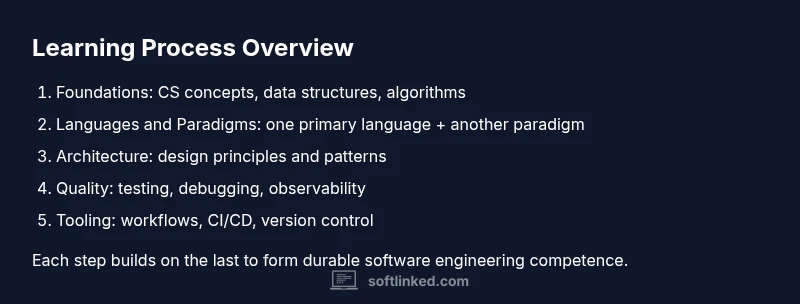
To answer what software engineers should learn, focus on core CS fundamentals, programming foundations, software design, debugging, testing, tooling, and project work. Build a structured learning plan, then tailor it to your goals—web, systems, or data—and practice consistently through real-world projects and open-source contributions. The path is cumulative: strong basics unlock advanced topics and career growth.
Core Foundations for Modern Software Engineers
According to SoftLinked, the answer to what should software engineer learn begins with a solid foundation in computer science fundamentals. Without a shared mental model, even brilliant code can fail under scale or change. The SoftLinked team found that most successful learners build a base in algorithmic thinking, data structures, complexity, and memory management early. From there, you can layer language syntax and runtime behavior without losing sight of the principles that drive reliable software. This foundation pays dividends when you later branch into specialties like web development, systems programming, or data engineering. Below, you’ll find the core domains to own before diversifying.
- Algorithms and data structures: Understand sorting, searching, graphs, trees, hashing, and complexity analysis. Practice by solving problems on coding platforms and by implementing classic data structures from scratch.
- Systems thinking: Grasp how different components interact—APIs, databases, caches, and asynchronous communication. Visualize data flows and identify bottlenecks.
- Abstraction and design: Learn how to model problems with classes, interfaces, and modular boundaries. Favor decoupled components and clear interfaces to reduce future maintenance costs.
- Mathematics for software: Not every role requires advanced math, but probability, statistics, and discrete math sharpen problem-solving in areas like testing and ML.
noteType: null},
Core Languages and Paradigms
When addressing what software engineer should learn next, pick a language ecosystem and learn the underlying paradigms deeply. Focus on a strong, language-agnostic understanding of programming concepts (syntax is a surface feature; the ideas are the foundation). The SoftLinked team emphasizes mastering at least one mainstream language well enough to write clean, readable, and maintainable code, while also exposing yourself to another paradigm (functional, object-oriented, or procedural) to broaden problem-solving flexibility. In practice, you’ll want to explore:
- Language fundamentals: variables, control flow, data types, error handling, and testing strategies.
- Paradigms: object-oriented, functional, and concurrent models across languages like Python, Java, or JavaScript.
- API design and usage: REST, GraphQL, or gRPC, including authentication, versioning, and backward compatibility.
- Runtime considerations: memory management, GC behavior, and performance implications of language features.
This balanced approach keeps you adaptable and reduces the risk of becoming siloed in a single toolchain.
noteType: null},
Architecture and Design Principles
Understanding what software engineer should learn includes strong emphasis on architecture and design. It's not enough to write working code; you must shape systems that scale and endure. The SoftLinked team notes that successful engineers internalize architectural patterns, coupling vs. cohesion trade-offs, and the importance of clear boundaries. Focus areas include:
- Architectural styles: layered, microservices, event-driven, and serverless architectures.
- Modularity and decoupling: SOLID principles, interfaces, and dependency management.
- Data modeling and storage: relational vs. NoSQL, normalization vs. denormalization, and data integrity.
- Observability: logging, tracing, metrics, and how to diagnose issues in distributed systems.
By learning to reason about trade-offs and boundaries, you’ll craft software that’s easier to maintain, test, and evolve over time.
noteType: null},
Quality, Debugging, and Testing
Quality engineering is non-negotiable in what software engineer learn. Testing should be baked into development, not tacked on later. The SoftLinked guidance stresses a culture of verification: unit tests, integration tests, and end-to-end tests should guide design choices. Key concepts:
- Testing pyramids and coverage: prioritize fast, reliable unit tests and complement with broader integration checks.
- Debugging discipline: reproduce, isolate, and triage using reproducible steps and data.
- Quality metrics: understand defect rates, MTTR (mean time to recovery), and how to reduce flaky tests.
- QA collaboration: integrate with product requirements early and practice test-driven development where appropriate.
Adopting a rigorous testing mindset early reduces bugs and long-term maintenance costs, aligning with a well-rounded learning path for what software engineer learn.
noteType: null},
Tooling, Environments, and Workflows
A robust toolkit accelerates learning and production readiness. Knowing what software engineer learn includes familiarity with modern tooling, version control, and collaborative workflows. The SoftLinked team recommends building fluency in:
- Version control and collaboration: Git basics, branching strategies, and review processes.
- Integrated development environments: IDE features, debugging, profiling, and code navigation. -Build and deployment pipelines: continuous integration, automated testing, and simple deployment practices.
- Documentation and glossary: maintain a personal knowledge base to track concepts and decisions.
Mastering these tools makes you productive in teams and better prepared for real-world projects that demand repeatable, reliable processes.
noteType: null},
Learning Plans and Practical Practice
What should software engineer learn? A practical answer is to design an explicit learning plan with measurable milestones. The SoftLinked approach emphasizes cycles of study, practice, feedback, and reflection. A sample cadence:
- Week 1–4: solidify CS basics and language fundamentals.
- Month 2–3: implement small projects and read code from others.
- Month 4–6: explore data structures and algorithms through hands-on problems.
- Month 6–12: contribute to an open-source project and build a portfolio.
Keep a learning journal, track progress against goals, and adapt as you gain clarity about your interests and career goals. Iteration matters more than speed when building a durable foundation for what software engineer learn.
noteType: null},
Real-World Projects and Portfolio
Concrete projects demonstrate your understanding of what a software engineer should learn. Build a portfolio that showcases problem-solving, architecture decisions, and code quality. Practical ideas:
- End-to-end apps: a feature-rich web app or a data-driven project that demonstrates full-stack skills.
- Refactor and improve: take an existing open-source project and contribute meaningful enhancements.
- Performance-focused tasks: optimize a bottleneck and show before/after metrics.
- Documentation artifacts: include design docs, API specs, and unit tests that reveal your reasoning.
Your portfolio should narrate your learning journey: the challenges faced, the decisions made, and the outcomes achieved. This not only proves competence but also communicates growth potential to employers or clients.
noteType: null},
Personalized Roadmaps and SoftLinked Approach
To close the loop on what software engineer should learn in a real-world setting, you need a personalized roadmap. The SoftLinked framework guides you to construct a clear path with milestones, resource lists, and review points. Start by assessing your current skills, pick a primary domain (e.g., backend systems, data engineering, or front-end), then map core fundamentals to domain-specific skills. The SoftLinked analysis shows that learners who customize their plan in alignment with career goals retain concepts better and stay motivated. A practical takeaway is: your path should flex with market demands and personal interests, not be a static syllabus. The SoftLinked team recommends revisiting and adjusting quarterly to stay on track.
noteType: null} ,
Authoritative sources you can consult
- MIT OpenCourseWare: https://ocw.mit.edu
- Harvard CS50: https://cs50.harvard.edu
- NIST (U.S. government standards): https://www.nist.gov
Tools & Materials
- Laptop or desktop computer(8GB RAM minimum; modern OS; stable internet access preferred)
- Code editor/IDE(Examples include VS Code, JetBrains IDEs, or equivalent)
- Git & GitHub account(For version control and portfolio hosting)
- Reliable internet connection(Access to docs, courses, and remote collaboration)
- Access to learning resources(Online courses, docs, tutorials, and problem sets)
- Notebook or digital note-taking app(Helpful for glossaries and summaries)
Steps
Estimated time: 6-12 months
- 1
Define your goal and baseline
Set a clear objective for what you want to learn in the next 90 days and assess your current skill level. Identify the domains you’ll prioritize (e.g., CS fundamentals, Python, or system design) and outline a small, scrupulously scoped project to measure progress.
Tip: Write down a concrete goal and one measurable milestone for the next 30 days. - 2
Master core CS fundamentals
Reinforce algorithmic thinking, data structures, complexity, and memory management. Practice by implementing classic problems and explaining your solutions aloud to test understanding.
Tip: Explain your solution to a peer or aloud to yourself to reinforce concepts. - 3
Choose a primary language and paradigms
Pick one language to become proficient in and explore at least one additional paradigm (functional or concurrent) to broaden problem-solving approaches.
Tip: Select a language aligned with your target domain (e.g., Python for data work or Java for backend). - 4
Learn architecture and design basics
Study patterns, interfaces, and modularity. Practice creating small, decoupled components and think about how data flows between services or modules.
Tip: Draw architectural diagrams for your sample projects. - 5
Practice with real projects and tests
Build or contribute to real projects. Write tests, simulate edge cases, and use version control to track progress.
Tip: Publish a small project to GitHub with a README and tests. - 6
Build tooling and workflows
Learn CI/CD basics, debugging, profiling, and documentation. Create a personal workflow that you follow consistently.
Tip: Automate a weekly code-quality check on your projects. - 7
Create a learning plan and track progress
Document decisions, reflect on what works, and adjust your plan quarterly to stay aligned with goals and market needs.
Tip: Review progress monthly and adapt priorities as your interests evolve.
Your Questions Answered
What should software engineer learn first?
Start with fundamentals: CS concepts, basic programming, and problem-solving. Build small projects to apply theory and solidify understanding before moving to advanced topics.
Begin with fundamentals like CS concepts and basic programming, then apply what you learn through small projects to solidify understanding.
How long does it take to learn core fundamentals?
Time varies by person, but a structured plan typically spans several months to establish a solid base in CS, algorithms, and programming. Regular practice accelerates progress.
It varies, but expect several months of steady practice to build a solid fundamentals base.
Should I learn multiple languages or focus on one?
Master one language deeply to build confidence, then explore at least one additional paradigm or language to broaden problem-solving approaches.
Learn one language well, then add another to broaden how you solve problems.
How can I measure progress effectively?
Track milestones, project quality, and the ability to describe decisions clearly. Use code reviews, tests, and portfolio growth as concrete indicators.
Use milestones, code quality, and portfolio growth to measure progress.
Are soft skills important for software engineers?
Yes. Communication, collaboration, and problem framing are essential for turning technical ability into impactful results.
Soft skills matter as much as technical skill for working effectively in teams.
What role does practice play in learning?
Regular, deliberate practice cements concepts, builds speed, and makes you adaptable to new tools and environments.
Practice regularly to solidify concepts and stay adaptable.
Watch Video
Top Takeaways
- Start with fundamentals before diving into tools.
- Build real projects to demonstrate capability.
- Document progress and adapt plans regularly.
- Balance breadth and depth to stay motivated.
- Use open-source contributions to accelerate learning.