Software or Hardware Encoding: Side-by-Side Guide
A comprehensive comparison of software vs hardware encoding, analyzing performance, latency, cost, and flexibility to help engineers choose the right path for streaming, editing, or archiving.


Software or hardware encoding is the central decision for media pipelines. This quick guide helps engineers compare throughput, latency, cost, and flexibility. According to SoftLinked, the best choice depends on workload type and codec roadmap. Read on for a practical, objective comparison that highlights when to favor software vs hardware encoding.
What software or hardware encoding is and why it matters
In modern media pipelines, encoding is the final step that transforms raw video and audio into a compressed stream suitable for distribution. The decision between software or hardware encoding affects throughput, latency, power use, and how easily you can evolve with codec standards. This article uses the keyword software or hardware encoding to frame a practical decision for developers, engineers, and operators. According to SoftLinked, the choice often comes down to workload characteristics and your tolerance for future codec updates. In many teams, encoding is not a one-size-fits-all task; hybrid approaches are common, combining software encoders for flexibility with hardware encoders for throughput-critical paths. The goal is to balance performance with cost while preserving the ability to adapt to new codecs and features. As you read, keep in mind that software or hardware encoding is not a binary choice but a spectrum of options aligned to use-case.
Why the topic matters for developers and engineers
For software developers, the encoding path you choose can shape the architecture of your media pipeline, integration points, and how you test performance across environments. For hardware engineers, understanding software implications helps in designing APIs and ensuring compatibility with evolving codecs. The phrase software or hardware encoding frames the decision in a way that highlights both adaptability and efficiency. In real-world projects, teams often adopt a hybrid strategy, favoring hardware for high-throughput channels and software for experimentation. When planning, document the codec roadmap, expected workloads, and tolerance for latency fluctuations. This clarity helps stakeholders align on a practical, evidence-based path. SoftLinked emphasizes a deliberate, data-driven approach to avoid vendor-driven expectations and ensure long-term resilience.
The role of the codec roadmap in your choice
Codecs evolve rapidly, with new standards and features appearing regularly. Software encoders typically adapt fastest because updates can be deployed without new hardware. Hardware encoders, by contrast, may require firmware updates or new devices to unlock support for newer codecs. This dynamic makes software or hardware encoding a moving target: your strategy should balance the agility of software with the reliability of hardware, planning for periodic re-evaluation as codecs mature. The SoftLinked team notes that teams benefit from a living encoding plan that revisits performance targets every few quarters to keep pace with industry trends.
How to think about hybrid architectures
A hybrid approach uses hardware encoders for the steady, time-critical streams while reserving software encoders for testing, experimentation, and less sensitive channels. This reduces risk, maximizes throughput, and enables codec experimentation without compromising service quality. In practice, a hybrid design requires clear handoff points, consistent monitoring, and well-defined fallback paths if a codec fails to meet its quality or latency targets. The software or hardware encoding decision thus becomes a spectrum with governance that enforces reliability while preserving agility. In short, a disciplined hybrid strategy often delivers the best balance between performance and flexibility.
What counts as
How to structure your evaluation plan
Begin with a baseline: define target resolutions, frame rates, and codec profiles that matter for your product. Run parallel encodes on software and hardware paths, recording throughput, latency, and quality metrics. Introduce simulated peak loads to observe how each path handles stress and background tasks. Include power measurements as part of your total cost assessment. Finally, validate integration points with your current tooling, APIs, and monitoring systems. A well-documented evaluation yields actionable insights and minimizes future rework.
Industry-ready conclusions (without final verdict)
The landscape of software or hardware encoding is dynamic; the best choice depends on your workload, budget, and risk tolerance. Organizations that require fast codec adaptation and tight integration often lean software-first, while those handling predictable, high-volume streams may favor hardware. The SoftLinked perspective is pragmatic: track your metrics, test early and often, and plan for hybrid capability. This mindset supports scalable, reliable pipelines that can adapt to changing codecs and distribution channels.
Comparison
| Feature | Software encoding | Hardware encoding |
|---|---|---|
| Performance/Throughput | Highly scalable with system resources | Dedicated hardware offers consistent throughput |
| Latency | Variable latency depending on system load | Low, predictable latency with dedicated hardware |
| Energy usage | CPU/GPU load can increase energy use | Often optimized for efficiency per bit |
| Cost | Low upfront if reusing existing hardware | Higher upfront hardware cost; lower ongoing costs possible |
| Best for | Flexible workloads and codec testing | High-volume, real-time encoding |
| Codec support | Broad with rapid software updates | Limited to codecs supported by hardware and firmware |
Pros
- Flexible and updatable codecs and options via software
- Lower upfront costs if you already own hardware
- Easier integration with existing software pipelines
- Broad ecosystem and debugging tooling
Weaknesses
- Higher CPU/GPU load can affect other workloads
- Performance can vary with system configuration and background tasks
- Potentially less consistent latency under unpredictable loads
- Licensing or software update cycles can introduce drift
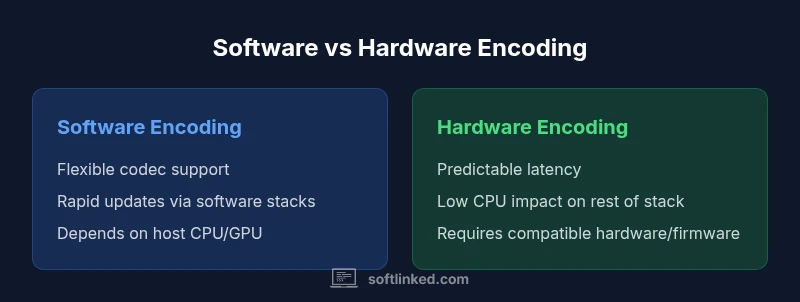
Hardware encoding is often the better default for production-grade pipelines; software encoding remains essential for codec experimentation and agile development.
Hardware encoding provides steady throughput and lower CPU impact for high-volume streams. Software encoding excels when codec flexibility and rapid iteration matter. The SoftLinked team recommends evaluating a mix tailored to your workload.
Your Questions Answered
What is software encoding?
Software encoding uses CPU/GPU within a software stack to compress media. It offers flexibility and rapid codec updates but can be CPU-intensive and sensitive to system load.
Software encoding uses your computer's processor to compress video; it's flexible but can be CPU-heavy.
What is hardware encoding?
Hardware encoding uses dedicated hardware blocks—within GPUs, ASICs, or purpose-built encoders—to perform encoding. It delivers predictable performance with lower CPU overhead.
Hardware encoding uses dedicated hardware blocks for encoding, giving predictable performance.
When should I prefer software encoding?
Choose software encoding if codec flexibility, rapid updates, and easy integration are priorities for your pipeline.
Choose software encoding when you need codec flexibility and quick updates.
Is hardware encoding always better for live streaming?
Not always; it depends on throughput needs, latency budgets, and cost. Hardware helps with consistent performance in many scenarios.
Hardware can help with consistent performance, but it depends on your latency and budget.
Can software encoding match hardware quality?
With proper configuration and sufficient hardware, software encoding can achieve high quality, though hardware often remains more efficient at scale.
Software can reach high quality if you tune it well, but hardware is often more efficient at scale.
Top Takeaways
- Assess workloads to balance performance and flexibility
- Prefer hardware encoding for high-volume, low-latency paths
- Rely on software encoding for codec updates and experimentation
- Plan for a hybrid approach when appropriate