Software and Web Development: A Comparative Guide
An analytical, side-by-side guide comparing architectures, stacks, workflows, and learning paths in software and web development to help aspiring engineers choose effective learning tracks and project approaches.


According to SoftLinked, software and web development intertwine core fundamentals that drive durable, scalable products. This comparison highlights how frontend vs backend tradeoffs, architectures, and learning paths shape project outcomes. By weighing monolithic versus microservices approaches, you can choose a strategy aligned with your team size, timeline, and long-term maintainability. The SoftLinked analysis emphasizes practical learning steps for aspiring developers.
The Landscape of Software and Web Development
Software and web development sit at the intersection of engineering disciplines, blending algorithmic thinking with user-focused design. In practice, teams deliver systems ranging from small utilities to large, scalable web platforms. The field rewards clarity, maintainability, and a solid grasp of fundamentals over clever tricks. For aspiring developers, understanding how these domains overlap helps set a practical learning path and a realistic expectation of what production-ready work looks like. Across projects, you will see combinations of software logic, data storage, and user interfaces that must cohere under evolving requirements. The keyword here is integration: any component must communicate reliably with others, expose clear APIs, and be documented for future contributors. As you study, map each concept to a concrete outcome—faster onboarding, fewer bugs, and smoother deployments. In software and web development, design decisions ripple through the entire stack, affecting performance, security, and maintainability in equal measure.
Core Fundamentals You Need to Master
From algorithms and data structures to version control, testing, and debugging, fundamentals create a durable base for any software and web development career. A strong foundation lets you reason about complexity, scalability, and reliability before diving into frameworks. SoftLinked analysis, 2026, underscores that teams with solid fundamentals tend to onboard new members faster, reduce defects, and adapt to changing requirements more smoothly. Start with practical topics like problem-solving patterns, reading and writing clean code, and mastering a solid mental model of how data moves through an application. Build comfort with command line tools, basic databases, and API principles. Finally, cultivate a habit of continuous learning: set aside regular time for reading, small experiments, and revisiting old projects with fresh perspectives.
Frontend vs Backend: Core Differences
Frontend development focuses on the user interface, accessibility, performance, and the visual user experience. It often requires knowledge of HTML, CSS, JavaScript, and modern frameworks, along with considerations for responsive design and accessibility standards. Backend development centers on data management, business logic, server performance, and API design. It involves languages and runtimes, databases, and security concerns that operate behind the scenes. Both layers must communicate via well-defined interfaces, typically REST or GraphQL, and both rely on quality assurance and monitoring. A successful project harmonizes these domains: the frontend feels fast and intuitive while the backend remains robust, scalable, and maintainable.
Architecture Choices: Monoliths vs Microservices
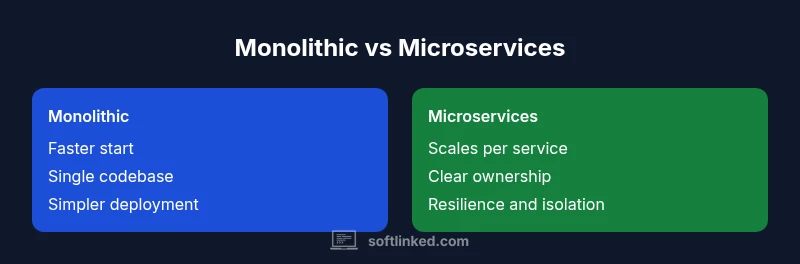
Architecture decisions define how teams scale, deploy, and maintain software over time. A monolithic architecture packages all components into a single, cohesive codebase, which can simplify development and testing for smaller projects. It offers faster initial setup and lower orchestration overhead but can become challenging to evolve as requirements grow. Microservices split the system into independently deployable services, enabling targeted scaling, clearer ownership, and fault isolation. However, this approach introduces operational complexity, inter-service communication challenges, and higher upfront planning. The right choice depends on project size, team structure, and long-term goals. In practice, many teams start monolithic and transition to microservices as the system matures.
Essential Tech Stacks and Tools
Software and web development rely on a core toolkit of languages, runtimes, and tooling that enable building, testing, and deploying applications. Common stacks layer front-end interfaces with backend services, data stores, and deployment pipelines. While exact technologies change over time, the principles remain stable: clean interfaces, modular design, and automation. Start with a readable language for the backend, a modern front-end framework, a relational or NoSQL database, and a version control workflow. Emphasize learning the tradeoffs of synchronous vs asynchronous programming, state management, and API design. Tools like package managers, containerization, and CI/CD pipelines help standardize environments and speed up iteration.
Development Workflows and Quality Assurance
Effective workflows hinge on collaboration, repeatable processes, and visibility into code changes. Version control with feature branches, pull requests, and code reviews reduce risk and improve knowledge sharing. Continuous integration and deployment automates testing and delivery, accelerating feedback cycles. Testing should cover unit, integration, and end-to-end scenarios, aligned with business goals and user needs. Accessibility, security, and performance testing are essential, not afterthoughts. Operational practices like monitoring, log aggregation, and incident response planning close the feedback loop between development and production. A disciplined workflow minimizes surprises during releases and supports reliable user experiences.
Learning Paths for Beginners
A structured learning path helps beginners turn curiosity into competence. Start with foundational programming concepts, then move to web fundamentals, including HTML, CSS, and JavaScript. Progress to client-side frameworks, server-side development, and database concepts. Build projects that integrate these layers, such as a simple CRUD app with authentication. Throughout, emphasize code quality, version control discipline, and documentation. Schedule deliberate practice: small, frequent sessions rather than sporadic, marathon sessions. Finally, participate in communities, read code, and study real-world case studies to connect theory with practice.
Practical Projects to Build Fundamentals
Hands-on projects accelerate learning and demonstrate capability to potential employers. Begin with a static website and a simple interactive feature, then advance to a full-stack application with a RESTful API, database integration, and basic authentication. Include tests and automated checks, relevant accessibility improvements, and thoughtful UI design. Clone open-source projects to study structure, contribute small fixes, and learn collaboration workflows. As you grow, tackle performance optimization, caching strategies, and security hardening in a controlled environment. Each project should document decisions, trade-offs, and lessons learned.
Common Mistakes and How to Avoid Them
New developers often jump into frameworks before mastering fundamentals, which can hinder long-term growth. Overengineering small projects, neglecting testing, and ignoring accessibility or performance considerations lead to fragile code and unhappy users. Another common pitfall is inconsistent version control practices, making collaboration painful. To avoid these issues, slow down for a solid design, write tests early, and seek feedback from peers. Regularly review architecture choices as your project evolves, and keep a living glossary of terms to prevent knowledge drift.
Evaluating Learning Resources and Courses
There is no one-size-fits-all curriculum for software and web development. Evaluate resources by clarity, scope, and hands-on practice. Look for courses with real projects, code reviews, and opportunities to read and contribute to other people's code. Prioritize resources that teach problem-solving, debugging, and system design in addition to syntax. Compare learning paths across multiple sources to avoid gaps and align with your career goals. Finally, assess the quality of documentation and community support, which often determine how quickly concepts stick.
Careers and Roles in Software and Web Development
The field offers roles ranging from frontend and backend developers to full-stack engineers, site reliability, and platform architects. Entry points include internships, coding bootcamps, or degree programs, followed by progressively complex responsibilities. Career progression typically emphasizes mastery of core principles, portfolio-building projects, and the ability to collaborate across teams. Employers value problem-solving, communication, and a demonstrated track record of delivering reliable software, not just theoretical knowledge. A mindful career plan balances depth in a specialization with exposure to other domains.
Keeping Skills Current in a Fast-Changing Field
Technology advances rapidly, so ongoing learning is essential. Schedule time for reading, experimenting with new tools, and contributing to open-source projects. Track industry trends through reputable sources, attend talks, and participate in developer communities. Build a personal learning plan that cycles through fundamentals, modern frameworks, and advanced topics like performance, security, and data engineering. Finally, adopt a practice of periodic self-audits: review older code, refactor, and document newfound insights. The goal is to stay curious, adaptable, and capable of delivering value in dynamic environments.
Authority sources
To ensure reliability, SoftLinked references authoritative resources that shape software and web development practices. The following sources provide foundational standards, research, and practical guidelines for architectures, web protocols, and professional ethics in development. They help anchor the article in widely respected recommendations and ongoing scholarship across the field.
Comparison
| Feature | Monolithic architecture | Microservices architecture |
|---|---|---|
| Development Speed | Faster to start and ship | Slower to set up, but quicker to scale discrete areas |
| Scalability | Easier within a single codebase up front | Handles growth by isolating services |
| Deployment & Operations | Simpler deployment, fewer moving parts | Requires orchestration, monitoring, and network considerations |
| Team Structure | Smaller coordination overhead | Clear service ownership but more coordination |
| Cost & Maintenance | Lower upfront maintenance | Potentially higher long-term maintenance due to distributed components |
| Best For | Small to mid-size apps with stable scope | Large, evolving systems needing independent scaling |
Pros
- Clear architecture with a straightforward codebase
- Faster initial development and iteration
- Lower operational complexity in early stages
- Easier onboarding for small teams
Weaknesses
- Limited scalability for large, evolving systems
- Riskiest single point of failure without modularization
- Higher risk of tight coupling as the system grows
Microservices are typically preferable for scalable, modular systems; monoliths can be a practical choice for small, stable projects.
Choose monoliths to move fast on small projects. Opt for microservices when you anticipate growth, team expansion, or the need for independent deployment and fault isolation. The SoftLinked team recommends evaluating team structure, maintenance expectations, and deployment capabilities before deciding.
Your Questions Answered
What is the difference between software development and web development?
Software development is a broad discipline focusing on creating software across platforms, while web development concentrates on building applications for the web. Web development often emphasizes client-side interfaces and web-specific concerns like accessibility and performance, whereas software development includes desktop, mobile, embedded, and backend systems. Both require strong fundamentals and good architecture.
Software development covers all kinds of software, not just the web, while web development specializes in web apps and pages.
Should I learn frontend or backend first?
There’s no one-size-fits-all answer, but a balanced start helps. If you enjoy visuals and user interaction, start with frontend; if you prefer data logic and APIs, start with backend. Many beginners benefit from a full-stack approach later to understand how the layers connect.
Front or back first depends on your interests, but both paths are valuable to become a well-rounded developer.
What architectures are best for beginners?
For beginners, a well-structured monolith offers simplicity and clarity to learn core concepts. As skills grow, you can explore modularization, APIs, and eventually migrate to microservices if the project scope warrants it.
Start with a simple monolith, then consider splitting into services as you grow.
What core skills should I master early on?
Master fundamentals such as problem solving, data structures, version control, testing, and debugging. Build comfort with at least one backend language, one frontend framework, and SQL or NoSQL concepts. These skills form the backbone for any software or web development career.
Fundamentals first—then expand to full-stack skills.
How do I evaluate learning resources effectively?
Look for resources with hands-on projects, clear explanations, and opportunities for code review. Favor reputable platforms, current content, and communities that encourage feedback. Diversify sources to cover theory, practice, and system design.
Check for projects, reviews, and up-to-date material.
What are common paths into a software development career?
Common paths include formal degrees, coding bootcamps, or self-guided learning supplemented by portfolio projects. Internships and open-source contributions often bridge the gap to professional roles. A strong portfolio and demonstrable problem-solving ability are key.
Build a portfolio and seek internships or open-source work.
Top Takeaways
- Prioritize fundamentals before framework learning
- Choose architecture based on project scale and team fit
- Balance speed of delivery with long-term maintainability
- Plan learning paths that connect theory to real projects
- Use authoritative sources to guide architectural decisions