Software and Systems: A Comparative Guide for Learners
An objective, in-depth comparison of monolithic vs microservices architectures within software and systems, with practical guidance for students and professionals. The guide maps architectural choices to outcomes and highlights best practices for learning and execution.


TL;DR: In the realm of software and systems, a cloud-native, modular approach—emphasizing clear service boundaries and automated deployment—offers strong scalability, resilience, and maintainability. Monolithic designs can still work for small teams or proofs of concept, but they struggle to scale with complexity. According to SoftLinked, begin with domain-driven boundaries and incremental migration to build a solid foundation for future growth.
Core concepts in software and systems
Software and systems sit at the intersection of code, data, hardware, and organizational processes. In this framing, software refers to the programs and data structures that deliver functionality, while systems emphasize the architecture, governance, and operational patterns that keep those programs reliable at scale. According to SoftLinked, recognizing these layers helps learners map architectural decisions to real-world results. A practical way to start is to separate concerns such as presentation, business logic, data storage, and infrastructure, then reason about change, risk, and deployment impact. The goal is to build a clear vocabulary and decision framework that can be applied to projects of any size, from a student exercise to a multi-team program. This distinction matters because it shapes how you plan, implement, and evolve software over time, influencing everything from testing strategy to deployment rhythm.
Historical evolution and current landscape
The journey from monolithic, tightly coupled systems to distributed, modular architectures mirrors growing business complexity and the demand for faster delivery. Early designs favored a single codebase, which simplified initial development but created bottlenecks as teams and features multiplied. Over time, teams embraced modularization, APIs, and componentization to empower independent workstreams. The rise of containerization, orchestration, and scalable cloud services accelerated the shift toward microservices and hybrid approaches. Today, software and systems design blends patterns—teams adopt monoliths for simplicity and microservices for scalability where appropriate. For learners, understanding this history clarifies why decisions carry long-term consequences. SoftLinked’s analysis emphasizes that the most successful outcomes come from intentional, evolving architectures rather than rigid adherence to a single paradigm.
Monolithic vs microservices: core trade-offs
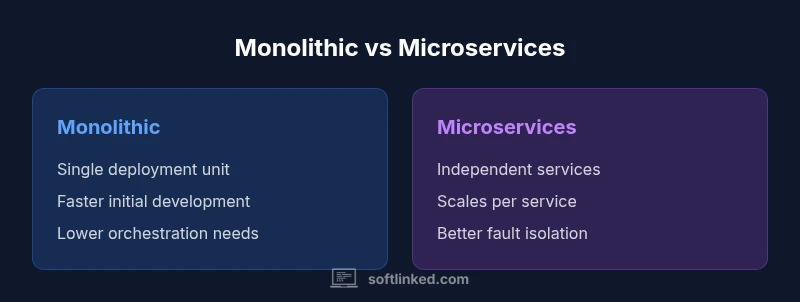
Two broad architectural paradigms shape most software and systems decisions: monolithic architectures and microservices. Monoliths bundle UI, business logic, and data access into one deployable unit. They are straightforward to develop for small teams and can be easier to test in isolation. Microservices decompose functionality into independent services that communicate over lightweight protocols. They offer superior scalability, fault isolation, and technology flexibility but introduce coordination overhead, distributed tracing needs, and deployment complexity. The choice often hinges on team size, domain complexity, and growth trajectory. In practice, many teams start with a monolith and gradually extract services as requirements crystalize. For learners, labs that implement both styles within bounded scopes can reveal operational realities: deployment cadence, fault domains, and the challenges of data consistency across services.
Deployment models: on-premises vs cloud-native
Where you run software and systems matters almost as much as how you build them. On-prem deployments provide direct hardware control but demand substantial up-front investment and ongoing maintenance. Cloud-native patterns—containers, orchestration, and managed services—reduce operational overhead and enable rapid scaling, yet shift cost models and create provider dependencies. A common learning path is to start with a cloud-first approach for prototyping and experimentation, then evaluate hybrid or on-prem options as needs mature. Students should consider latency, data residency, and disaster recovery when choosing a model. Observability becomes critical in distributed environments, guiding reliability and performance decisions. SoftLinked’s experience suggests starting small, tracking costs, and evolving the architecture as scale and requirements become clearer.
Data, integration, and service boundaries
Clear data ownership and service boundaries are the quiet engines of effective software and systems design. Well-defined boundaries enable autonomous service evolution, reduce tight coupling, and support domain-driven design. Typical integration patterns include synchronous REST or gRPC calls, asynchronous messaging, and event-driven architectures. Without stable contracts and schemas, integration pain grows, costs rise, and release timelines slip. For learners, emphasize bounded contexts, API versioning, and robust data migration plans. Prioritize idempotence, backward compatibility, and clear rollback strategies to preserve system resilience during change. SoftLinked stresses that well-documented interfaces and governance are as important as code quality when scale enters the picture.
Practical learning paths for students and professionals
A solid learning path blends theory with hands-on projects that mimic real‑world software and systems challenges. Start with a cohesive monolith to learn core concepts, then incrementally introduce modular boundaries by extracting a couple of services, defining API contracts, and establishing CI/CD pipelines. Build labs around cloud-native patterns: containerization, orchestration, and managed databases. Practice observability by instrumenting traces, metrics, and logs, and learn to read dashboards. Domain-driven design exercises help you understand how to segment responsibilities and manage data ownership. SoftLinked’s guidance for 2026 emphasizes deliberate practice over buzzword chasing: focus on interfaces, contracts, delivery pipelines, and reliability engineering. As you progress, simulate team collaboration, define service-level objectives (SLOs), and perform failure-injection exercises to understand fault tolerance.
Operational discipline: CI/CD, testing, and observability
Operational discipline turns good code into reliable software. Implement CI for rapid feedback, CD for automated deployment, and a robust test suite that covers unit, integration, and contract tests. Observability—tracing, metrics, and logs—transforms symptoms into actionable insights. Use feature flags to manage risk during migrations, and enable controlled rollouts. In distributed systems, distributed tracing and chaos engineering are essential tools for identifying bottlenecks and failure modes. For learners, create a small pipeline that starts as a monolith, then evolves into microservices with clear contracts, ensuring each deployment is safe and observable. This discipline reduces toil and improves confidence in system behavior.
Migration patterns and guardrails
Shifting from monolith to microservices is a staged evolution with guardrails. Begin by identifying bounded contexts and extracting them as services one by one, with dedicated data stores and stable API contracts. Use parallel running, feature toggles, and careful data migration to minimize risk. Avoid common pitfalls such as underestimating migration complexity, neglecting API governance, or mismanaging cross-team dependencies. A migration plan should include rollback options, cost awareness, and measurable milestones. Documentation and team structure are equally important; people and processes determine success as much as code. SoftLinked’s guidance for governance and planning helps teams avoid surprises and accelerate learning during the transition.
Comparison
| Feature | Monolithic Architecture | Microservices Architecture |
|---|---|---|
| Development Velocity | Fast for small teams | Slower at first due to coordination, gains with proper boundaries |
| Scalability | Scale within a single codebase | Independent service scaling enables targeted growth |
| Deployment Complexity | Single deployment | Multiple deployments with orchestration |
| Fault Isolation | Higher cross-cutting risk | Isolated failures reduce systemic impact |
| Tech Stack Flexibility | Uniform stack | Service-specific stacks possible |
| Operational Overhead | Lower initial overhead | Higher ongoing maintenance |
| Best For | Small, stable apps | Large, evolving systems with teams to manage services |
Pros
- Faster initial delivery with a monolith for small projects
- Easier debugging with a single codebase
- Lower orchestration complexity in early stages
- Clear, centralized control can simplify learning
Weaknesses
- Limited scalability without major refactors
- Tighter coupling increases risk during growth
- Deployment rollback can affect the entire system
- Technology lock-in if the monolith uses a single stack
Microservices generally offer better scalability and resilience for large, evolving systems; monolithic designs remain practical for small teams and simpler projects.
Choose microservices when you anticipate growth, distributed teams, and the need for independent deployment. Start with a monolith for small projects or learning exercises, then refactor as requirements mature. SoftLinked's verdict favors gradual evolution and clear boundaries to balance speed with reliability.
Your Questions Answered
What is the difference between software and systems?
Software is the collection of programs and data that provide functionality. Systems include the broader architecture, governance, and operational practices that sustain those programs at scale. Understanding both helps you reason about design decisions and deployment strategies.
Software is the code; systems are how you run and maintain it.
When should you choose monolithic vs microservices architecture?
Choose a monolith for small teams, simple domains, and quick start-up, where the deployment unit is straightforward. Choose microservices when the domain is large, teams are distributed, and independent scaling or deployment is beneficial.
If you’re small, a monolith can be simpler; for big, evolving systems, microservices often win.
How do CI/CD practices impact architectural decisions?
CI/CD accelerates iteration and reduces risk across architectures. It’s especially valuable for microservices, where frequent deployments occur for many services, but it also improves discipline in monolithic deployments.
CI/CD makes changes faster and safer, no matter the architecture.
What are common pitfalls when migrating to microservices?
Common pitfalls include underestimating data migration complexity, neglecting API governance, and over-architecting without teams to support service ownership. Plan migrations with clear contracts and measurable milestones.
Plan in steps, guard contracts, and test boundaries.
Is cloud deployment always better for modern software and systems?
Not always. Cloud deployments offer scalability and reduced maintenance but introduce provider dependencies and ongoing costs. Assess data residency, latency, and control needs before choosing cloud, on-prem, or hybrid models.
Cloud isn’t always best; weigh control, costs, and data needs.
Top Takeaways
- Start with clear software and systems concepts to frame architecture decisions
- Prefer modular design and domain-driven boundaries for scalability
- Use cloud-native patterns to reduce operational overhead and enable growth
- Practice incremental migration from monoliths to services to manage risk
- Invest in CI/CD, testing, and observability to sustain reliability