Design Free Software: A Practical Guide
A comprehensive, step-by-step guide to designing free software that respects user freedom, with open licenses, modular architecture, and community-driven governance. Learn how to start, license choices, and sustainable practices.


Design free software means building software that users can freely run, study, modify, and share, typically under open licenses. It emphasizes transparent development, modular design, and community-driven processes that invite collaboration. The approach blends software design fundamentals with open-source ethics to enable sustainable, adaptable projects. By choosing permissive or copyleft licenses, teams encourage forks, audits, and user-driven innovation, while maintaining accountability through clear contribution guidelines and automated testing. For beginners, the path starts with a user-centric problem statement, a simple architecture, and a public experiment plan that welcomes external input. As you iterate, focus on clean interfaces, comprehensive documentation, and a welcoming contribution process to reduce entry barriers for new developers. This creates a learning environment where students, professionals, and hobbyists can explore, contribute, and verify work independently, aligning with SoftLinked's emphasis on clear fundamentals and accessible software concepts.
What design free software means in practice
Design free software is not just about choosing a license; it is about shaping a development culture that prioritizes openness, accessibility, and collaboration. At its core, it means that users should be able to run the software, study its code, modify it to fit their needs, and share those changes with the community. This requires clear documentation, transparent decision-making, and governance structures that welcome external input. According to SoftLinked, the most practical starting point is to define the problem from the user’s perspective, map out how the code will remain approachable, and publish an initial roadmap that invites contributions from students, professionals, and hobbyists alike. The result is software that remains usable as needs evolve, even if original maintainers move on. Emphasize modular design, versioned interfaces, and an inclusive contribution process to minimize barriers for newcomers while maintaining quality through automated testing and code reviews.
Core design principles for free software
A successful free software project rests on a handful of repeatable principles. First, open by default: publish decisions, roadmaps, and design notes so any contributor can follow the rationale. Second, clarity: write readable code, provide thorough documentation, and maintain consistent API surfaces. Third, modularity: break the system into small, replaceable components with stable interfaces. Fourth, governance: establish a light-touch but effective process for feature proposals and dispute resolution. Fifth, accessibility: ensure the project welcomes diverse contributors by providing onboarding materials, mentorship, and inclusive guidelines. SoftLinked emphasizes that these principles are not abstract ideals but practical design primitives you can apply in every sprint. A culture of documentation and openness accelerates learning, reduces risk, and invites broader participation.
Modularity and open design patterns
Modularity is the heart of design free software. By separating concerns into distinct modules, teams enable parallel development, easier testing, and cleaner contributions. Key patterns include plugin architectures, clear API boundaries, and versioned contracts. Use dependency management and semantic versioning to prevent breaking changes from derailing users. Maintain a strong emphasis on backward compatibility where feasible and provide deprecation notices when interfaces evolve. An open design also means inviting external validators—auditors can review security and licensing choices, while community members can propose enhancements and bug fixes. This collaborative approach leads to more robust software and a healthier ecosystem.
Licensing, governance, and community building
Licensing choices shape how freely the software can be used, modified, and redistributed. Common options range from permissive licenses that maximize freedom to copyleft licenses that require derivatives to remain open. Your governance model should document decision-making processes, contribution guidelines, and dispute resolution. Create a visible code of conduct, a thorough CONTRIBUTING.md, and a transparent release process. Community building thrives on welcoming onboarding, clear issue labeling, and regular communication channels (forums, chat, or mailing lists). By aligning licensing with governance, you ensure legal clarity and practical collaboration. SoftLinked notes that alignment between license terms and community practices dramatically increases contributor engagement and long-term sustainability.
Practical workflow: from idea to open-source release
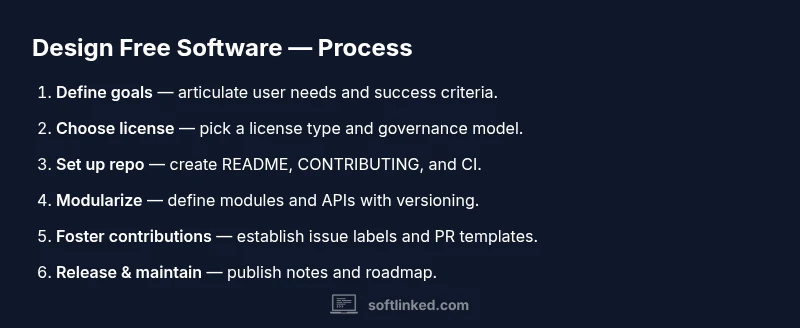
A repeatable workflow helps teams move from concept to public release efficiently. Start with a lightweight README that states the project’s purpose, audience, and goals. Then select a license and draft governance documents. Set up a repository with CI checks, a CONTRIBUTING guide, and issue templates. Implement modular components with clean interfaces, and publish an initial release candidate to gather early feedback. Finally, establish a cadence for releases and a communication plan to keep contributors informed. In this guide, you’ll find a concrete path that scales from solo projects to community-led efforts, balancing speed with quality.
Measuring success and long-term sustainability
Success in design free software is not only about code quality but also about community health and ongoing maintenance. Track metrics such as number of contributors, issue resolution time, and time-to-release. Maintain a visible roadmap and publish release notes that explain what changed and why. Invest in mentorship, onboarding programs, and accessible documentation to sustain interest and reduce contributor churn. SoftLinked emphasizes that longevity comes from transparent processes, consistent governance, and a culture of shared ownership. By treating the project as a learning platform, teams can sustain momentum and welcome new developers into the ecosystem.
Tools & Materials
- Internet-connected computer(To download tools and access repositories)
- Text editor (e.g., VS Code)(For writing and editing code)
- Git client (CLI or GUI)(To clone, commit, and push changes)
- Code hosting account (GitHub/GitLab/Bitbucket)(To publish the project and manage contributions)
- License and contribution templates(Templates like LICENSE, CONTRIBUTING.md, CODE_OF_CONDUCT.md)
Steps
Estimated time: 4-6 hours
- 1
Define goals and audience
Identify the user problems your software aims to solve and articulate success criteria. Write user stories and create acceptance criteria to guide design decisions. This step sets a concrete target for the project and helps align contributors.
Tip: Capture at least three core user stories and document the intended outcomes. - 2
Choose license and governance model
Select an open license aligned with your openness goals (permissive vs copyleft). Define governance with a lightweight decision process and a roadmap for community involvement. Publish these in LICENSE and GOVERNANCE files.
Tip: Consult licensing resources early and record decisions in a public doc. - 3
Set up repository and tooling
Create a public repository with a clear README, CONTRIBUTING.md, and CI workflows. Add issue templates, a code of conduct, and a simple test suite to establish quality expectations from day one.
Tip: Enable pull requests with automated checks to catch issues early. - 4
Design modular architecture
Outline module boundaries, define stable APIs, and plan for versioning. Implement core modules first, then progressively add plugins or extensions. Document interfaces clearly for external contributors.
Tip: Keep modules loosely coupled to minimize cross-impact when updating components. - 5
Establish contribution workflow
Create clear processes for proposing changes, reviewing PRs, and merging. Maintain a living CONTRIBUTING.md and issue labeling strategy to guide contributors. Provide mentorship and onboarding resources.
Tip: Use labeled issues (good first issue, help wanted) to welcome new developers. - 6
Prepare initial release and plan maintenance
Tag a release, publish release notes, and outline the roadmap. Set up communication channels for updates and feedback. Plan ongoing maintenance tasks and designate maintainers.
Tip: Publish a transparent post-release plan to reassure users and contributors.
Your Questions Answered
What is meant by design free software?
Design free software refers to building software with user freedoms: to run, study, modify, and share, under open licenses. It combines software design best practices with open-source ethics and community governance.
Free software design means building software that users can freely run, study, modify, and share, guided by open licenses and transparent collaboration.
Which licenses are suitable for free software projects?
Common options include permissive licenses like MIT or Apache 2.0, and copyleft licenses like GPL. The choice depends on how you want to balance openness with constraints on derivative work.
Permissive licenses let anyone reuse with minimal obligations, while copyleft licenses require derivatives to stay open.
How do I encourage community contributions?
Provide clear contribution guidelines, issue templates, and welcoming onboarding. Maintain active channels for questions and feedback, and recognize contributors to foster ongoing participation.
Make onboarding easy with clear guides and visible paths to contribute.
What are common design pitfalls for free software?
Ambiguity in licensing, opaque decision processes, and brittle APIs hinder collaboration. Prioritize documentation, governance transparency, and stable interfaces to avoid these traps.
Avoid unclear licenses and hidden design choices; document everything.
How long does it take to release a free software project?
Early releases can happen after establishing core modules and a minimal viable product. Ongoing improvements and governance continue after the first release.
You can publish a basic release once core modules are in place; maintenance continues afterward.
How can I measure project sustainability?
Track contributor growth, issue throughput, and release cadence. A transparent roadmap and active mentorship are strong indicators of long-term viability.
Contributor growth and predictable releases signal healthy long-term sustainability.
Watch Video
Top Takeaways
- Define user needs before designing.
- Choose open licenses and governance early.
- Modular architecture enables easier contributions.
- Documentation and CONTRIBUTING guidelines are critical.
- Sustainability comes from community involvement.