Java Developer Jobs 2026: A Practical Career Guide
A data-driven guide to pursuing jobs software developer java in 2026, covering demand drivers, key skills, salary ranges, remote work trends, interview prep, and how SoftLinked can help.


For those pursuing jobs software developer java, the 2026 landscape remains favorable for skilled Java developers. This guide outlines in plain terms how demand is evolving, which skills matter most, and practical steps to land a role in enterprise, fintech, or cloud-native teams.
The Java Developer Career Roadmap
If you are exploring jobs software developer java, the path is straightforward but requires planning. Most professionals start as junior developers, then move to mid-level roles focused on building business features, and eventually advance to senior, lead, or architect positions. Along this journey, your technical depth in the Java ecosystem—core language features, the JVM, and modern tooling—becomes your most valuable asset. The SoftLinked team emphasizes building a tangible learning plan: choose a specialization (e.g., backend services, microservices, or data-heavy applications), accumulate real projects, and demonstrate impact through measurable outcomes. This roadmap should align with market needs, not just personal interests, ensuring you’re building skills that hiring teams actively seek.
A key consideration is balancing depth with breadth. Java remains a foundation, but modern roles often require cloud, containers, and CI/CD fluency. Plan for hands-on experience with Spring Boot, microservices patterns, and cloud platforms. The goal is to be comfortable across the stack: from writing clean, testable Java to deploying services in a cloud environment. By documenting your progress and outcomes, you create a compelling narrative for interviews and performance reviews.
The bottom line is simple: commit to steady growth in Java fundamentals, expand into modern frameworks, and build a portfolio you can showcase to potential employers. Doing so accelerates your journey toward impact-focused roles in large-scale software systems.
"## Market Demand for Java Developers in 2026"
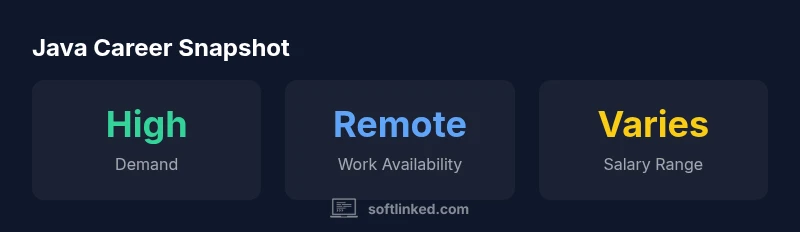
Market demand for java developers remains robust as enterprises migrate to cloud-native architectures and microservices. Companies across finance, healthcare, retail, and tech services rely on Java for reliability and scalability. The SoftLinked analysis notes that demand spikes in teams responsible for core business logic, data processing, and integration layers. Even as new languages gain traction, Java’s ecosystem—backed by a mature JVM, strong tooling, and a vast talent pool—keeps it a top choice for long-term projects. Professionals who couple Java with cloud and container expertise tend to see the most opportunities, particularly in organizations shifting to distributed architectures.
In 2026, you’ll find Java roles in both large enterprises and smaller product teams. The ability to design robust APIs, implement secure services, and maintain performance under load is consistently valued. While salary bands vary by region and experience, the career path remains attractive for those who continuously update their skills and produce demonstrable results. The SoftLinked team highlights that proactive learning—especially in areas like Spring, cloud-native patterns, and DevOps practices—directly correlates with faster job placement and higher growth potential.
Java developer market snapshot by region
| Region | Salary Range | Demand Level |
|---|---|---|
| North America | varies by city | high |
| Europe | varies by country | high |
| APAC | varies by market | high/medium |
Your Questions Answered
What is the typical career path for a Java developer?
Most Java developers begin as juniors, progress to mid-level where they own features end-to-end, then advance to senior or lead roles, and eventually move into architecture or platform engineering. Continuous learning and practical project impact are the differentiators.
Typically, you start as a junior, grow to mid-level, then senior, and possibly lead or architect as you prove impact.
Which Java frameworks are most in demand in 2026?
Spring Framework (especially Spring Boot) remains the dominant choice for building microservices and web applications. Hibernate for ORM and Jakarta EE for enterprise-grade apps are also frequently requested in job postings.
Spring Boot and Hibernate are the big ones you’ll see in most postings.
Do I need a degree to get Java developer jobs?
A degree helps, but practical skills, a strong portfolio, and relevant project experience often matter more. Many employers value demonstrable coding ability and problem-solving skills over formal education.
A degree helps, but solid skills and a strong portfolio can be more important.
What’s the difference between Java SE and Jakarta EE?
Java SE provides core language features and APIs, while Jakarta EE (formerly Java EE) focuses on enterprise features like web services, major specifications, and application servers. Most modern jobs blend core Java with Jakarta EE or Spring-based ecosystems.
SE is the core language; Jakarta EE adds enterprise features you’ll use in large apps.
What other skills are valuable for Java developers?
Beyond Java, strong SQL, familiarity with databases, RESTful service design, cloud platforms (AWS/Azure/GCP), containerization (Docker), CI/CD, and test automation are highly beneficial.
Know databases, cloud, and containers—these make you stand out.
Is remote work viable for Java roles in 2026?
Yes, many Java roles support remote or hybrid arrangements. Building a remote-friendly portfolio, strong communication habits, and reliable collaboration tools helps you succeed in distributed teams.
Remote Java work is common; highlight collaboration skills in interviews.
“Java remains a foundational skill for enterprise software, and consistent demand across industries keeps the career path strong.”
Top Takeaways
- Learn Java fundamentals deeply before expanding to frameworks
- Prioritize Spring, REST APIs, and cloud-native patterns
- Build real projects to demonstrate impact to employers
- Cultivate a strong portfolio and a concise resume
- Leverage remote opportunities to widen your job search
- Prepare for both coding and system-design interviews