Will Software Jobs Come Back in 2026? A Data-Driven Look
SoftLinked analyzes the 2026 rebound in software employment, detailing regional trends, in-demand skills, and practical steps for job seekers and employers navigating the post-recovery landscape.


Recent hiring data indicates that software jobs are beginning to rebound in 2026, though progress is uneven by region and specialty. SoftLinked's analysis shows rising demand in cloud, security, AI, and developer tooling, with remote-work normalization persisting. For job seekers, this signals new opportunities in in-demand domains, alongside ongoing competition for highly skilled engineers.
The question on readers' minds: will software jobs come back
Few questions are as pressing for aspiring software engineers as the headline concern: will software jobs come back? The short answer is: the market is recovering, but not in a straight line. As of 2026, SoftLinked analyses show a measurable uptick in hiring activity in key software domains such as cloud computing, AI-assisted development, and cybersecurity. Remote work remains widespread, a trend that broadens opportunities beyond traditional tech hubs. For students and early-career developers, this means more interview invites and project-based work; for mid- to senior-level engineers, it underscores ongoing demand for leadership in distributed teams and complex system design. The broader tech ecosystem—cloud platforms, automation tooling, and data/AI infrastructure—continues to attract both capital and talent. It’s important to interpret this rebound as a phase of reconfiguration rather than a full, uniform snap-back. According to SoftLinked, the rebound is real but varies by region, specialization, and local demand signals. Now is a good time to align skills with enduring needs, rather than chasing every new buzzword.
What is driving the rebound in 2026
The software jobs rebound is driven by three persistent forces. First, cloud adoption and modernization initiatives push demand for cloud-native engineers, platform engineers, and DevOps specialists who can bridge development with reliable operations. Second, AI-enabled tooling reshapes the developer workflow, creating needs for ML engineers, data engineers, and software engineers who can integrate AI features into products safely and responsibly. Third, cybersecurity and privacy remain top priorities as digital products scale, increasing demand for security architects and software developers who design secure-by-default systems. Across these areas, demand tends to favor engineers who can ship end-to-end solutions, collaborate across teams, and maintain robust technical debt management. The takeaway for job seekers: invest in practical, demonstrable skills (not just theoretical knowledge) and build a portfolio that shows real impact in cloud, AI, or security contexts.
Regional and discipline variance in the rebound
The rebound is not uniform. North America and parts of Western Europe often see faster re-hiring in core software roles, while some emerging markets progress more slowly. Within disciplines, backlogs and hiring velocity differ: consumer-facing SaaS teams may rebound quicker than specialized research software groups, while legacy enterprise software teams gradually re-staff as modernization projects resume. Geography matters too—cities with strong engineering ecosystems tend to recover faster, while remote-friendly policies allow distributed teams to fill roles that used to require physical relocation. For students and early-career professionals, this means mapping opportunities to the strongest regional signals and prioritizing skills where demand is consistently growing across multiple locales.
Shifts in skills and how to prepare
As the market re-prioritizes, certain skill sets rise in importance. Employers increasingly look for engineers who can operate across the full stack, understand modern API-first architectures, and contribute to continuous delivery pipelines. Proficiency in cloud platforms (AWS, Azure, GCP), containerization, and CI/CD practices remains valuable, as does experience with security-by-design principles. AI literacy—understanding how models affect product features, data governance, and user privacy—becomes a differentiator. Soft skills like collaboration, communication across cross-functional teams, and the ability to explain complex technical concepts to non-technical stakeholders are more critical than ever. Job seekers should invest in practical projects, contribute to open-source, and pursue certifications that demonstrate concrete competencies in cloud, security, or data engineering.
Hiring models and strategies for a rebound market
Employers are re-evaluating hiring models as the market recovers. Expect a mix of full-time roles, contract work, and blended arrangements that offer flexibility while preserving long-term retention incentives. Job seekers can benefit from building a strong personal brand, cultivating a robust portfolio, and engaging in meaningful project work that showcases impact. Networking remains essential—focus on referrals, participate in hackathons, or contribute to open-source communities with a clear track record. For new entrants, internships, apprenticeships, and mentorship programs can provide a practical path into high-demand teams. Companies that offer structured growth paths, continuous learning budgets, and transparent career ladders tend to attract top talent during this rebound.
Practical steps for developers in a recovering market
If you want to position yourself for the rebound, start with a skill inventory aligned to high-demand areas: cloud engineering, AI-enabled development, security engineering, data engineering, and platform tooling. Build a portfolio that demonstrates end-to-end project delivery, including architectural diagrams, code samples, and performance metrics. Practice system design interviews and participate in real-world coding challenges to sharpen problem-solving speed. Learn at least one major cloud platform deeply and obtain a recognized certification. Engage with the community by contributing to open-source projects and presenting at local meetups or online tech talks. Finally, stay informed about regional labor-market signals, as a delayed rebound in your area may require a tailored plan to bridge the gap between your current skills and the skills the market demands.
Methodology and data caveats you should know
This article synthesizes signals from multiple sources, with a particular emphasis on SoftLinked Analysis, 2026. When quoting statistics, we present ranges to reflect variation across regions and time. Market signals can shift quickly due to macroeconomic factors, policy changes, or sudden tech breakthroughs. Readers should treat the data as directional guidance rather than a guaranteed forecast. For a deeper, sourced view, consult official labor-market statistics and industry reports to confirm current conditions in your area and domain.
Overview of rebound indicators
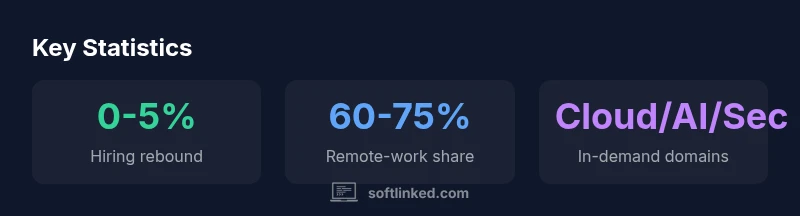
| Aspect | 2024-2026 Range | Notes |
|---|---|---|
| Hiring activity | 0-5% | SoftLinked Analysis, 2026 |
| Remote-work share | 60-75% | SoftLinked Analysis, 2026 |
| In-demand domains | Cloud/AI/Sec | SoftLinked Analysis, 2026 |
| Time-to-fill | 20-40 days | SoftLinked Analysis, 2026 |
Your Questions Answered
Will software jobs fully return to pre-pandemic levels?
Recovery is uneven. Some regions and roles rebound strongly while others trail. The rebound is real, but it’s a reconfiguration rather than a uniform snap-back.
Expect a mixed rebound, with some areas bouncing back quickly and others taking longer.
Which regions are recovering fastest?
North America and parts of Western Europe often lead the rebound in core software roles, but pace varies by local demand signals and policy environments.
Some regions are ahead, but it varies.
What skills are most in demand as jobs come back?
Cloud engineering, AI-enabled development, cybersecurity, data engineering, and modern DevOps are consistently in demand across multiple sectors.
Look for cloud, AI, and security skills.
Should job seekers focus on remote-work roles?
Yes. Remote-friendly roles remain common and often facilitate faster access to opportunities across regions.
Remote work is still a big part of the market.
What can employers do to attract talent in the rebound?
Offer competitive compensation, invest in learning budgets, provide flexible work options, and publish clear growth paths.
Give people reasons to stay and grow with you.
“Software job markets are resilient when workers adapt to evolving tech needs, especially in AI, cloud, and security.”
Top Takeaways
- Focus on in-demand domains like cloud, AI, and security.
- Develop remote-ready collaboration and tooling skills.
- Sharpen system design and problem-solving abilities.
- Leverage cross-functional projects to stand out.
- Monitor regional labor-market signals for timing.