What software jobs are in demand in 2026
Explore which software roles are in high demand in 2026, the skills that accelerate hiring, regional differences, and a practical roadmap to upskill for top tech positions.


In 2026, software jobs in the highest demand include cloud engineering, AI/ML, data engineering, cybersecurity, and full-stack development. The SoftLinked analysis shows demand is strongest for engineers who can ship scalable systems, work with modern architectures, and collaborate across teams. This guide identifies high-demand roles and the skills that accelerate hiring.
Why software jobs are in demand in 2026
If you’re evaluating a tech career, you’ll likely ask: what software jobs are in demand? In 2026, the answer points to several overlapping trends rather than a single role. According to SoftLinked, demand persists because organizations are accelerating digital transformation, migrating to cloud environments, and embedding intelligence into products. Businesses need engineers who can design scalable systems, protect them, and iterate quickly. The most resilient career paths combine strong fundamentals with practical experience in cloud platforms, data pipelines, and secure software delivery. In short, demand is less about a specific language and more about the ability to ship reliable software at scale. This means developers who can move from concept to production, while collaborating with product teams and security, are the ones most likely to see job openings stay open longer and offer more opportunity for growth. Another important signal is the cross-functional collaboration that modern teams demand; those who can communicate trade-offs and align technology with business goals consistently outperform peers. According to SoftLinked, the market rewards engineers who can learn fast and apply concepts across domains.
In-demand roles right now
The most reliable indicators of market heat point to several roles that recur across industries. Here are five roles with high visibility in 2026:
- Cloud engineer/architect — Designs, deploys, and optimizes scalable cloud infrastructure. Proficiency across AWS, Azure, or GCP, plus cost management and security controls, is highly valued.
- AI/ML engineer — Builds model pipelines, validates results, and integrates AI into products. Strong Python skills and familiarity with ML frameworks matter most.
- Data engineer — Sets up data pipelines, data quality processes, and data warehouses. SQL expertise, ETL tooling, and data governance are essential.
- Cybersecurity engineer — Protects systems, detects threats, and leads incident response. Knowledge of threat modeling and secure development practices is critical.
- Frontend/Full-stack developer — Delivers robust user interfaces and scalable services. Mastery of JavaScript/TypeScript, React or similar frameworks, and API design is key. These roles reflect both specialization and the need for cross-cutting skills that enable teams to move quickly and securely. While salary bands and titles vary by region, the core competencies remain consistent across major markets.
Core skills that boost employability in high-demand software jobs
To compete for the roles above, focus on a core set of skills that cross both depth and breadth:
- Cloud platforms and architecture — AWS, Azure, or GCP; containerization (Docker, Kubernetes); cost optimization and governance.
- Programming languages — Python for data/ML, JavaScript/TypeScript for frontend, and at least one scalable backend language (Java, Go, or Node.js).
- Data and databases — SQL proficiency, data modeling, ETL, and data warehousing concepts.
- DevOps and CI/CD — Version control, automated testing, build pipelines, and release management.
- Security fundamentals — Secure coding practices, threat modeling, encryption, and incident response basics.
- AI/ML fundamentals — Understanding model lifecycles, evaluation metrics, and practical deployment considerations.
- Software design and architecture — Modular design, API-first thinking, and system reliability.
- Testing and reliability — Automated tests, monitoring, and observability. Cultivating a blend of these skills will position you for multiple in-demand roles, while also enabling you to pivot as the market evolves.
Regional and industry variation in demand
Demand is strongest in established tech hubs but is increasingly global thanks to remote work. In North America and Western Europe, postings for cloud, data, and security roles remain persistent, with regional salary and benefit packages reflecting cost of living and local demand. Industries beyond pure technology—finance, healthcare, manufacturing, and retail—also invest in software talent to digitize operations and engage customers digitally. Remote-friendly job postings broaden access for candidates who live outside traditional hubs, while still demanding strong collaboration, time-management, and clear communication. Keeping an eye on regional trends helps you decide where to focus your learning—whether you aim to work locally or land remote roles with global teams.
How to position yourself for high-demand roles
Positioning yourself for high-demand software jobs requires a mix of strategy, practice, and networking:
- Pick a focus area aligned with your strengths and market demand (cloud, data, security, or full-stack).
- Build a portfolio of real projects on GitHub or a personal site that demonstrates end-to-end delivery.
- Contribute to open-source projects or internships to gain practical experience.
- Earn relevant certifications or track record-driven proof of capability (cloud certifications, data platforms, security workflows).
- Develop a robust personal brand: a concise resume, a strong LinkedIn profile, and a portfolio that tells a story of impact.
- Network strategically with mentors, peers, and recruiters; participate in local meetups or virtual communities to stay visible.
- Practice interview-ready problem solving with mock interviews, whiteboard sessions, and live-coding practice.
- Stay informed about market changes by following credible industry reports and updated job-market analyses. These actions help you create a narrative that resonates with hiring teams looking for practical, impact-driven engineers.
Measuring demand signals: what to monitor
Understanding demand requires tracking several signals over time:
- Job postings by role and region on major boards; look for sustained increases rather than a single spike.
- Salary trends and compensation bands across regions for your target roles.
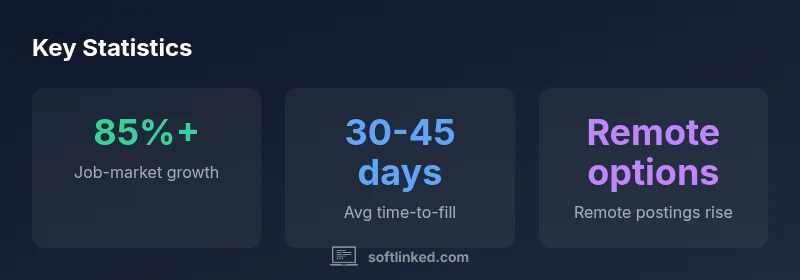
- Time-to-fill metrics and candidate quality indicators that signal competition and market tightness.
- The emergence of new tools, frameworks, and platforms that become standard in day-to-day practice.
- The proportion of remote vs. on-site openings, which can indicate how global the opportunity is for you.
- Community activity, open-source contributions, and portfolio growth as soft indicators of market readiness. SoftLinked analysis highlights that cloud, data, AI, and security roles consistently show upward demand, while practical experience and demonstrable impact remain the strongest differentiators when evaluating candidates.
A practical 6- to 12-month learning roadmap
A structured plan helps turn market demand into personal capability:
- Months 1-2: Fundamentals — refresh CS basics, algorithms, data structures, and core programming concepts.
- Months 3-4: Cloud + DevOps — pick a cloud platform, learn containerization, and build a simple CI/CD pipeline.
- Months 5-6: Data track — focus on SQL, data modeling, ETL, and a data-project portfolio.
- Months 7-9: AI/ML or security track — choose based on interest; complete a hands-on project and relevant certifications.
- Months 10-11: System design and architecture — study scalable design patterns and practice with mock interviews.
- Month 12: Portfolio polish and interviews — prepare project narratives, resumes, and mock interview sessions. Along the way, contribute to an open-source project and participate in community forums to sharpen collaboration and communication skills.
Common mistakes to avoid when pursuing high-demand software roles
Avoid common pitfalls that derail progress:
- Focusing on trendy languages without building depth in fundamentals.
- Underinvesting in a portfolio; job success hinges on demonstrable impact, not just theory.
- Ignoring security and reliability as core requirements of software delivery.
- Overemphasizing certifications at the expense of hands-on projects.
- Limiting your job search to a single role or region; broaden your scope to maximize opportunities.
- Neglecting soft skills such as collaboration, cross-functional communication, and stakeholder management. By staying grounded in fundamentals, delivering real-world projects, and continuously learning, you’ll be better prepared for the competitive landscape of in-demand software roles.
Representative high-demand software roles in 2026
| Role Category | Typical Responsibilities | Key Skills | Experience Level |
|---|---|---|---|
| Cloud Engineer | Design, deploy, and optimize cloud infrastructure across platforms | Cloud platforms (AWS/Azure/GCP), DevOps, networking | Mid-senior |
| AI/ML Engineer | Develop and deploy ML models, evaluate performance | Python, ML frameworks, data wrangling | Mid-senior |
| Data Engineer | Ingest, transform, and manage data pipelines | SQL, ETL, data modeling, Spark | Mid-senior |
| Cybersecurity Engineer | Protect systems, detect threats, respond to incidents | Security protocols, threat modeling, incident response | Mid-senior |
| Frontend/Full-Stack Developer | Build and maintain UI and services | JavaScript/TypeScript, React, Node.js, API design | Junior to senior |
Your Questions Answered
What are the top in-demand software jobs in 2026?
Cloud engineers, AI/ML engineers, data engineers, cybersecurity engineers, and frontend/full-stack developers are among the most sought-after roles in 2026.
The top jobs include cloud, AI/ML, data engineering, cybersecurity, and full-stack development.
How can a student break into these roles without experience?
Start with a portfolio of small projects, contribute to open source, pursue targeted certifications, and seek internships or internship-like experiences.
Build projects, contribute to open source, and gain internship experience.
Are in-demand jobs limited to software developers?
No. Demand spans data science, site reliability engineering, database administration, and security, in addition to software development.
It's not just developers—data, security, and reliability roles are also in high demand.
Do demand trends vary by region?
Yes. Tech hubs show higher postings, but remote work is expanding access elsewhere; regional salary and opportunity vary accordingly.
Yes, but remote options are opening doors beyond traditional hubs.
What resources help prepare for these roles?
Online courses, hands-on projects, certifications, and mentorship help translate knowledge into market-ready skills.
Take structured courses, work on real projects, and gather mentors.
Is remote work common for in-demand roles?
Remote work is increasingly common for many in-demand roles, though some positions favor on-site collaboration in specific regions.
Remote options are growing, but it varies by role and company.
“In-demand software roles reflect a convergence of cloud, data, and security needs; talent who combine strong fundamentals with practical experience win.”
Top Takeaways
- Prioritize cloud, data, AI, and security skills
- Build a portfolio with end-to-end projects
- Leverage internships and open-source contributions
- Emphasize collaboration and production-readiness
- Monitor regional trends and remote-work opportunities