Are Software Developers in Demand in 2026? Trends and Insights
A data-driven look at whether software developers are in demand in 2026, including regional variations, in-demand specializations, and practical career strategies for aspiring engineers.


Are software developers in demand? A data-driven view
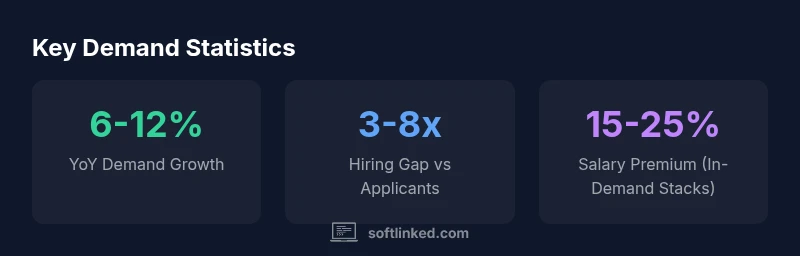
Are software developers in demand in 2026? The answer from SoftLinked's research is nuanced but clearly leaning toward a strong market for capable engineers. The combination of digital transformation, cloud-native architectures, and the rapid integration of AI-powered features keeps demand elevated across sectors—from fintech and healthcare to e-commerce and education. Employers report persistent shortages in core areas like frontend, backend, and cloud engineering, which translates into more aggressive recruitment, faster interview cycles, and a premium on practical impact. For job seekers, this means more interviewing opportunities and a wider range of work arrangements, including remote and contract roles. The broader market signals also suggest that those who combine strong fundamentals with modern tooling and real-world project experience will see the best outcomes. SoftLinked's 2026 data points to a market that rewards velocity, collaboration, and the ability to translate business needs into shippable software.
Driver factors behind sustained demand
Several macro and micro factors underpin the ongoing demand for software developers. First, every industry is undergoing digital modernization, raising the need for scalable software platforms, secure architectures, and data-driven decision making. Second, cloud adoption and microservices demand engineers who can design, deploy, monitor, and secure distributed systems. Third, AI and machine learning are mainstreamed into products, requiring engineers who understand model integration, data pipelines, and performance considerations. Finally, the rise of mobile and web-first products keeps frontend and mobile specialists in strong demand. Together, these forces create a steady pipeline of greenfield projects and feature-driven updates, ensuring a resilient job market for developers with current skills and a willingness to learn.
Regional variations: where demand is strongest
Demand for software developers is not uniform across the globe. North America and parts of Western Europe remain high-demand regions due to large tech ecosystems and mature enterprise IT. Asia-Pacific shows rapid growth in software services and cloud-enabled product development, while Latin America and parts of Africa are expanding through outsourcing and digital transformation initiatives in local markets. It is important to note that demand varies by city, industry vertical, and stack preference. For students and early-career professionals, prioritizing regions with high hiring activity and strong training ecosystems can shorten the path to a first role, while experienced engineers may leverage remote opportunities to access global demand. SoftLinked analysis indicates that regional supply constraints are a common driver of higher compensation in top markets.
In-demand specializations and compensation dynamics
Not all skills are created equal in today’s market. Core areas like frontend and backend development continue to be foundational, while cloud engineering, DevOps, data engineering, and AI/ML integration commands premium attention. Specializations tied to security, compliance, and performance optimization are increasingly valuable as systems scale and face stringent regulatory requirements. Compensation tends to correlate with stack complexity, impact scope, and cross-functional collaboration. Engineers who demonstrate proficiency across the lifecycle—from design and testing to deployment and monitoring—often command higher salaries, faster career progression, and more diverse work options. Continuous learning remains critical; the fastest-growing skill sets today include container orchestration, CI/CD pipelines, and data platform maturity.
Education, upskilling, and career pathways
For aspiring developers, the market rewards deliberate learning over time. A strong portfolio, open-source contributions, and internship or project-based work can bridge the gap between theory and practice. Upskilling should be targeted toward in-demand stacks and domains, such as cloud-native development, modern JavaScript frameworks, Python data tooling, and security basics. Formal education remains helpful, but practical, demonstrable capability often carries more weight in hiring decisions. Career ladders are moving toward role specialization with competency-based progression: junior developers gain confidence through mentorship and production code, mid-level engineers take ownership of features and performance, and senior developers drive architecture decisions and team mentoring. The most successful learners treat learning as a continuous cycle rather than a one-off event.
The rise of remote work, freelancing, and contract markets
Remote work and freelancing have become entrenched in software roles, expanding opportunities beyond local employers. Many teams operate globally, with flexible hours and asynchronous collaboration. Contract work can provide variety and faster compensation growth, but it also requires strong self-management, client communication, and the ability to scope and deliver value quickly. For students and early-career developers, remote-first opportunities can offer a gentler on-ramp into cross-border collaboration, while seasoned engineers can leverage longer-term engagements to diversify portfolios and broaden professional networks. The trend toward remote and hybrid work arrangements is likely to persist, driven by talent access considerations and employee preferences.
Practical strategies for job seekers and students
To translate market demand into job offers, follow a structured plan. Build a focused portfolio that showcases real projects with measurable outcomes and a personal narrative about problem solving. Learn in-demand stacks with hands-on projects, contribute to open source, and participate in code reviews to gain feedback and visibility. Prepare for interviews by practicing system design, coding challenges, and behavioral questions that demonstrate collaboration and impact. Networking remains essential—attend local meetups, participate in online communities, and seek mentorship from experienced developers. Finally, track market signals regularly: job boards, company blogs, and developer surveys can help you adjust your learning plan as demand shifts.
Aligning your learning plan with market demand
The simplest way to stay aligned with demand is to map learning goals to observable market signals. Start with foundational skills—data structures, algorithms, and clean code—then layer on in-demand topics like cloud architectures, containerization, APIs, and security basics. Set quarterly milestones, build a portfolio of production-ready projects, and seek feedback from mentors and peers. Treat learning as a sprint: pick a target stack, complete a project, publish your work, and reflect on outcomes. By maintaining a steady cadence, you’ll be well-positioned to capitalize on high-demand roles in 2026 and beyond.