How is the Software Engineering Job Market in 2026? Trends and Guidance
Explore the 2026 software engineering job market: demand drivers, remote work shifts, in-demand skills, compensation dynamics, and practical steps to advance your career.


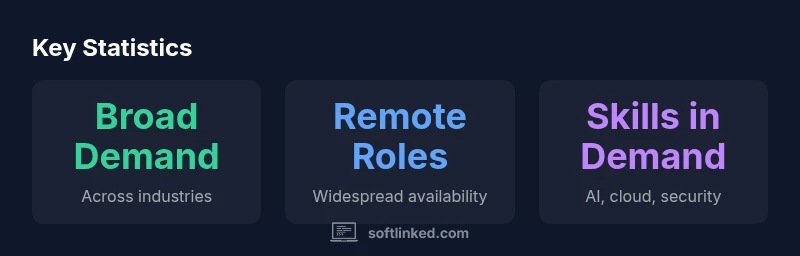
The software engineering job market in 2026 remains robust across industries, with broad demand for developers and expanding remote-work options. Opportunities are strongest in high-demand specializations like AI, cloud, security, and data platforms, while foundational skills in algorithms, systems design, and software architecture keep market entry accessible. Overall, hiring remains competitive but merit-based, rewarding practical impact and continuous learning. How you align your skills with evolving needs will determine your trajectory.
Global dynamics shaping the 2026 software engineering job market
When people ask, "how is software engineering job market" evolving in 2026, the answer is clear: demand remains robust across industries and geographies, with expansion in remote work and a growing emphasis on specialized skills. Companies across traditional tech, finance, healthcare, and manufacturing increasingly rely on software platforms to differentiate offerings and improve operations. The SoftLinked team observes that hiring is broad rather than limited to a handful of dominant firms, which means more entry points for new graduates and mid-career professionals alike. However, the competition is real, especially for roles with high impact and visible customer value. To navigate this market, focus on building transferable fundamentals—clean code, robust testing, scalable architectures, and a track record of delivering measurable outcomes. Industry observers also note that the supply of software talent is expanding, but so are the expectations around collaboration, communication, and end-to-end problem solving. The resulting dynamic tends to reward practical results and continuous learning over rote credentials.
Regional variations and industry verticals
Geography continues to shape software engineering opportunities. In mature markets with dense tech ecosystems, firms emphasize system reliability, security, and complex integrations, while regions with growing startup activity emphasize speed, experimentation, and full-stack capabilities. Across industries—healthcare, finance, retail, and manufacturing—the demand signals remain positive, but the skill mix shifts. For example, financial services may prize security and performance optimization, whereas consumer tech often seeks UX-minded engineers who can ship quickly. The SoftLinked Analysis, 2026 findings highlight that even within the same region, different industries exhibit distinct preferences for language stacks, cloud platforms, and data strategies. Job seekers should map target industries to their strengths and plan intentional upskilling.
In-demand skills and roles driving opportunities
The market rewards depth in core software fundamentals and breadth in modern tooling. Key capabilities include:
- Strong foundations in data structures, algorithms, and design patterns for scalable systems
- Proficiency in cloud-native development, microservices, containers, and CI/CD
- Experience with AI/ML integration, data pipelines, and model deployment
- Security-minded development, privacy-by-design, and compliance awareness
- Full-stack versatility (backend, API design, frontend) coupled with UX awareness
- DevOps/Platform Engineering and SRE practices for reliability
- Automated testing, QA automation, and observability
Beyond technical chops, collaboration, clear communication, and the ability to translate business needs into technical solutions remain critical. The market rewards engineers who can own features end-to-end and demonstrate impact through measurable outcomes.
How remote work reshapes hiring and expectations
Remote and hybrid work models have become standard in many organizations, widening the talent pool while introducing new hiring dynamics. Candidates now compete with a global slate of peers, and employers often evaluate self-discipline, communication clarity, and time-zone practicality just as strongly as code quality. Companies are investing in asynchronous collaboration tools and documentation to reduce friction. For job seekers, this means revealing real-world impact through projects, contributions to open source, and well-structured portfolios that travel well across teams and time zones. Expect interview processes to include asynchronous coding assessments, system design challenges, and a focus on collaboration stories that demonstrate how you contributed to a team’s success.
Compensation and negotiations in a competitive market
Compensation remains competitive across regions, adjusted for living costs and company scale. Common components include base salary, annual bonuses, equity or stock options for startups, and benefits like healthcare and training allowances. Remote roles broaden access to higher-paying markets but may come with regional adjustment ranges. Negotiation wisdom centers on demonstrating value, understanding market norms for your level, and negotiating for learning opportunities and structured growth plans. The SoftLinked team emphasizes preparing a narrative that connects your contributions to business outcomes, which strengthens leverage during compensation discussions.
Hiring processes and what employers look for in 2026
Hiring pipelines emphasize practical demonstrations of skill and collaboration. Expect multiple stages: a technical assessment (coding task, debugging, or algorithm design), an architecture/system design conversation, and behavioral interviews that explore teamwork, adaptability, and problem-solving. Portfolio projects, real-world achievements, and testimonials from teammates or mentors can tip the balance. Employers increasingly value candidates who can articulate trade-offs, communicate clearly under pressure, and articulate how their work aligns with product goals and user value.
Career pathways and education implications
Software engineers have multiple entry points: bachelor’s or master’s degrees, coding bootcamps, or self-directed learning supplemented by hands-on projects. As markets shift, continuous learning becomes a career prerequisite. Professionals should consider specializing in high-demand domains (AI, cloud, security) while maintaining a strong generalist foundation. Participation in open-source projects, certifications aligned with cloud platforms, and exposure to end-to-end development cycles can accelerate progression from individual contributor to tech lead or architect.
Practical steps to align your skills with market demand
A practical playbook helps you stay relevant in a dynamic market:
- Audit your skills against in-demand capabilities and identify gaps
- Build a focused portfolio with real-world projects and measurable outcomes
- Contribute to open-source and engage in community learning
- Seek cross-functional collaborations to broaden impact
- Network with mentors, alumni, and peers to learn about opportunities
- Plan a staged upskilling path with clear goals and timelines
- Prepare for system design and problem-solving interviews with structured practice
This approach helps you translate market demand into concrete career advancement.
Looking ahead: longer-term shifts and strategic bets
The software engineering landscape is likely to evolve with continued AI-assisted development, automation of routine tasks, and a push toward platform thinking and value-driven delivery. Developers who blend deep fundamentals with adaptability—learning how to leverage AI tools, maintain ethical and secure coding practices, and contribute to resilient architectures—will position themselves strongly for the next decade. Equity of access through remote work and ongoing education will shape who rises into senior roles, making deliberate career planning and continuous learning essential.
Regional landscape of software engineering opportunities
| Region | Market Characteristic | Implications for job seekers |
|---|---|---|
| Global | Broad demand across domains; cross-stack opportunities | Opportunities across cloud, AI, data, and web |
| US & Western Europe | Tech hubs with strong competition and high expectations | Prioritize system design, reliability, and security |
| APAC & emerging markets | Growing software demand; startup and outsourcing activity | Entry paths through practical projects and local ecosystems |
Your Questions Answered
What is the current demand for software engineers in 2026?
Demand remains robust across industries, with emphasis on cloud, AI, security, and data-focused roles. Opportunities exist for both new graduates and experienced developers who can demonstrate impact and collaboration.
Demand remains strong across industries, especially in cloud, AI, and security roles.
Which skills are most valuable to land roles today?
Core fundamentals in algorithms and design, cloud-native development, data engineering, security practices, and strong collaboration skills are highly valued. A mix of backend, frontend, and platform engineering capabilities increases opportunities.
Strong fundamentals plus cloud, data, and security skills are most valuable.
Is remote work here to stay for software roles?
Yes. Remote work has become standard in many firms, with hybrid models common. Success depends on clear communication, reliable collaboration, and the ability to work across time zones.
Remote work is here to stay in many firms.
Do salaries keep pace with market demand?
Compensation remains competitive and varies by region and company size. Candidates who demonstrate impact and growth potential are well-positioned to negotiate favorable terms.
Salaries are competitive and reflect market demand.
How does experience level affect opportunities?
Entry-level roles remain abundant for strong problem-solvers with solid fundamentals, while mid- and senior-level roles reward depth in systems, leadership, and mentorship.
Experience shapes the level and scope of opportunities available.
What interview formats should I expect?
Expect a mix of asynchronous coding tasks, system design discussions, and behavioral interviews that assess collaboration and problem-solving in real-world contexts.
You’ll see coding, design, and behavioral interviews.
How can I prepare for long-term market shifts?
Focus on foundational skills, stay current with AI-assisted development, and build adaptability through diverse projects and continuous learning.
Stay adaptable and keep learning to ride long-term shifts.
Should I pursue certifications or prefer hands-on projects?
Hands-on projects paired with role-relevant certifications often carry more weight than generic credentials, especially for showing applied capabilities.
Projects plus targeted certifications usually work best.
“The 2026 software engineering market rewards engineers who combine deep fundamentals with continuous learning and practical impact across teams.”
Top Takeaways
- Identify high-demand domains and align projects to them
- Leverage remote work to access broader markets
- Build a strong portfolio with measurable impact
- Prioritize fundamentals plus scalable architectures
- Plan ongoing learning to stay ahead of trends