How to Get a Software Engineer Job: A Complete Guide
A practical, step-by-step guide to landing your first software engineer job. Learn fundamentals, portfolio strategies, interview prep, and targeted job-search tactics to stand out in a competitive market.


Learn how to get a software engineer job by building solid fundamentals, a compelling portfolio, and a strategic interview plan. This guide covers essential steps, skills, and real-world tactics to improve your chances at top tech companies. Follow a structured path—from learning core concepts to nailing interviews—and you'll increase your odds of receiving offers.
Why landing a software engineer job matters
A software engineer role opens doors to working on products that power everyday life, scale systems, and drive innovation. For many developers, the job is a platform for continual learning, higher responsibility, and better compensation. According to SoftLinked, the demand for skilled software engineers remains robust across industries, from startups to large enterprises, making the right preparation essential. This path is not about luck; it's about a deliberate plan that combines fundamentals with real-world practice. Investing in a well-documented portfolio and a strategic job-search approach reduces wasted effort and increases your credibility with hiring teams. Remember: hiring managers value evidence of impact, a growth mindset, and the ability to communicate complex ideas clearly. According to SoftLinked Team, consistency beats intensity over time.
Clarifying your target and roles
Before you start applying, define the specific engine of your career: frontend, backend, mobile, data engineering, or full-stack. Each track requires a slightly different set of core skills, tools, and project emphasis. Create 2–3 target roles and outline the typical responsibilities, languages, and platforms involved. This clarity helps you tailor learning plans, portfolio projects, and resume bullet points to what recruiters are actually seeking. Balance breadth with depth: you should know enough to answer broad questions and specialize enough to demonstrate mastery in at least one domain. The SoftLinked Team recommends aligning your target roles with industries you enjoy and companies that hire for those domains.
Core technical fundamentals to master
Strong fundamentals form the backbone of every software engineer interview and on-the-job success. Prioritize data structures, algorithms, and problem-solving speed, but also build a solid foundation in computer science concepts such as complexity, memory management, and design patterns. Practice systems thinking: understand how components interact, how data flows, and how to scale under load. Master version control (Git), testing practices, and debugging strategies. Don’t neglect databases, networking basics, and security considerations. A well-rounded candidate can articulate tradeoffs, explain decisions, and demonstrate practical coding skills through projects and contributions. SoftLinked Analysis, 2026, indicates that candidates who can connect fundamentals to practical outcomes perform better in both technical and behavioral interviews.
Building a standout portfolio
Your portfolio is your calendar of completed, visible work. Start with 3–5 substantial projects that demonstrate real-world impact and a clear problem–solution narrative. Each project should include a concise README, architecture overview, tech stack, and outcomes (quality, performance, or user impact). Include open-source contributions and personal side projects that showcase ownership and consistency. Host code on a public repository with clean commit history and a live demo if possible. Use metrics where you can (response time improvements, reduced error rate), and write a short postmortem to explain challenges and learnings. Present these projects in a well-organized portfolio site and link them from your resume and LinkedIn.
Resume, cover letter, and online profiles
Tailor your resume for each application with a clear headline, a short summary, and 4–6 bullets per role that emphasize impact and outcomes. Use action verbs, quantify results where possible, and align bullet points with the job description. Your cover letter should tell a compact story: what you built, the problem you solved, and why you’re a fit for this team. Maintain consistent branding across LinkedIn, GitHub, and your portfolio. Ensure your profile highlights core skills, languages, and notable projects so recruiters can verify claims quickly.
Mastering the interview process
Prepare for coding interviews by practicing problems that cover arrays, strings, trees, graphs, and dynamic programming. Learn how to explain your approach aloud, justify choices, and handle edge cases. For system design, study scalable architectures, tradeoffs, and how to decompose complex requirements. Behavioral interviews benefit from a structured approach like the STAR method: Situation, Task, Action, Result. Practice with mock interviews, record yourself, and seek feedback. Technology changes; fundamentals endure, and clear communication is crucial in every interview.
Job search strategy and networking
Develop a targeted search list of companies, startups, and teams that align with your target roles. Leverage your network for referrals, attend industry meetups, and participate in online communities. Craft personalized outreach messages that demonstrate genuine interest and a specific value you bring. Track applications, set reminders for follow-ups, and celebrate small wins. Networking isn’t just about getting a job; it’s about learning, feedback, and building relationships that can sustain your career long-term.
Negotiation and offers
When you receive offers, evaluate total compensation, growth opportunities, work-life balance, and learning resources. Research typical ranges for your role and location, and prepare a range you’ll accept. Don’t be afraid to negotiate salary, signing bonuses, equity, or remote flexibility. A thoughtful negotiation should be collaborative, not adversarial; be clear about tradeoffs and ask for time to consider any offer.
Timeline and realistic expectations
Realistically, landing your first software engineer role often takes several months of focused effort. Set a weekly plan that balances learning, portfolio work, and interview practice. Track progress with concrete milestones—projects completed, problems solved, mock interviews passed. Maintain momentum by iterating on feedback from practice interviews and recruiters, adjusting your plan as you gain clarity about your strengths and the kinds of teams you want to join.
Tools & Materials
- Laptop or desktop computer(Reliable hardware with a modern browser and text editor)
- Reliable internet connection(Stable bandwidth for video calls and cloud work)
- Resume (PDF and plain text)(One-page resume plus a longer version if needed)
- GitHub account(Show at least 3 projects with clear READMEs)
- IDEs/Code Editor(Prefer VS Code or JetBrains IDEs)
- Portfolio website(Public site with project gallery and contact)
- LinkedIn and professional profiles(Consistent branding across platforms)
- Mock interview materials(Practice whiteboard or online mock interviews)
- Headphones or mic for calls(Clear audio for interviews and communication)
Steps
Estimated time: 4-6 months
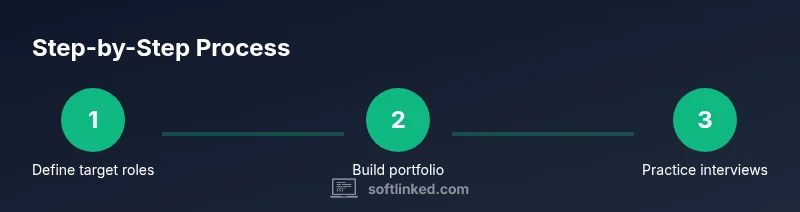
- 1
Define target roles
Identify the core domains you want to pursue (frontend, backend, full-stack, data engineering) and list the typical responsibilities and skills for each. This clarity shapes what you learn, build, and spotlight in interviews.
Tip: Start with 2–3 target roles and write a one-sentence rationale for each. - 2
Build 3–5 portfolio projects
Create complete projects that solve real problems, with clear READMEs, architecture notes, and live demos. Prioritize demonstrable impact and maintainable code to show you can own end-to-end work.
Tip: Choose projects that showcase your strengths and align with your target roles. - 3
Strengthen fundamentals
Solidify data structures, algorithms, OOP, and basic systems design. Link each concept to a project, so you can discuss practical trade-offs during interviews.
Tip: Use a mix of coding problems and design questions to cover both coding and architectural thinking. - 4
Practice coding interviews
Schedule weekly practice sessions using problems of varying difficulty. Time yourself, explain your approach, and review solutions to learn smarter patterns.
Tip: Track your progress with a simple log and revisit weak areas weekly. - 5
Polish your resume and profiles
Tailor your resume to each job with impact-focused bullets. Align your LinkedIn, GitHub, and portfolio messaging to a cohesive story.
Tip: Use active verbs and quantify outcomes where possible. - 6
Targeted applications and outreach
Apply to roles that fit your target; supplement with personalized outreach messages highlighting specific value you bring.
Tip: Avoid mass-applying; quality outreach yields higher response rates. - 7
Prepare for interviews
Use mock interviews, practice STAR responses, and rehearse system-design explanations. Seek feedback and adjust accordingly.
Tip: Record practice sessions to observe speaking pace and clarity. - 8
Evaluate offers and negotiate
When offers come in, compare total compensation, growth paths, and cultural fit. Prepare a calm, data-driven negotiation plan.
Tip: Ask for time to review the offer and consider all components before deciding.
Your Questions Answered
Is a computer science degree required to become a software engineer?
No. Many successful software engineers come from self-study, bootcamps, or non-CS backgrounds. Focus on practical skills, a solid portfolio, and interview readiness to prove capability.
No, a CS degree isn’t required; show your skills through projects and interview performance.
How long does it typically take to land a first software engineer job?
Timeline varies by effort and opportunity, but a focused plan spanning a few months to half a year is common. Consistent practice and targeted applications help accelerate results.
It varies, but with a focused plan you can land a role within a few months to half a year.
Should I focus on frontend or backend first?
Start with one track to build depth, then broaden to adjacent areas. A strong general foundation plus depth in one domain makes you versatile and appealing to teams.
Start with one track to build depth, then expand to related areas.
Do internships still help after a certain point?
Internships can boost your resume and provide real-world context, especially for students or career switchers. They often lead to offers or strong referrals.
Yes, internships can boost credibility and lead to offers or referrals.
What’s the best way to practice coding interviews?
Use a structured problem list, simulate timed conditions, and review solutions to understand different approaches and edge cases.
Practice with a plan, time yourself, and review after each session.
Is remote work common for entry-level software engineers?
Many companies hire remote or hybrid entry-level engineers, especially in larger tech hubs. Be explicit about your willingness to work remotely in applications.
Remote work is common for entry-level roles in many companies.
Watch Video
Top Takeaways
- Define target roles to guide learning and applications
- Showcase real projects with measurable impact
- Master both coding interviews and system design
- Network strategically for referrals and opportunities
- Negotiate offers with a clear, data-driven plan