How Much Do Software Testers Earn in 2026? Salary Trends
Find out how much software testers earn in 2026, with regional ranges, experience effects, and automation impact. SoftLinked analyzes base pay and total compensation.


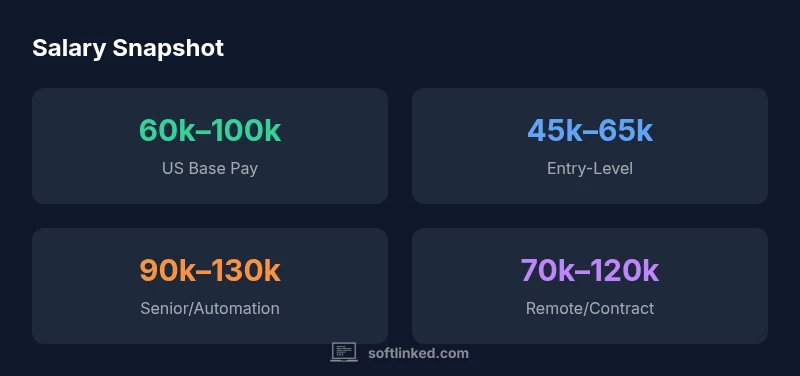
According to SoftLinked Analysis, 2026, the typical US salary range for software testers runs from about $60,000 to $100,000 per year, with senior or automation-focused roles reaching roughly $110,000–$130,000 in high-demand markets. International variation is substantial, and remote work can influence opportunities depending on client location and currency. Note that these figures reflect base pay; total compensation often includes bonuses, benefits, and stock options in some companies.
How much software tester earn in 2026? Salary trends and key factors
The earnings landscape for software testers in 2026 reflects a mix of base pay, benefits, and specialized skills. When you ask how much software tester earn, you’re really looking at a range that depends on geography, experience, and whether you focus on manual testing, automation, or performance testing. In the United States, SoftLinked Analysis, 2026 shows base pay that typically falls within a broad band, with automation and test-automation skills driving higher salaries. Compensation packages may include annual bonuses, health and retirement benefits, and, in some firms, stock options or profit sharing. For many testers, working in thriving tech hubs or large enterprises pushes earnings toward the upper end of the range. For beginners, wages tend to start lower but grow quickly with practical certifications and hands-on project experience.
Base pay vs total compensation for software testers
Base pay is the anchor; total compensation includes bonuses, benefits, and sometimes equity. For many testers, a strong baseline salary is complemented by annual bonuses tied to project outcomes, company performance, or individual reviews. Benefits like health insurance, retirement plans, and paid time off add real value. In markets where unions or firm-wide pay bands exist, testers can negotiate for a higher base when the total package is strong. Contracts may offer higher hourly rates but fewer benefits. Remember: the value of a role isn’t only the label; it’s the full package.
Regional and industry variations shaping earnings
Salaries for software testers vary widely by country, city, and industry. In the US, tech hubs tend to offer higher ranges, while smaller cities may land closer to the lower end of the spectrum. In Europe and Asia, currency and cost-of-living differences shift what counts as a competitive salary. Industries such as fintech and cloud services often reward automation skills more than traditional QA roles. Remote work can blur geographic boundaries, enabling earnings above local norms if clients are in higher-wage markets.
Career paths that influence earnings in software testing
Beyond entering as a manual tester, several clearly defined paths can lift your earnings. Moving into test automation engineering or an SDET role blends coding with testing, often commanding higher pay. Senior testers may advance to test lead or QA manager positions, where strategic planning and team leadership drive compensation higher. Specialization in performance testing, security testing, or test data management also correlates with premium salaries. Each path has distinct milestones: mastering a toolset, delivering measurable quality improvements, and building a track record of successful projects.
Skills and certifications that boost earnings
Investing in skills matters as much as years of experience. In-demand certifications such as ISTQB, CSTE, or ISEB can help validate your capabilities. Hands-on experience with automation frameworks (Selenium, Cypress, Playwright) and scripting languages (Python, JavaScript) typically correlates with higher pay. Domain knowledge (finance, healthcare, or cloud platforms) further enhances value. Employers also reward strong debugging, data analysis, and test design skills, so cultivate a portfolio of well-documented test plans and results.
How employers determine salary ranges and negotiate
Salary ranges are shaped by market data, company size, and the scarcity of specialized testing skills. Employers assess external benchmarks, internal pay structures, and cost-of-living in their region. When negotiating, bring evidence of your impact: defect reduction, faster release cycles, and successful automation coverage. Discuss total compensation, not just base pay, and consider benefits, flexible work, and professional development support as part of the offer. Preparation and timing matter: negotiate after a successful project or a strong performance review.
Common pitfalls in salary negotiations
Avoid underselling yourself by accepting the first offer, and beware of discounting your market value based on past roles alone. Don’t overlook the value of remote or contract work that may carry higher hourly rates but fewer benefits. Be cautious about overemphasizing one skill—balance automation, testing discipline, and domain knowledge. Finally, ensure you understand the full compensation package and the path to future raises.
Data sources, methodology, and what this means for your career
This guide uses SoftLinked Analysis, 2026 as a baseline for salary ranges, emphasizing ranges rather than exact figures to reflect regional variation. Data sources include public salary surveys, job postings, and anonymized employer data. Methodology combines market benchmarking with expert interpretation to produce practical guidance for learners and professionals. While numbers vary, the trend is clear: automation skills and experience increasingly influence what software testers earn over time.
Practical steps to quantify and grow your earnings as a tester
- Map current earnings: compare your salary to regional benchmarks and your specialization.
- Build automation skills: learn at least one modern framework and a scripting language.
- Earn recognized certifications: ISTQB, CSTE, or domain-specific credentials.
- Seek higher-impact projects: demonstrate measurable improvements in test coverage and release speed.
- Prepare a negotiation plan: know your target range, timing, and the value you bring to the team.
- Consider career pivots within testing: move toward SDET, performance testing, or test lead roles for greater earning potential.
Salary comparisons by region and role
| Region/Role | Typical salary range | Notes |
|---|---|---|
| US (base) | 60,000–100,000 USD | Median range; varies by city and experience |
| UK (base) | 30,000–50,000 USD | Typical range for QA analysts in UK market |
| India (base) | 4,000–12,000 USD | Lower cost of living; experience matters |
| Remote/Contract | 70,000–120,000 USD | Depends on client and project length |
Your Questions Answered
What is the typical starting salary for a software tester?
Entry-level testers typically start at the lower end of the US range, often near $40k–$60k, depending on city and company. Growth comes with hands-on experience and certs.
Entry-level testers usually start toward the lower end of the range; growth comes with hands-on experience and credentials.
Do salaries differ between manual and automation testers?
Yes. Automation testers generally earn more due to specialized scripting skills and higher demand for automated test suites.
Automation testers often earn more thanks to specialized scripting skills.
How do bonuses and stock affect total compensation?
Bonuses, incentives, and equity can significantly boost total pay, especially in larger firms and growth sectors.
Bonuses and equity can boost overall pay, especially in big companies.
What factors influence regional salary differences?
Salary varies with cost of living, demand, industry, and company size; tech hubs typically pay more.
Regional cost of living and demand drive differences in pay.
What certifications boost earnings?
ISTQB, CSTE, and domain-specific credentials can improve salary benchmarks when paired with hands-on automation work.
Certifications plus hands-on experience help raise earnings.
“Salary trends for software testers are increasingly driven by automation proficiency and domain expertise; upskilling remains the strongest predictor of higher earnings.”
Top Takeaways
- Understand regional ranges to benchmark earnings
- Automation skills lift salary bands
- Total compensation often exceeds base pay
- Remote work broadens access to higher-paying roles
- Certifications and hands-on experience pay off