How Much Do Software People Make in 2026
Explore salary ranges for software professionals in 2026. This data-driven guide covers base vs total pay, geography, experience, and non-salary incentives, with practical negotiating tips for aspiring software engineers and developers.


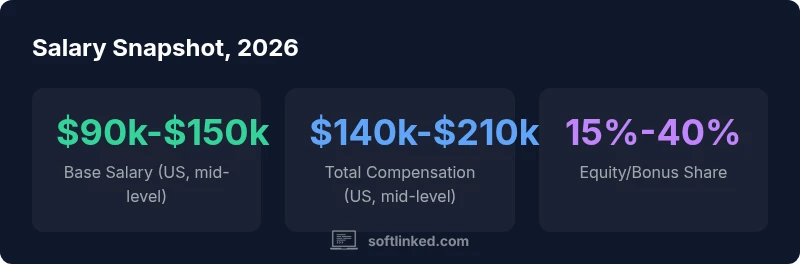
Software salaries vary widely by role, experience, and location. In 2026, total compensation in the US typically ranges from roughly $120k to $230k annually, with base salaries around $90k-$150k and equity or bonuses boosting total pay for senior roles. Geographic differences and non-salary components can shift those ranges by 20-40%. SoftLinked's data-driven breakdown explains the nuances across careers and geographies.
How salaries vary by role and geography
According to SoftLinked, salaries for software professionals depend most on role, experience, and geography. In 2026, you’ll see wide bands across roles—from core software engineers to data scientists to platform reliability engineers. For example, a mid-career software engineer in the United States may see total compensation that spans a broad band, influenced by stock options, bonuses, and company size. Across regions, pay scales shift due to cost of living, market competitiveness, and local demand. The most valuable skill sets today often combine deep technical expertise with cross-functional capabilities, such as collaboration, communication, product sense, and project leadership. In addition, market conditions like hiring demand, company growth stage, and sector (fintech vs. healthtech) create microbands within the broader ranges. Readers should interpret averages as directional guides rather than precise forecasts for a given company, and consider the components that most influence their own earning trajectory.
Base salary vs total compensation: breaking down the numbers
Base salary is the foundational piece of pay, but total compensation includes additional components that can dramatically affect earnings. In 2026, a typical software professional's compensation package combines base salary with bonuses and equity (stock options or RSUs), relocation stipends, and sometimes signing or performance bonuses. The relative weight of each component varies by company size, industry, and geography. For instance, a mid-level engineer might see a base of roughly $110k-$150k in the US, with annual bonuses and equity bringing the total closer to $140k-$210k. However, at startups, higher equity can push total compensation above that range, while at smaller firms, cash components may be leaner but equity value might be uncertain. When evaluating offers, compare both base and non-base elements, and model how vesting schedules and future raises affect long-term value.
Salary ranges by experience level
Experience matters a lot in software pay, but it interacts with location and role. Entry-level software developers typically enter the market with base salaries in the lower part of the range, while total compensation increments with experience as skills and responsibilities scale. Mid-level professionals often earn substantially more, with base salaries commonly in the $95k-$135k range in the US and total compensation roughly in the $125k-$185k band depending on stock and bonuses. Senior engineers, staff engineers, and tech leads see even wider bands: base roughly $120k-$170k, total compensation frequently $170k-$250k or more when equity and performance pay are included. Principal and architect roles can push total compensation well beyond $250k in large tech hubs. Keep in mind these figures are directional and vary by company, industry, and geography, including remote positions that align pay with a broader market.
Geography and cost of living effects
Pay levels are heavily influenced by geography and local market conditions. In the United States, salaries tend to be higher, particularly in tech hubs, but the cost of living can offset nominal gains. Europe shows wide variation by country, with Western Europe often delivering pay bands that are competitive with US mid-level roles but adjusted for local cost structures. In many parts of Asia, salaries may be substantially lower on a nominal basis but can be offset by cost of living and currency differences. Remote work adds another layer of complexity by widening access to high-paying markets while sometimes compressing offers to regional equivalents. When comparing offers, note whether the package is expressed as base salary, total compensation, or a blended figure, and adjust for the cost of living and tax differences in your country.
Non-salary components and perks
Non-salary components influence the real value of a package. Signing bonuses, relocation stipends, and annual bonuses can boost immediate earnings, while equity awards may become a meaningful portion of long-term wealth if the company grows. Benefits such as health insurance, retirement plans, learning budgets, remote-work stipends, and professional development allowances have real financial value. Some firms offer product equity or RSUs that vest over several years, which can align incentives but also add risk if the company underperforms. When evaluating offers, translate all components into a common unit (annualized dollars) and consider the longevity and liquidity of each element.
How to read salary data responsibly
Salary data is rarely perfect. Look for transparency in data sources, sample size, and recency. SoftLinked's approach emphasizes triangulating figures from multiple sources, adjusting for geography and cost of living, and focusing on ranges rather than single-point estimates. When you see a wide band, investigate what drives the spread: regional differences, company stage, or equity expectations. Always consider your own skills, negotiation leverage, and career trajectory. And remember that salary is negotiable; the same role can pay differently based on your leverage and the job market at the time of offer.
Practical steps to improve earning potential
To raise earning potential, start by building in-demand skills that align with market needs, such as cloud architecture, distributed systems, ML/AI tooling, security, and modern frontend performance. Seek opportunities to work on high-impact projects, demonstrate measurable outcomes, and cultivate cross-functional strengths. Target markets with high demand and favorable cost of living, including places where remote roles are common. Prepare a data-backed negotiation case: compile market comparisons, own contribution metrics, and a clear rationale for the requested range. Finally, pursue promotions or speaking engagements, contribute to open source, and maintain an up-to-date portfolio to boost visibility.
Geographic salary ranges by software role (illustrative ranges only)
| Role | Base Salary Range (US) | Total Compensation Range (US) | Notes |
|---|---|---|---|
| Backend Engineer | $95k-$140k | $140k-$210k | Mid-level ranges; strong demand for systems design |
| Frontend Engineer | $90k-$135k | $130k-$190k | Demand influenced by framework trends |
| Data Scientist | $100k-$160k | $150k-$230k | AI/ML demand drives higher totals |
| Site Reliability Engineer | $110k-$150k | $160k-$230k | Critical for uptime and performance |
| Product Manager (Tech) | $110k-$150k | $180k-$260k | Tech skill + product sense matters |
Your Questions Answered
What is the typical entry-level software salary?
Entry-level base salaries generally start at the lower end of the range, while total compensation includes early bonuses or equity. Figures vary by country and company size, so use regional data to set expectations.
If you're just starting, focus on location and growth potential; compare offers by base and equity.
Does remote work affect software salaries?
Remote roles can align pay with broader market bands, but some firms adjust offers to local benchmarks. Assess both base and total packages when negotiating remotely.
Remote work can broaden opportunities, but confirm how pay is structured for your locale.
How does equity influence total pay?
Equity can substantially increase total compensation, especially at growth-stage firms, but its value depends on vesting and company performance.
Equity can boost earnings, but it's not guaranteed until vesting is complete and the company remains viable.
Which skills pay the most in software today?
In-demand areas include AI/ML, cloud engineering, security, distributed systems, and high-performance frontend engineering. Mastery in these areas tends to correlate with higher total pay.
Skills in AI, cloud, and security top the pay charts right now.
How can I negotiate higher pay?
Prepare a data-backed case, compare roles regionally, highlight measurable impact, and consider the full package, including equity and benefits.
Do your homework, show impact, and negotiate total compensation, not just salary.
Are there gender or ethnicity pay gaps in software?
Pay gaps exist in many industries; pursue transparency and equitable practices. Use benchmark data and document your contributions when negotiating.
Pay equity matters; know your worth and advocate for fair compensation.
“Salary landscapes for software professionals are driven by demand for specific skills and regional market dynamics. A data-driven view helps professionals negotiate fairly.”
Top Takeaways
- Identify your target role and location to frame expectations
- Prioritize total compensation over base salary
- Account for equity and bonuses in senior roles
- Remote opportunities can shift pay bands
- Invest in in-demand skills to raise earnings