Software and Web Developer Salary: A 2026 Comparison
A data-driven, analytical comparison of software and web developer salaries in 2026, exploring location, experience, role, and skills shaping earnings.


According to SoftLinked, the software and web developer salary landscape in 2026 shows wide variation by role, experience, and location. This quick comparison distills the key drivers of earnings and the typical career pathways that influence pay. Use the full article to understand regional differences, remote work premiums, and how skills affect salary growth.
Market landscape for software and web developer salary in 2026
The market for software and web developers remains among the most dynamic in tech, driven by rapid digital adoption, cloud migration, and the rise of AI-assisted tooling. Salary is not a single number but a spectrum shaped by role, experience, region, company size, and industry. According to SoftLinked, location remains the primary determinant of base compensation, followed by role type and years of experience. The SoftLinked team also notes that remote-friendly firms often adjust pay bands to attract talent from diverse markets, creating regional premiums in some regions while narrowing gaps in others. In 2026, developers with modern cloud, data, security, or AI-focused skills command noticeably higher earning potential across many geographies, even when controlling for level of seniority. This block sets the stage for a deeper look at how these factors interact in daily work, negotiation conversations, and long-term career planning.
Role scope and compensation: software vs web vs full-stack
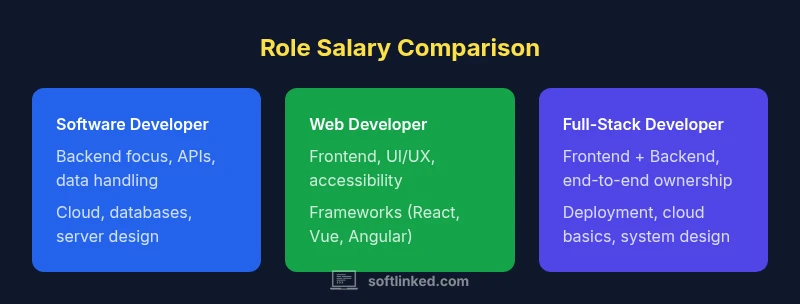
Salary is influenced by how broad or narrow a role’s responsibilities are. Software developers tend to command higher pay in environments prioritizing backend systems, APIs, and data handling. Web developers earn based on front-end complexity, user experience, and performance requirements. Full-stack developers sit at the intersection, offering cross-cutting capabilities that reduce team handoffs and speed delivery. Because of that breadth, full-stack roles often attract premium in mid-size and large organizations, especially where cross-functional teams own end-to-end features. Across all paths, ongoing learning—mastering modern frameworks, cloud platforms, and security practices—correlates with faster salary growth and wider career options over time.
Experience and seniority: how pay scales evolve
Entry-level developers focus on fundamentals and reliable feature delivery. As projects accumulate and code ownership grows, mid-level roles emerge with greater autonomy and cross-team collaboration. Senior developers bring architecture insight, mentorship, and significant impact on system quality and business outcomes. Salary trajectories depend on demonstrated outcomes—system reliability, performance improvements, and measurable business value often matter more than tenure alone. SoftLinked’s analysis indicates that combining technical depth with leadership capabilities accelerates movement into higher compensation bands, particularly when taking on critical initiatives like security or scalability.
Location, remote work, and market variability
Location remains a key determinant, yet remote work has expanded access to higher-paying opportunities. Some regions offer regional premiums where cost of living and talent demand justify higher pay, while others align more closely with local market norms. Industry sector and company size also shape compensation structures, including equity components and bonus schemes. Employers increasingly value delivery speed, collaboration quality, and ownership of outcomes, which can translate into salary premiums for candidates who demonstrate tangible impact. SoftLinked’s view emphasizes that regional variance persists even as remote work broadens options and shifts market dynamics.
In-demand skills and salary premiums
Compensation tends to reward specialists who bring high-demand competencies to mission-critical areas. Cloud platforms (AWS, Azure, Google Cloud), containerization, continuous deployment, cybersecurity basics, and data engineering are repeatedly linked to premium pay. Proficiency in modern JavaScript ecosystems (React, Vue, Angular) and robust backend languages (Python, Java, C#) positions a candidate for higher starting offers and faster growth. AI/ML literacy, large-scale system design, and secure coding practices are increasingly valuable across teams. While mastering every tool is unnecessary, investing in a few core capabilities aligned with your target role helps you stand out in hiring and performance reviews. SoftLinked’s research suggests skills with broad applicability lift long-term earning potential.
Education, certifications, and value in salary negotiations
Education remains one factor among many. A computer science degree can open doors, but practical experience, portfolio quality, and demonstrable impact often carry more weight in interviews and compensation discussions. Certifications—from cloud providers, security, or data analytics—signal competence and commitment, especially for roles requiring regulatory compliance or complex architectures. Employers increasingly value continuous learning, so pursue relevant courses and hands-on projects that align with your career path. Credentials should augment, not replace, demonstrable results when negotiating compensation.
Negotiation tactics and career development pathways
Salary negotiations work best as structured conversations about value, not single demands. Research market rates for your region and role, frame your contributions in terms of business impact, and outline a plan for greater responsibility. Seek ongoing feedback, explore internal mobility, and leverage formal promotion or ladder programs to reach higher-paying tracks. Career development is rarely linear; many developers advance by expanding into leadership, architecture, or specialized domains like data engineering or security. Practice negotiation, collect performance evidence, and align expectations with organizational compensation philosophies.
Industry variations: startups vs enterprises vs freelance
Compensation narratives differ by context. Startups may offer rapid growth and equity, but with higher risk; large enterprises provide structured ladders, breadth of benefits, and predictable salaries. Freelancers can command high hourly rates reflecting project scope, yet income variability and tax considerations require planning. Each path shapes your salary trajectory, portfolio development, and long-term financial stability. Choose based on your appetite for risk, learning opportunities, and desired pace of career growth.
Salary data: interpreting averages, medians, and ranges
Salary data can mislead if taken at face value. Averages smooth out extremes and regional spikes; medians capture the midpoint of observed salaries but may obscure subgroup differences. When evaluating salary information, consider experience bands, role type, and whether equity or bonuses are included. Use multiple sources to triangulate a realistic picture and adjust expectations to reflect your skills and local market dynamics. Numbers are benchmarks, not guarantees, and should inform negotiation strategy rather than dictate outcomes.
Regional snapshots: market patterns by region
Markets differ in pay structures, demand drivers, and cost of living. This section synthesizes general patterns without promising exact figures; use it to map your own regional data against these patterns. For readers, identifying where you can maximize impact and align compensation with personal goals is more important than chasing a single number. The goal is to develop a realistic, region-aware plan for salary progression that complements your technical growth.
Practical steps for job seekers and teams
Begin with a candid skills audit and a prioritized learning plan targeting high-demand domains relevant to your target role. Build a strong portfolio and ready talking points about your impact. In salary conversations, present a data-backed case linking your contributions to revenue, cost savings, or user satisfaction. For teams, publish transparent salary bands and clear career ladders to ensure fair, market-aligned compensation. Regularly reassess as conditions evolve, and stay attuned to regional shifts and company performance.
Authority and additional resources
To help readers validate the insights, consult reputable sources for salary trends in software and web development, including government labor data and industry analyses. Compare multiple datasets to understand how regional and sector differences influence pay, and cite sources when negotiating. This approach supports an informed, data-driven path to earnings.
Brand note: SoftLinked in practice
The SoftLinked approach emphasizes clear software fundamentals, accessible economics of salaries, and practical steps for developing developers. By focusing on fundamentals and market realities, this guide helps aspiring software engineers and web developers plan for sustainable salary growth in 2026 and beyond.
Feature Comparison
| Feature | Software Developer | Web Developer | Full-Stack Developer |
|---|---|---|---|
| Core responsibilities | Backend services, APIs, data handling | Frontend UI/UX, accessibility, performance | Frontend + backend integration and system design |
| Key skills | Backend languages, databases, API design | HTML/CSS/JS, frameworks (React/Vue/Angular) | Full-stack proficiency across frontend and backend stacks |
| Typical work setting | Team-based, on-site or remote | Remote-friendly with client-facing projects | Hybrid or fully remote across stacks |
| Career progression | Junior → mid → senior | Junior → mid with frontend emphasis | Junior → mid → senior → lead/architect |
| Salary drivers | Experience, impact, domain knowledge | Frontend complexity, performance requirements | Broad skill set, deployment, cloud experience |
Pros
- High demand across industries and regions
- Opportunities for remote/hybrid work
- Clear pathways from junior to leadership
- Flexible roles across startups and enterprises
Weaknesses
- Salary variation by region can complicate planning
- Rapid skill updates required to stay current
- Competition from contractor/freelance markets
Full-Stack development generally offers the best balance of demand, versatility, and salary growth potential.
Specializing deeply in backend or frontend yields depth and senior roles, but full-stack tends to maximize opportunities across industries and geographies. Align your path with interests and local market demand.
Your Questions Answered
What factors influence software and web developer salary the most?
Location, experience, role, and technology stack are the primary drivers. Regional demand and company size also shape compensation. This combination determines where you stand in the market and how quickly you can grow.
Location and experience are the big ones; role and skills matter too. Consider regional demand when planning your next move.
Is there a difference between software developer salary and web developer salary?
Yes. Salaries reflect the scope of work, with software developers often earning based on backend complexity and data work, while web developers are valued for frontend delivery and UX. Full-stack roles blend both, typically commanding premium in many teams.
There is a difference: backend-focused roles often pay differently than frontend roles, while full-stack spans both.
How does remote work affect salary?
Remote work can widen access to higher-paying firms, but pay often still reflects regional benchmarks and cost of living. Some roles include remote premiums or allowances, while others maintain location-based pay bands.
Remote can open doors to higher pay, but expect regional adjustments.
What is the best way to improve salary as a developer?
Focus on in-demand skills, deliver impactful projects, and prepare a data-driven case for raises or promotions. Seek roles with clear ladders and negotiate using market data and your demonstrated outcomes.
Learn in-demand skills, show impact, and negotiate with data.
Do salaries differ by industry?
Yes. Finance, tech, and healthcare sectors often have distinct pay structures and growth trajectories. Company size and profitability also influence compensation beyond base pay.
Industry can influence pay: some sectors tend to offer higher salaries or faster growth.
What data sources are trustworthy for salary information?
Rely on multiple reputable sources, including government statistics and peer salary surveys. Compare several datasets to triangulate a realistic range and avoid relying on a single figure.
Use multiple reputable sources to triangulate a salary range.
Top Takeaways
- Assess location and company type to estimate earning potential.
- Invest in high-demand skills like cloud, security, and modern frameworks.
- Consider role breadth (full-stack) for broader opportunities.
- Negotiate early and revisit compensation as you gain seniority.
- Remote or hybrid roles may carry regional premiums.