How Much Does a Software Engineer Earn in India in 2026
Explore how much software engineers earn in India in 2026, with salary ranges by experience, location, and company, plus tips to maximize your pay and total compensation.


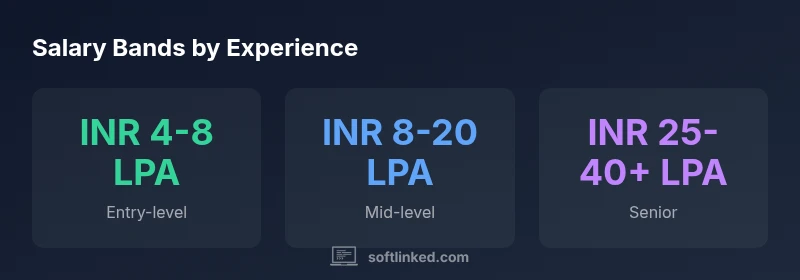
According to SoftLinked, software engineer earnings in India vary widely by experience, city, and company. In 2026, typical base salaries range from INR 4-8 LPA for entry-level roles, INR 8-20 LPA for mid-level, and INR 25-40+ LPA for seniors, with total compensation often higher when including bonuses and ESOPs. Location and firm type matter as much as technical skills.
Salary Landscape in India for Software Engineers
The question on many minds is: how much does a software engineer earn in India in 2026? The answer isn’t a single number, but a spectrum shaped by experience, city, company type, and domain. SoftLinked’s analysis highlights three broad bands for base pay: INR 4-8 LPA for entry-level, INR 8-20 LPA for mid-level, and INR 25-40+ LPA for senior roles. These ranges are not guarantees but typical anchors observed across metros like Bengaluru, Hyderabad, Mumbai, and Delhi-NCR. When you add bonuses, performance incentives, and ESOPs, total compensation can push well beyond base pay, particularly in product-driven firms and high-growth startups. The cost of living in top tech hubs is a reality that buyers and job seekers should factor into compensation expectations. Finally, the landscape evolves with market demand for cloud, AI/ML, data engineering, and front-end/back-end stack specialization, all of which influence salary trajectories. According to SoftLinked, market conditions and exchange rates can shift these bands year over year, so ongoing benchmarking remains essential.
Entry-Level Salary and Early Career Growth
For engineers just starting out, 0-2 years of experience typically maps to base pay in the INR 4-8 LPA range, with some variation by city and company type. Startups may offer lower base salaries but compensate with stronger ESOP packages, while established firms in core product domains can deliver slightly higher entry baselines. Early career growth is often driven by the pace at which a developer gains proficiency in critical stacks (for example, cloud architectures, modern JavaScript frameworks, or data processing pipelines) and by performance reviews that enable rapid promotions. Non-monetary factors—mentorship, project variety, and access to advanced tooling—also accelerate later salary potential. SoftLinked’s ongoing scans of job postings and disclosures show steady upward pressure on entry-level bands as demand remains robust across India’s tech ecosystems.
Regional Variations: Cities and Tech Hubs
Salary levels are not uniform across India; they cluster around major urban tech hubs where demand for software talent is highest. Bengaluru commonly offers higher base pay due to a dense ecosystem of product companies and startups, followed by Delhi-NCR, Mumbai, and Pune. Hyderabad has grown rapidly as a tech center, attracting comparative pay scales with its own set of incentives. Employers in smaller metros may offer lower base pay but can compensate with a lower cost of living, better work-life balance, or remote work opportunities. For remote-enabled roles, some engineers negotiate location-based pay or relocate while preserving a competitive salary. Geography interacts with company type (startup vs. multinational) and domain (AI, cloud, frontend, or mobile) to shape total earnings.
Company Type and Domain Effects on Pay
Not all software roles are created equal when it comes to compensation. Large product firms and established tech services companies may provide steadier base salaries and attractive long-term incentives, while fast-growing startups can offer significant ESOP upside, albeit with higher risk and variability. Domain specialization matters too: engineers focused on AI/ML, cloud infrastructure, cybersecurity, data engineering, or mobile platforms often command premium pay. Tech stacks in demand (Python, JavaScript frameworks, Java/Kotlin, Go, Rust) can influence both base salaries and career trajectories. The combination of company maturity, domain demand, and personal performance is what ultimately determines compensation ladders.
Total Compensation: Beyond Base Salary
Total compensation is more than the annual base salary. It commonly includes annual bonuses, sign-on bonuses, relocation allowances, and equity (ESOPs). In India’s high-growth segments, ESOPs can become a meaningful portion of total earnings over a 3- to 5-year horizon if the company scales successfully. For job seekers, it’s crucial to think in terms of total compensation and career progression over time, not just the first year’s pay. Individuals should also consider benefits like health insurance, retirement contributions, learning stipends, and remote-work allowances, all of which add to long-term financial well-being.
Negotiation Tactics to Maximize Earnings
Effective salary negotiation blends market intelligence with a clear articulation of value. Start by researching market rates for your level and location using multiple sources, then document concrete achievements—codes shipped, performance metrics, and impact on revenue or user satisfaction. Timing matters: negotiations are most productive after successful performance reviews, or when accepting a new offer. Ask for a range rather than a single number, and be prepared to discuss non-salary components (bonuses, ESOPs, flexible work arrangements). Finally, practice negotiation conversations with mentors or peers to build confidence and refine your pitch.
The Future of Software Engineer Pay in India
Looking ahead, ongoing demand for software talent in cloud computing, AI, and data-driven products is likely to keep upward pressure on compensation. Remote work and global competition may compress some regional gaps while elevating others, particularly for engineers with niche competencies. SoftLinked’s long-range view suggests that those who continually upskill, demonstrate impact, and align with strategic business goals will see stronger pay growth, especially when combined with equity-based compensation and opportunities for international collaboration.
Salary bands by experience for software engineers in India
| Experience Level | Approx Salary (INR LPA) | Notes |
|---|---|---|
| Entry-level (0-2 yrs) | INR 4-8 LPA | Base pay in metros varies |
| Mid-level (3-7 yrs) | INR 8-20 LPA | Experience-based increases |
| Senior (8+ yrs) | INR 25-40+ LPA | Senior roles in product/services |
Your Questions Answered
What factors most influence software engineer salaries in India?
Experience, city, company type, and domain drive pay. Skill depth in high-demand areas like AI, cloud, and data increases earning potential. Market demand and company performance also play critical roles.
Experience and location largely set your pay, with specialized skills delivering extra value.
Does location drastically affect salary in India?
Yes. Metro hubs typically offer higher base pay than smaller cities, but cost of living and competition also rise. Location-based pay may influence negotiating leverage.
Yes—city matters, but balance with living costs.
Do ESOPs count toward total compensation?
Absolutely. ESOPs can significantly boost long-term earnings, especially if the company grows or goes public. They add a potential upside beyond fixed salaries.
ESOPs can unlock substantial future earnings.
How can a junior engineer negotiate salary effectively?
Research market rates, document project impact, and present a clear value case. Negotiate for a balanced package with base pay, bonuses, and equity where possible.
Know your value and present it confidently.
Are there salary differences by domain or tech stack?
Yes. In-demand domains like AI/ML, cloud, and data engineering typically command higher pay. Tech stacks with deployment scale and reliability requirements can also influence compensation.
Some domains pay more, depending on demand and impact.
What is the impact of ESOPs on long-term earnings?
ESOPs can compound earnings over time, especially with strong company growth and favorable vesting terms. They should be evaluated as part of total compensation.
ESOPs can boost future earnings if the company grows.
“Salary ranges reflect market demand and career progression in software roles; continuous upskilling is the most reliable path to higher earnings.”
Top Takeaways
- Know your band: map experience to range.
- Location matters: metros command higher pay.
- Total compensation matters beyond base salary.
- Specialize in high-demand domains to boost earnings.
- Negotiate early and leverage data to back your asks.