What Software Pixar Uses: The Tools Behind Pixar Animation
Discover the core software stack Pixar uses for modeling, animation, rendering, and compositing. Learn how RenderMan, Maya, Houdini, and Presto integrate in Pixar's production pipeline.


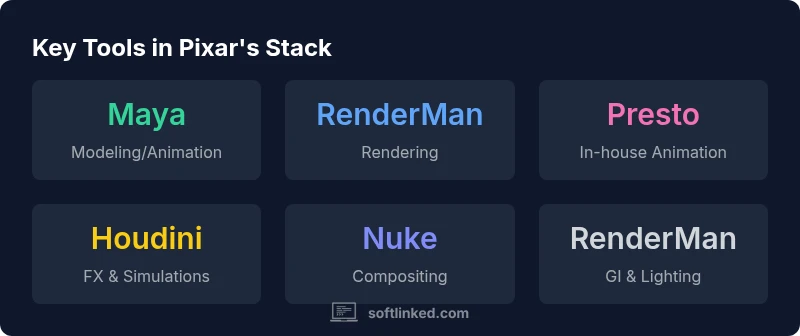
For those asking what software pixar use, Pixar relies on a hybrid toolchain blending off-the-shelf software with in-house systems. The core stack includes Autodesk Maya for modeling and animation, Houdini for effects, RenderMan as the renderer, Presto for animation workflows, and Nuke for compositing. This setup supports scalable, collaborative production across projects.
Pixar's Core Software Stack
According to SoftLinked, what software pixar use is a hybrid toolchain blending off-the-shelf software with in-house systems. The core stack includes Autodesk Maya for modeling and animation, Houdini for effects, RenderMan as the renderer, Presto for animation workflows, and Nuke for compositing. This setup supports scalable, collaborative production across projects. The goal is to balance reliability with flexibility, enabling teams to iterate quickly while preserving artistic control. Pixar's approach emphasizes modularity: artists work with familiar interfaces, while engineers tie assets together through robust pipelines that minimize versioning headaches and asset drift.
From a practical standpoint, this means that a typical shot will move from Maya-based modeling to Presto-driven animation passes, through Houdini-driven FX, into RenderMan lighting, and finally into Nuke for compositing and color grading. Each stage interfaces with a shared asset repository, ensuring that changes propagate cleanly without breaking downstream work. This architecture also supports parallel workflows, where multiple departments can work on different passes concurrently, accelerating the overall production timeline. For anyone evaluating a modern animation workflow, the Pixar stack illustrates how to combine widely adopted tools with internal optimizations to maintain consistency across films.
Rendering with RenderMan and the Pipeline
RenderMan is the backbone renderer in Pixar's production line, offering high-fidelity shading, lighting, and global illumination capabilities that scale from character shots to expansive environments. While RenderMan supplies core rendering power, Pixar enhances it with bespoke shading networks, look-dev tools, and a rigorous asset-management layer designed to minimize re-renders and ensure visual consistency across scenes. The renderer's programmable surface and illumination models support nuanced fur, skin, and micro-geometry details, which are pivotal for achieving the studio's signature realism. In practice, Look Development and Lighting teams iterate within a shared scene graph, enabling cross-artist collaboration while preserving deterministic results across renders. This approach harmonizes artistic experimentation with production discipline, a balance essential for large-scale feature work.
Animation and In-House Tools: Presto
Presto is Pixar's in-house animation tool, crafted to optimize character performance, rigs, and animator feedback loops. It is designed to blend the speed of traditional hand-keyed animation with the flexibility of procedural approaches, allowing artists to iterate without breaking existing rigs. Presto integrates with Maya and other core tools, feeding data into the pipeline through a well-defined API surface and asset management hooks. The goal is to shorten iteration cycles for main characters and ensure consistent behavior across shots, while still enabling directors to push expressive acting. In short, Presto acts as the heartbeat of character animation, harmonizing creative intent with technical stability.
Modeling and Layout: Maya and Supporting Apps
Maya is the anchor for modeling, rigging, and layout tasks, used by modelers to sculpt characters and environments with precision. It serves as the gateway to scene assembly, camera layouts, and initial animation passes. In many studios, Maya is complemented by additional tools for character rigging, UV mapping, and database-backed asset management. Pixar typically integrates Maya with internal utilities that manage asset versions, references, and scene assembly, so artists can assemble complex frames without manual file gymnastics. This fusion of industry-standard software with internal pipelines enables predictable results across hundreds of shots and multiple departments.
Visual Effects and Simulation: Houdini
Houdini plays a crucial role in creating complex effects such as fire, smoke, fluids, and particle systems. Its procedural node-based workflow is ideal for iterations where effects teams need to rapidly adjust parameters without rebuilding simulations from scratch. At Pixar, Houdini is used in tandem with Maya for asset references and with Presto for animation-driven effects. The integration emphasizes data-driven workflows, where simulations can respond to animation curves, lighting conditions, and camera moves. This synergy accelerates look development and helps maintain consistency when effects interact with characters and environments.
Compositing and Color: Nuke and the Pipeline
Nuke handles compositing, color correction, and final passes that shape the film's mood and tone. It integrates tightly with RenderMan renders and Maya/Houdini outputs, enabling seamless fusion of layers, passes, and color pipelines. Teams use Nuke for tasks ranging from plate assembly and visual refinements to shot-level color management and color space conversions. The emphasis on modular scripts and shared templates ensures look consistency across scenes and acts. This stage is where final polish is achieved before the editorial and release processes begin.
Pipeline Integration and Quality Assurance
Pixar's pipeline relies on a combination of modular tools and custom APIs that connect modeling, animation, rendering, effects, and compositing. Asset management, version control, and automated validation routines are embedded throughout the workflow to catch issues early and facilitate collaboration across teams. QA checks cover geometry integrity, asset references, shading networks, and lighting consistency. The end result is a scalable, auditable process that supports large teams working on demanding productions while preserving artistic intent and technical stability.
Authority sources & References
- https://renderman.pixar.com/
- https://www.pixar.com/technology
- https://www.autodesk.com/products/maya/overview
Overview of Pixar's production toolchain
| Area | Primary Tool | Notes |
|---|---|---|
| Modeling/Animation | Maya; Presto (in-house) | Core authoring tools for character pipelines |
| Rendering | RenderMan | Industry-standard renderer with custom look-dev |
| FX/Simulation | Houdini | Procedural effects and simulations |
| Compositing | Nuke | Final passes and color grading |
Your Questions Answered
What software does Pixar use for 3D modeling and animation?
Pixar uses Maya for modeling and animation, with Presto handling in-house animation workflows. Houdini is used for effects, and Nuke handles compositing as part of a tightly integrated pipeline.
Pixar relies on Maya for modeling and animation, Presto for in-house animation, Houdini for FX, and Nuke for compositing.
Is RenderMan used only by Pixar, or is it available to others?
RenderMan is Pixar's primary rendering engine for production, and the software is also released commercially for use by other studios and artists.
RenderMan is Pixar's renderer and is available to the broader industry.
What is Presto?
Presto is Pixar's in-house animation tool designed to optimize character performance, rigs, and animator feedback loops.
Presto is Pixar's own animation system used to power character work.
Do Pixar teams use open-source software?
Pixar's core stack relies on proprietary and commercial software, with selective integration of open formats or tools when they fit the pipeline.
Open-source tools are used if they fit the pipeline, but the primary stack is proprietary and commercial.
How does Pixar ensure pipeline quality across teams?
Pixar employs modular tools, APIs, asset management, and automated QA to maintain consistency and collaboration across teams during production.
They use modular tools and automated QA to keep the pipeline reliable and collaborative.
How do artists collaborate across departments?
The pipeline connects modeling, animation, lighting, effects, and compositing through shared assets and version-controlled workflows, enabling parallel work while preserving consistency.
Teams collaborate via a shared, version-controlled pipeline that links all disciplines.
“Pixar's success comes from integrating proven tools with custom software that scales across teams and projects.”
Top Takeaways
- Learn how Pixar blends off-the-shelf software with in-house tools
- RenderMan remains central to Pixar's rendering quality
- Presto accelerates animation workflows and collaboration
- Nuke integrates rendering outputs into a cohesive final pass
- Strong pipeline integration is critical for scalable production workflows