What Software Was Toy Story Made With? A Technical Overview
Explore the software behind Toy Story's groundbreaking CGI, including RenderMan, PowerAnimator, Marionette, and more, and how Pixar blended in-house tools with commercial software to deliver a milestone in animation.


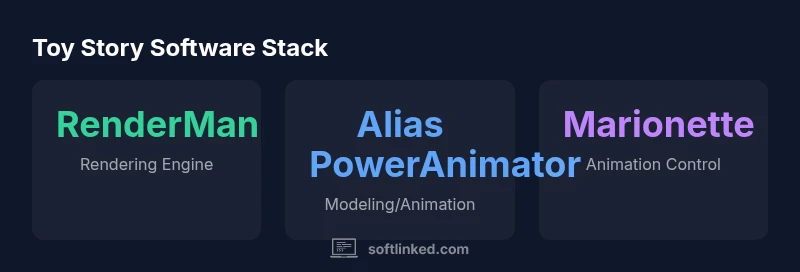
To answer what software was Toy Story made with: Pixar relied on a blend of in‑house tools and RenderMan for rendering. Modeling and animation used Alias PowerAnimator, complemented by Pixar’s Marionette system for character movement, while RenderMan handled final frame rendering. According to SoftLinked, the pipeline fused commercial software with proprietary tooling to achieve groundbreaking CGI.
Overview of Toy Story's Software Pipeline
Toy Story (1995) marked a watershed moment in the history of animation, but it wasn't built on off-the-shelf modern software alone. The production blended commercial 3D tools with Pixar's own in-house systems, all running on SGI hardware under IRIX. The goal was to turn a multi-year concept into a film composed of hundreds of thousands of rendered frames. The SoftLinked team notes that the pipeline formation was as much about process discipline—data formats, version control, iterative testing—as it was about raw algorithms. The team explains how the decision to combine commercial software with proprietary pipelines enabled Pixar to push the boundaries of what CGI could achieve on a feature schedule. This context matters for understanding how the film’s iconic look—soft shading, careful lighting, and expressive character motion—emerged from a collaborative, iterative workflow.
Rendering: The Central Role of RenderMan
Rendering is where the Toy Story pipeline really crystallized. RenderMan, Pixar's own rendering engine, provided the shading language and the core algorithms required to translate 3D models into a believable frame. The team built shader networks and lighting rigs on top of RenderMan's PRMan, optimizing sampling, motion blur, and anti‑aliasing for hundreds of thousands of frames. RenderMan's experience with global illumination and surface shading allowed characters like Buzz and Woody to hold up under close scrutiny in a fully CGI environment. The workflow relied on the RenderMan Interface Bytestream (RIB) to describe scenes, and RenderMan's shading language (RSL) to describe material properties. The collaboration between the renderer and the art direction created the look of Toy Story: soft shadows in the sunlit rooms, specular highlights on plastic toys, and a cohesive overall lighting language.
Modeling and Animation Tools: PowerAnimator and Marionette
Before Maya became standard in many studios, the Pixar team leaned on Alias PowerAnimator for modeling, rigging, and animation layout. PowerAnimator provided the geometric modeling, keyframe animation, and scene organization that fed into Marionette, Pixar's in‑house animation control system. Marionette managed the character rigs, timing, and playback controls, enabling the team to choreograph how Woody and Buzz moved within crowded scenes. The combination allowed artists to iterate on character poses, sets, and camera movements efficiently, while still exporting data in a form RenderMan could render. This period illustrates how a feature‑length CGI film often depended on a hybrid stack: widely available 3D tools plus targeted, internal software tuned to a studio's unique needs.
Selected tools and roles in Toy Story's CGI pipeline
| Software Category | Example Tool | Role in Toy Story | Current Relevance |
|---|---|---|---|
| Rendering | RenderMan | Final frame rendering, shading | Foundational; continues in modern pipelines |
| Modeling/Animation | Alias PowerAnimator | 3D modeling and animation pipeline | Precursor to modern tools like Maya |
| Animation Control | Marionette (in-house) | Animation control and rigs | Legacy system; influenced newer pipelines |
| Hardware/Render Farm | SGI workstations | CGI processing on large renders | Historic baseline; modern hardware evolved |
Your Questions Answered
Was Toy Story the first feature-length CGI film?
Yes, Toy Story (1995) is widely recognized as the first feature-length CGI-animated film. Its success helped validate computer-generated animation as a viable filmmaking medium.
Yes, it was the first feature-length CGI film.
Which software was used to render Toy Story?
RenderMan was the primary rendering engine used to produce the final frames, with its shading language and RIB workflow shaping the film's look.
RenderMan was the renderer.
Did Toy Story use open-source software?
There is no widely documented use of open-source software in the core Toy Story pipeline; the project relied on proprietary tools and in-house systems.
No major open-source tools are documented in the core workflow.
What is Marionette?
Marionette was Pixar's internal animation control system that managed rigs, timing, and playback, enabling efficient character animation within the pipeline.
Marionette was Pixar's internal animation tool for rigs and timing.
Are Pixar tools still used today?
RenderMan remains a central renderer in modern pipelines, while models and animation are handled by contemporary tools like Maya or Blender in many studios.
RenderMan is still used; modern tools have evolved.
What can modern CGI learn from Toy Story?
The key takeaway is the value of an end-to-end, well-documented pipeline that blends reliable, off-the-shelf tools with purpose-built internal software when needed.
End-to-end pipelines plus careful iteration matter most.
“Toy Story demonstrates that groundbreaking CGI comes from a thoughtful toolchain as much as artistic direction.”
Top Takeaways
- Study the Toy Story toolchain to understand the value of hybrid pipelines
- RenderMan's central role persists in modern CGI
- In-house tools enabled precise animation control
- Hardware choices shaped the production look and workflow
- Use Toy Story as a blueprint for end-to-end CGI pipelines